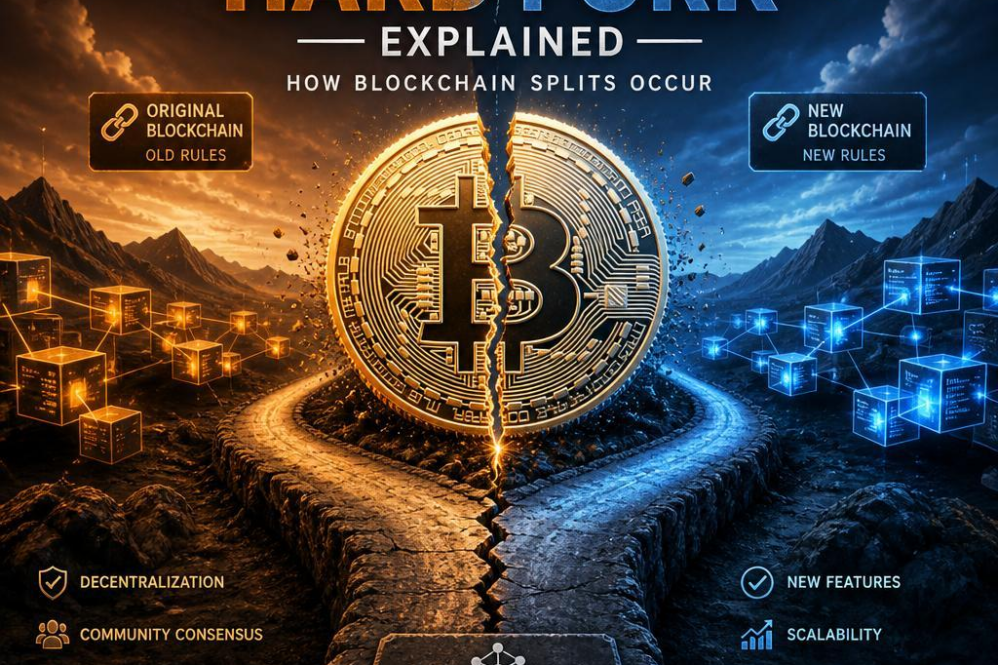
Understanding the Technical Mechanisms Behind bitcoin hard Forks
At the core of a blockchain’s operation lies consensus rules-sets of protocols that dictate how transactions are validated and blocks are created. When disagreements arise over protocol upgrades or changes, the blockchain community may split into two factions: one that adopts the new rules and another that retains the old. This division results in a hard fork, where the blockchain diverges into two separate chains with shared history but incompatible future states. The divergence is permanent unless one chain overtakes the other in total accumulated work, which is rare in practice.
Technically, a hard fork involves:
- Protocol upgrades: Introducing new consensus rules that are not backward compatible with existing ones.
- Chain split: Nodes that update their software validate blocks under the new rules, while others continue on the original chain.
- Double tracking: Two parallel blockchains co-exist, each with its own miners, nodesand community support.
| Component | Old Chain Behavior | New Chain Behavior |
|---|---|---|
| Consensus Rules | previous protocol | Upgraded protocol |
| Block Validation | Validates blocks per old rules | Validates blocks per new rules |
| Transaction Fees | standard fees | Potentially adjusted fees |
| Community | Nodes/miners opposing upgrade | Nodes/miners supporting upgrade |
The Impact of Blockchain Splits on Network Security and User Assets
When a blockchain undergoes a split, particularly through a hard fork, the repercussions ripple deeply through the network’s security infrastructure. A hard fork effectively creates two competing versions of the ledger, each maintained by different factions of miners and nodes. This division can dilute the overall hash power securing each chain, thereby reducing the cumulative difficulty of the Proof-of-Work mechanism. Consequently, both chains may become more vulnerable to 51% attacks, where a single actor or coalition gains majority control and potentially manipulates transaction history or doubles spends. Network security relies heavily on unified consensus; splits inherently challenge this foundation.
From the outlook of user assets, the consequences of blockchain splits are equally meaningful. Upon a fork, holders of the pre-fork cryptocurrency typically receive equivalent balances on both resultant chains. While this might seem favorable, it can also lead to confusion and risk. Users could inadvertently replay transactions on both chains if replay protection is absent. Moreover, exchanges and wallets may delay deposits, withdrawalsor trading pairs until the fork’s outcome stabilizes, imposing temporary liquidity constraints. Below is a brief overview of user concerns commonly associated with blockchain splits:
- Replay Attacks: Transactions on one chain executed on another without user intent.
- Balance Uncertainty: Difficulty in determining which chain will retain value over time.
- Delayed Transactions: Exchange and wallet integrations may require time to adapt.
- Increased Transaction fees: Potential fee volatility due to split market dynamics.
Examining a simplified comparison of security and asset-related impacts during a blockchain split reveals the nuanced trade-offs each forked chain faces:
| Aspect | Post-fork Chain A | Post-Fork Chain B |
|---|---|---|
| Hash Power Percentage | 65% | 35% |
| Network Vulnerability | Lower | Higher |
| Asset Value Stability | Moderate | Uncertain |
| Replay Protection Implemented | Yes | No |
evaluating the Economic and Governance Implications of Forks in bitcoin
Cryptocurrency forks,particularly those involving bitcoin,introduce significant economic implications by effectively creating competing versions of the blockchain. These splits can impact market valuation, user confidenceand miner incentives. For instance,when a hard fork occurs,holders of the original bitcoin are often granted an equivalent balance on the new chain,temporarily doubling the perceived asset count.however, this can fragment liquidity and create price volatility, as exchanges and investors adjust to the existence of two distinct assets with potentially divergent use cases and technological upgrades.
From a governance perspective, forks expose the decentralized decision-making processes inherent to blockchain technology.Unlike traditional financial systems where changes are controlled centrally, bitcoin’s community must reach consensus on protocol adjustments. When disagreements arise-whether related to block size limits, transaction speedsor security upgrades-a fork can become the ultimate expression of conflicting visions.This decentralized governance model is both a strength, promoting innovation and resilienceand a vulnerability, risking network fragmentation and reduced cohesion.
The economic and governance consequences of forks are frequently enough summarized in key considerations:
- Market Impact: Price fluctuations and trading pairs diversification.
- Miner Behavior: Allocation of hash power between chains influences security.
- Community Division: Support bases may split, affecting advancement momentum.
- Network Security: Competing chains can dilute overall network strength.
| Aspect | Pre-Fork | Post-Fork |
|---|---|---|
| Token Supply | Single asset (bitcoin) | Two distinct tokens |
| Community Sentiment | Unified | Potentially divided |
| Development Path | One protocol | Multiple competing protocols |
| Security Model | Concentrated hash power | Split hash power |
Best Practices for Users and Developers to Navigate bitcoin Hard Forks Safely
When dealing with bitcoin hard forks, users should prioritize securing their private keys before interacting with any new chain or software version. This ensures that control over funds remains intact regardless of the fork outcome. It’s equally critical to verify the legitimacy of wallets and exchanges supporting the hard fork to avoid phishing or scams, as fraudulent services commonly target those caught off-guard by sudden blockchain splits.
Developers must focus on consensus integrity and backward compatibility when designing a hard fork. Carefully testing the fork implementation across diverse network nodes helps prevent accidental chain splits or unintended vulnerabilities. Engaging with the community through open repositories and forums promotes openness,allowing prompt identification and resolution of issues. Additionally, providing clear migration guides and tools fosters smooth transitions for end-users.
Both users and developers benefit from staying informed about the specifics of the fork through multiple credible sources. Here’s a concise checklist of best practices:
- Backup wallets and private keys securely before any fork activation.
- Use trusted wallets and exchange platforms with proven support for the forked chain.
- Verify software authenticity by downloading from official repositories or verified sources.
- Keep updated on community announcements to understand the fork’s purpose and expected changes.
- Test transactions on small amounts first to minimize risks during the transition period.
| Role | Primary Focus | Key Action |
|---|---|---|
| User | Security & Accessibility | Backup keys, verify wallet legitimacy |
| Developer | Code Integrity & community transparency | Test fork, publish clear guides |
| Both | Education & Preparedness | Follow updates, practice cautious transactions |
