January 28, 2026

Capitalizations Index – B ∞/21M

Bitcoin Exchange Bithumb: Researchers Uncover Likely Fake Volume

Bitcoin exchange bithumb: researchers uncover likely fake volume

Bitcoin Exchange Bithumb: Researchers Uncover Likely Fake Volume


Bitcoin exchange bithumb: researchers uncover likely fake volume
Advertisement

Korean exchange Bithumb reported volumes more than 10x its summertime averages in early November.

CryptoExchangeRanks.com, a research firm linked with Hacken, decided to vet the data. They made the report available to CCN and it’s at the bottom of this article.

Interesting patterns were uncovered when Bithumb’s trading patterns were put under a microscope. The researchers broke the trading activity down into three periods: August 25th to October 7th, October 8th to November 11th, and the third period, November 12th to present day.

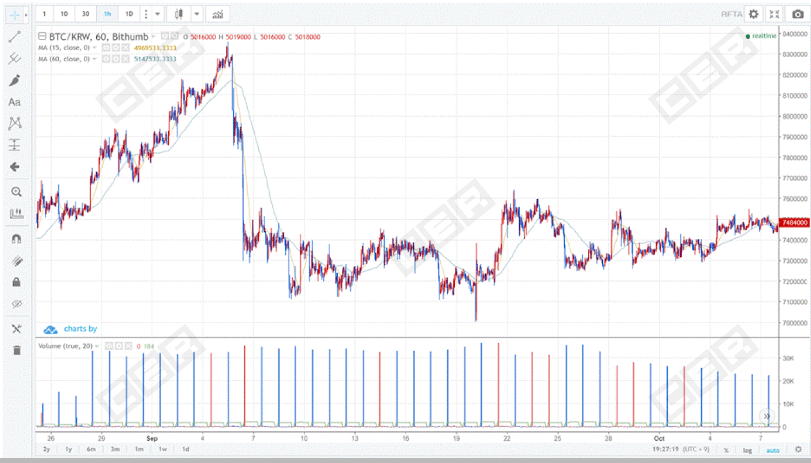
During the first period, they discovered that every day around the same time, the majority of Bithumb’s bitcoin trading would take place in the space of an hour.
Bitcoin exchange bithumb: researchers uncover likely fake volume
Due to the daily spikes around 11am local time, a “comb pattern” emerges.

Between 90 and 95% of the day’s trading volume at Bithumb took place around 11AM each day. As the researchers write, it created a “comb-like” pattern on the chart above. That chart is the hourly volume for the month of September.

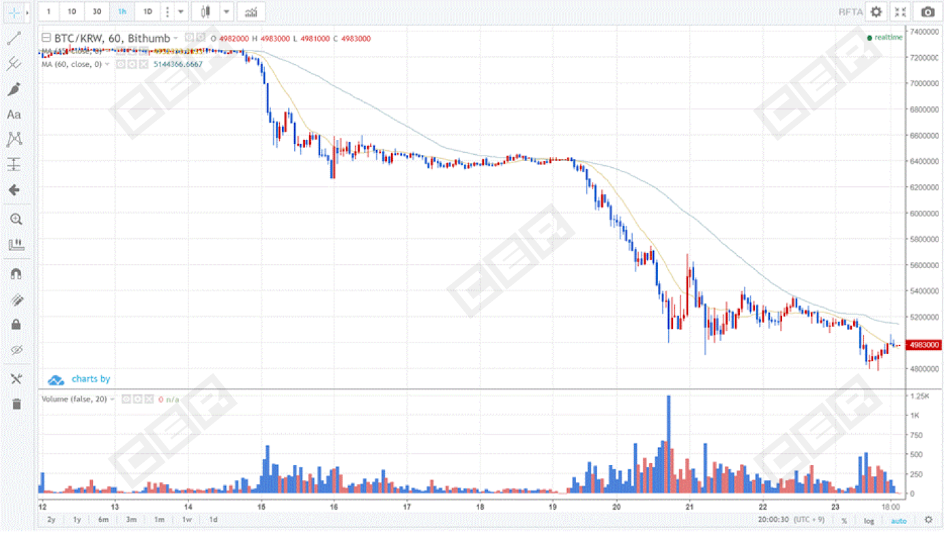
During the second period beginning October 8th, Bithumb’s volumes divorce from the price movement of the same period, posting irregular volumes on a regular basis. On October 8th, the daily volume was 22,000 BTC, while on November 6th, they posted more than 100,000 BTC in trade volume.

Volume Did Not Correspond To Significant Price Movements

On November 12th, volume was just over 1,500 BTC. If this volume isn’t fake, the researchers conclude, then it’s highly irregular. Something’s not right with this, to say the least. If similar trading activity were seen on any regulated mercantile exchange of the old world financial system, regulators would be interested, to say the least.

An interesting thing to note is that following November 12th, the bitcoin price dropped nearly $1,000. It was the beginning of the slide from over $6,500 to the current levels of today. Typically, any major price movement will spur volume, regardless of direction. People will panic sell and people will seize buy opportunities. Even when people aren’t in charge of the decisions, trading bots will take advantage of price movement. Again, they will do this regardless of price momentum. Also, pre-configured trades are often triggered when unexpected price changes take place. But a slide of hundreds upon hundreds of dollars did nothing to return the volume of Bithumb to its previous highs. Volume following November 12th was what the researchers consider “natural” levels.
Bitcoin exchange bithumb: researchers uncover likely fake volume
Volume following november 12th was what the researchers consider “natural” levels.

The researchers calculated the average trading size on Bithumb and noted that it drastically increased over the periods studied. At the beginning of the summer, the average trade at Bithumb was around .21 BTC prior to the first period studied.

During the first period, it increased to more than 1.8 BTC. The second period saw even greater increases, to more than 5.8 BTC per trade. In real terms, this would mean that even the low ends of the average were trading more than $4,000 worth of BTC in every swap – all of a sudden.

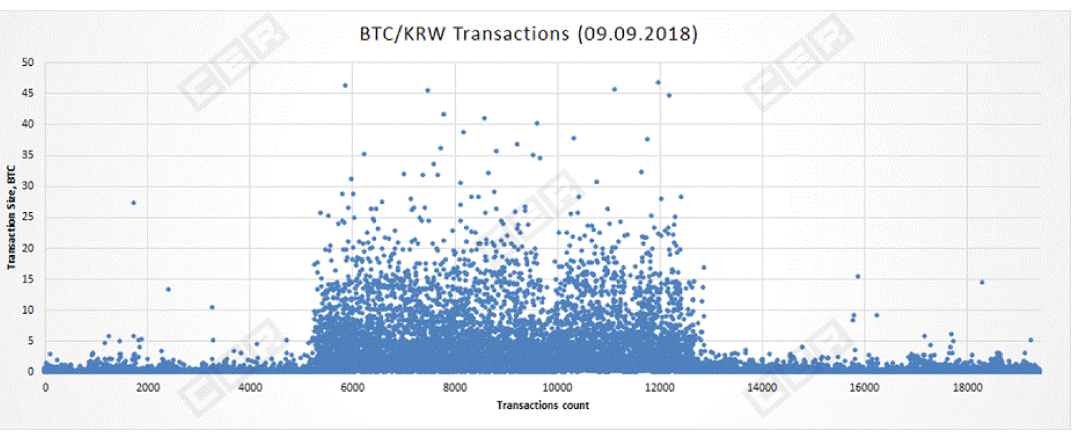
Also, prior to the first period, only a handful of trades (200 or so) were over 2 BTC at all. Yet the average trade size just a month or so later is more than twice that amount. The following chart shows BTC/KRW trades on Bithumb for September 9th. The period that raises the average and is significantly higher lasted only 5 minutes.
Bitcoin exchange bithumb: researchers uncover likely fake volume
The researchers calculated the average trading size on bithumb and noted that it drastically increased over the periods studied.

This trend would be repeated daily for the next 30 or more days. In the particular example shown above, 39% of the day’s trades were conducted in that five minute period for a total of more than 34,000 BTC, which accounts for nearly all of the volume reported by Bithumb that day.

Fast forward to the day before the drop-off point, which happens to also be the day bitcoin prices began to slide. The following pie chart shows the average transaction sizes during a one hour period which started at 3AM local time. IT is vastly higher than normal transaction size on the same exchange.
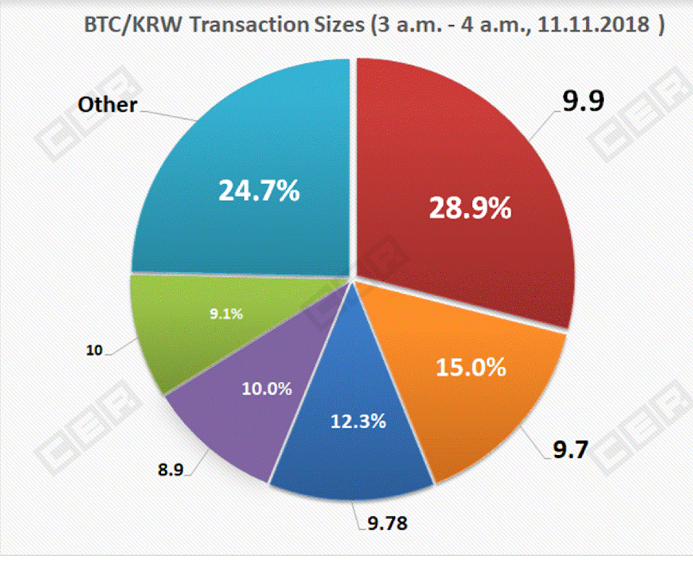
Bitcoin exchange bithumb: researchers uncover likely fake volume

Waltonchain (WTC) Pumped and Traded During Same Period

All the pairs traded on Bithumb saw similar trading patterns at various times, though never all at once. Thus, the volume reported ultimately to places like CoinMarketCap was not just representative of bitcoin/fiat pairs, but also the pairs offered on various altcoins, further inflating the figures. The token that stands out among them, according to the report, is Waltonchain. As the reports’ authors write:

WTC stands out from all the coins we observed, as it was only listed on the exchange on the last day of August and had the shortest pump period which started on October 28th and lasted till November 11th. For or that reason its pump was one of the most intensive. The inflated daily volume of Waltonchain jumped by 350 times from 348k WTC (on average prior to the pump) to 122.5mln WTC (on average during the pump) only to then drop by by 1,450 times in one day from 206.7mln WTC to 141.8k WTC on November 12th.

Waltonchain is an independent bitcoin implementation which aims at the mercantile and other large industries for the purpose of tracking units using RFIDs. It allows factories or companies to create their own sidechain to track various data relating to their wares. It has periodically seen large pumps, but there wasn’t much driving the activity that began in the periods described.

According to the report, Monero and ZEC seem to have been exempt from the fluffing that was going on in other markets:

Interestingly, in contrast to the other pumped coins, XMR and ZEC volume didn’t drop to their pre-pump levels on November 12th. While XMR volume maintained the average daily values of the “second period” after sliding down from the peak, ZEC volume slid from the peak as well but dropped to August levels on November 19th, spiking the next day to half of the average “second period” value and dropped again on November 21st. ATS performance of both coins was in line with their trade volume trends.

Average Trading Size Huge Increases: Most Conclusive Evidence

The conclusions of the report are hard to refute because they are based on exhaustive research and publicly available data. The bottom line is that you can see massive volume spikes, especially during price fluctuations, but it’s unlikely that the class of clientele Bithumb was servicing came in for a few minutes or a few hours of every day and traded more than 8 times the previous average trading size.

For “average” numbers increasing in such a fashion, the change should be at least somewhat sustained over a long period of time. Still, the pre-existing smaller trading sizes would drag the average down over time, so it would be a more healthy sign.

The reader may wonder why Bithumb would want to inflate their volumes, which this reporter does not find the evidence conclusive enough to absolutely say for sure. Some internal leakages would be necessary to verify it.

The answer to why they might,  however, is simple: in the exchange wars, volume is king. Binance is the dominant exchange precisely because it is a magnet the world over. It has dozens upon dozens of trading pairs and conducts a massive amount of trades on a daily basis. Traders often feel they’ll get the most representative rate on the exchange with the most volume in a given token. Often, Binance’s overall USD volume is almost double its nearest competitor.

Even being the nearest competitor is a lucrative position to be in, and Bithumb frequently appears in the top 10 not very far behind Binance. We reached out to Bithumb for comment on this article. After a full day we had not heard anything back at all, but we will update this story if they do send comment.

Bithumb Volume Report by phm.link on Scribd

Featured image from Shutterstock. Thanks to CryptoExchangeRanks.com for other data.

Get Exclusive Crypto Analysis by Professional Traders and Investors on Hacked.com. Sign up now and get the first month for free. Click here.

Advertisement

Published at Thu, 20 Dec 2018 15:11:54 +0000

Previous Article

BTC/USD 30 min/4H charts (12/20/2018)

Next Article

There’s no stopping the Bitcoin train

You might be interested in …

Social Messaging App Kik Will Bring Crypto Tokens to Teen Market

Social Messaging App Kik Will Bring Crypto Tokens to Teen Market

Chat platform Kik has revealed that it is launching its Kin token that will deliver the basis for a decentralized ecosystem of digital services.

Ontario-based chat platform Kik, which has over 300 million active users registered worldwide, including around 40 percent of American teens, has announced today that it is launching its Kin token, a digital currency that will provide a foundation for a decentralized ecosystem of digital services.

Today’s technology has meant that it is impossible not to stay connected with friends and family worldwide with many using messaging apps to do so.

So much so, that by 2019 more than one-quarter of the world’s 7.5 billion population will be using messaging apps, according to data from eMarketer.

Aside from being a cheaper alternative to SMS and MMS, messaging apps are big business that offer a slew of functions: group chats, gaming, GIFs, videos, stickers, emojis, photos and in-built web pages. Not only that, but a majority of messaging apps users are young, which is an extremely important demographic for messaging apps.

Kik believes that through its token it can bring together the areas of communications, information and commerce in a new way that will fuel how today’s generation and future ones will connect. Founded in 2009, Kik was the first chat app that went viral in 2010 from zero to one million users in 15 days. Since then the company has continued to meet the innovation space by becoming the first chat app to become a platform in 2011 before establishing itself as the first app within the Western world to add bots in 2014. Now, Kik is the first chat app to add its own digital currency.

Speaking to bitcoin Magazine, Ted Livingston, Kik’s CEO said that the main motivation for launching their Kin token, which comes from the word “kinship,” came down to two main insights: digital services, which are becoming more important to our daily lives, and the fact that these services are being owned and controlled by fewer and fewer companies. This, in turn, is bringing about less innovation and choice. According to Livingston, this centralization is the result of both economics and competition.

“From an economic side, it’s very hard for independent developers, including companies as big as Kik, to monetize,” he said. “There are a few companies that have huge scale that use that scale to monetize their advertising.”

Livingston adds that, when these bigger companies monetize their advertising, they then give everything else away for free. This means that for independent digital services who don’t bring in enough money through advertising, they live in a world where these giants have set the expectations where everything should be free.

“As a result, it’s very hard for all these digital services to monetize,” Livingston adds. “Those that do, these giants then turn to a copy-and-crush strategy where they take all the ideas from the players, copy it and use their much larger resources to crush the other competitors who do make it.”

As a result, Livingston states that now is the right time to put forward an alternative ecosystem of digital services that isn’t just open, but through digital currencies and decentralization, better. By launching their Kin token, Kik is attempting to set up a new economic system that can monetize digital services and deliver a new way to compete together with the larger companies.

The Kin Token and the Kin Foundation

Through the advanced developments in digital currencies and the blockchain, Kik is planning on creating a decentralized ecosystem of digital services through four steps: creating the Kin token on Ethereum, integrating Kin into Kik, developing the Kin Rewards Engine and launching the Kin Foundation.

Implemented on the Ethereum blockchain as an ERC20 token, Kin will serve as the basis of interoperability for all transactions within the Kin ecosystem. By adopting the token within the Kik app, it’s hoped that millions of users will facilitate widespread adoption of Kin, establishing demand and value for the cryptocurrency. In preparation for the eventual launch of Kin, Kik has been experimenting with the integration of a cryptocurrency on its platform since 2014.

“In 2014, we launched an experiment called Kik Coins and the question we were trying to answer was: Could we get millions of everyday consumers earning and spending natively in a digital currency?” Livingston said. “The result is that we created a transaction volume that was three times better than bitcoin’s global transaction volume at the time.”

Kik also realized that the best way for consumers to understand cryptocurrency was for them to earn it through digital services like Kik.

“The biggest flaw with all the other cryptocurrencies is that nobody gets their paycheck in that cryptocurrency; the only way to get it is to buy it, for 99.99 percent of people,” he added. “This is where teenagers are another big asset for Kik in that they don’t have a ton of spending power and this is a way to earn that spending power by offering value inside the community itself.”

Over time, Livingston explained, there will be various ways that users can earn Kin. One of the examples he gives is through exclusive group chats by charging an entrance fee with Kin to then spend within the Kik ecosystem.

Kin Distribution

Kik is planning on starting a crowdsale where the amount of Kin tokens available will be $1 trillion. However, the majority of the Kin will be set aside to form the Kin Rewards Engine. Modelled similarly to the bitcoin mining system, the Kin Rewards Engine will release a certain amount of Kin every so often to all the developers that build digital services within the ecosystem.

“Every day there will be a daily reward, which we think will start roughly at $100,000 per day,” he said. “As an owner of a service, if you integrate Kin and get people transacting Kin inside your digital service, which generates 10 percent of all transactions within the ecosystem, that would entitle you to 10 percent of this daily reward.”

Ultimately, the more services that join the Kin ecosystem computes to more transactions that happen each day, which increases Kin’s value on public exchanges and, in turn, boosts the daily reward.

“It creates this amazing network effect where all these digital services work together to grow the overall value of the ecosystem,” Livingston adds. “They all get a fair and equitable piece of that economic value they create, and consumers get this ecosystem of services that continues to grow in both size and quality.”

According to Livingston, one of the most underappreciated values of digital currencies is how much economic opportunity they can produce. For instance, he said even though they are giving away $100,000 per day, the amount of Kin available won’t run out anytime soon.

“If Ethereum was giving out $100,000 of Ether a day at its current $10 billion market cap, it would take them 273 years to give away all the Ether,” he said. “If bitcoin was doing it at their $30 billion market cap, they could give away $300,000 a day for 273 years, and these are both cryptocurrencies not used by mainstream consumers.”

As such Livingston believes that the Kin reward could easily go to $200,000, $500,000, even $1 million a day, incentivizing the creation of an open and compelling ecosystem of digital services for consumers.

Through the Kin Foundation, the team are ultimately trying to achieve a decentralized system where the developer doesn’t need to trust the Kin Foundation. As a nonprofit, the foundation will oversee the open and fair growth of the system where it will provide three things: it will administer the rewards system, it will offer an identity service for users to move between the digital services and it will provide a transaction service for users to earn and spend Kin in a secure and frictionless way, Livingston states.  

Kik is due to release their whitepaper today, at which point they expect to start working with the crypto community, which will lead to their crowdsale in the next few months.

The post Social Messaging App Kik Will Bring Crypto Tokens to Teen Market appeared first on Bitcoin Magazine.