October 12, 2026

Capitalizations Index – B ∞/21M

There’s no stopping the Bitcoin train

There’s no stopping the bitcoin train

There’s no stopping the Bitcoin train

There’s no stopping the bitcoin train

A recent report published by Bloomberg states that Tether “has the billions it promised”, indicating that USDT may be backed 1-to-1 by USD after all.

In the past, some sources claimed that USDT is not backed entirely by US Dollars and this spurred allegations of misconduct and price manipulation (some voiced concern that BTC’s rise to $20,000 was fueled by dishonest Tether trades). It is also believed that this controversy played a part in bitcoin’s 2018 bear market.

Bloomberg reported that “$2.2 billion was in Tether’s account at Puerto Rico’s Noble Bank Ltd. on Jan. 31. That same day, 2.195 billion Tethers existed, according to data compiled by Coinmarketcap.com”. However, this doesn’t prove that Tether has been continuously backed by US Dollars and doesn’t solve the price manipulation allegation, which is still being investigated by the U.S. Justice Department.

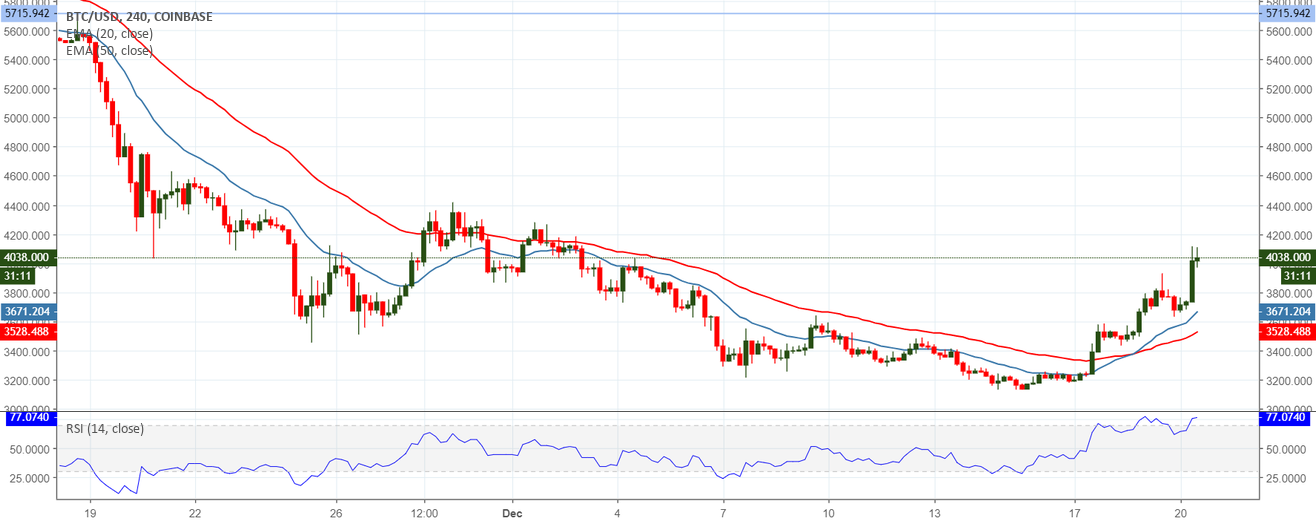
It seems there’s no stopping the bitcoin train as the digital currency continues higher largely unfazed by Tether concerns or by overbought levels shown by technical indicators. It added almost 8% in the last 24 hours and more than 20% over the last 7 days, breaking the key level at $4,000 and trading at 4,160 on Bitfinex at the time of writing.

The short to medium term bias is clearly bullish and the recent break of 4000 shows that buying pressure is still high, with a potential to push BTC/USD into 4480 – 4500. That being said, the Relative Strength Index has broken above its 70 level for the third time in a short while, which is an indication that a bearish retracement will soon follow.

This potential correction can find support at 4000 (or at 4100 if it goes higher before retracing) but as long as this barrier still stands, we favor a climb into 4500 over the next few days.

Support zone: 4000
Resistance zone: 4480 – 4500
Most likely scenario: push into 4500 area (possible retracements until that target is reached)
Alternate scenario: move below 4000 and choppy price action

Published at Thu, 20 Dec 2018 15:28:51 +0000

Previous Article

Bitcoin Exchange Bithumb: Researchers Uncover Likely Fake Volume

Next Article

Only 13 Days Left to participate in The Ethereum Sweepstakes 1,500,000 ETHERS estimated $166,500,000 USD Jackpot

You might be interested in …

Ending the Federal Reserve from the Bottom Up

federal reserve.jpg

mises.org / William Greene / March 31, 2017

Since its inception, the U.S. Federal Reserve’s monetary policies have led to a decline of over 95% in the purchasing power of the U.S. dollar. As a result, there have been several attempts to curtail or eliminate the Federal Reserve’s powers (e.g., the efforts of Rep. Louis T. McFadden in the 1930s; the efforts of Rep. Wright Patman in the 1970s; the efforts of Rep. Henry Gonzalez in the 1990s; and the efforts of Rep. Ron Paul since the 1990s). However, none have proven successful to date, due mainly to the constraints of strong political opposition at the national level. In contrast to these “top‐down” attempts at the national level, this paper proposes an alternative approach to ending the Federal Reserve’s monopoly on money: the “Constitutional Tender Act,” a bill template that can be introduced in every state legislature in the nation, returning each of them to adherence to the U.S. Constitution’s “legal tender” provisions of Article I, Section 10.

This approach would have a greater likelihood of success for a number of reasons. First, it is decentralized: rather than facing concerted political opposition at a single Federal level, it attacks the issue at the State level, where strategies and tactics can be adapted to the types and amount of political opposition they encounter. Second, it is diffused: it can be attempted in any number of States, which can cause the opposition to spread its resources much more thinly than would be necessary at the Federal level. Finally, it is legally sound: it relies on the U.S. Constitution’s negative mandate in Article I, Section 10, that “No State shall… make any Thing but gold and silver Coin a Tender in Payment of Debts.” Therefore, in contrast to “top‐down” attempts to “end the Fed,” a “bottom‐up” approach using “constitutional tender” laws will find greater success.

READ MORE

The post Ending the Federal Reserve from the Bottom Up appeared first on Silver For The People.