The views and opinions expressed here are solely those of the author and do not necessarily reflect the views of Cointelegraph.com. Every investment and trading move involves risk, you should conduct your own research when making a decision.
The market data is provided by the exchange.
In the stock markets, the introduction of was a popular move. Why? It attracted many new investors because it is easy to invest and it provides better returns than most of the hedge funds.
Cryptocurrency trading is like a roller coaster ride that many are unable to digest. However, if they can be offered a less volatile option with comparable returns, most would probably jump into the fray.
To cater to this requirement, scores of are cropping up. These are advertised to be less volatile, providing commensurate returns. If they can prove themselves over a bull and bear cycle, a bunch of new investors should flock to cryptocurrencies.
As it is, the large investment banks like and are rumored to be laying the groundwork to start cryptocurrency trading desks. Their entry will increase the volume and deepen the markets.
Finally, the traditional banking community is recognizing the importance of digital currencies. The latest boost was provided by a blog post by Christine Lagarde, head of the International Monetary Fund (IMF) where she potential benefits of the cryptocurrencies.
Many recent prices developments are giving us a feeling that the worst might be behind us and most of the virtual currencies will enter a bottom forming process.
BTC/USD
has hardly gained any ground after breaking out of the descending channel on April 12. It is stuck between both moving averages. The bears are defending the 50-day SMA, whereas, the bulls are buying at the 20-day EMA.

If the pair doesn’t break out of the 50-day SMA within a couple of days, traders can raise their to breakeven or can close their positions. A failure to cross the overhead resistance will attract selling, which can sink the digital currency back towards the $6,757 levels.
If the price breaks out of the 50-day SMA, a rally to $9,400 followed by a move to $10,000 is possible.
ETH/USD
For the past four days, has been taking support close to the $500 levels. Though the downtrend has ended, we are yet to see buying conviction return.

The 20-day EMA has flattened out, while the 50-day SMA is still falling. The pair is stuck between these two moving averages.
A breakout above the 50-day SMA can push prices towards $600 and then to $730 levels. On the other hand, a breakdown below the 20-day EMA can sink the cryptocurrency to $418 levels.
We don’t find a high conviction setup; hence, we are not suggesting a trade on it.
BCH/USD
After finding support at the 20-day EMA, is moving towards the 50-day SMA. Previously, it has not faced any selling at this moving average. That’s why we don’t expect any major resistance at the 50-day SMA at the moment.
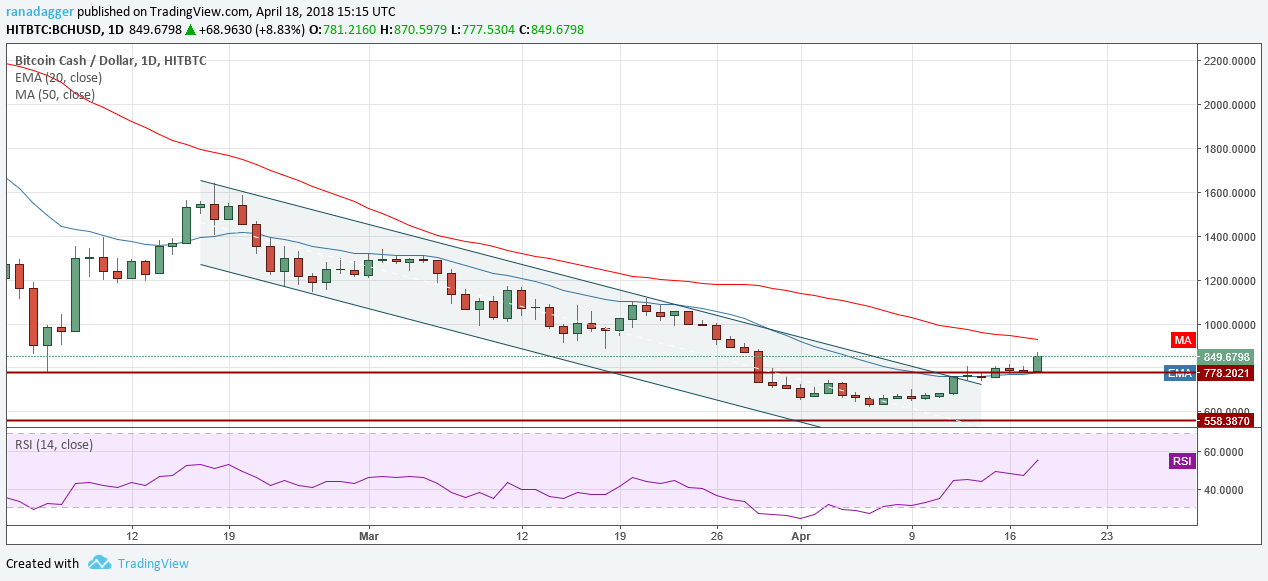
Our target objective remains a rally to levels where traders can book partial profits. The pair has a history of vertical rallies when it starts a new trend. Therefore, we suggest holding some position with a trailing stop loss.
In case vertical rally does take place, traders can expect levels to see the price reaching $1,300 and $1,600 levels. The stops can be raised to $700 levels. We don’t want to stick with the trade if it breaks below the 20-day EMA again.
XRP/USD
did not correct to the support levels of $0.56270, as we had . It has been trading in a tight range of $0.613-$0.70789.

The 20-day EMA is turning up and the 50-day SMA is flattening out. Chances of a bullish crossover have increased. If the bulls break out of this range, a rally to $0.83296 will be on the cards.
Therefore, aggressive traders can initiate long positions on the pair at $0.71 with a stop loss of $0.61. Partial profits can be booked close to $0.83, and the remaining positions can be held with a trailing stop because a move above $0.83 can push the digital currency to $1 levels.
If the price breaks down below $0.61, a decline to $0.56 is likely.
XLM/USD
is moving towards our first target objective of $0.36, where it can face some resistance. Therefore, traders can book partial profits at this level and hold the rest for higher levels of about $0.47.

The RSI has reached close to overbought levels; hence, a few days of consolidation can’t be ruled out.
The pair has broken out of a long downtrend. It can now either become range bound and build a base or start a new uptrend. The next dip will give us a better idea of the probable trend.
LTC/USD
We have been neutral on because we believe that it will face considerable resistance at the $141 mark. On April 17, prices broke out of this level but could not sustain it.

The pair is again trying to break out of the range. A breakout will give it a pattern target of $168, but we anticipate another round of selling at the downtrend line.
We shall turn positive if the virtual currency breaks out and sustains above the downtrend line. At the current levels, we don’t find a buy setup with a good risk to reward ratio.
ADA/BTC
reached very close to our target objective of on April 17 when it reached an intraday high of 0.00003405. In our , we had recommended booking partial profits at 0.0000323 and trailing the stops higher.

The RSI is close to the overbought levels, that’s why a couple of days of consolidation is likely. On the downside, the 20-day EMA will act as strong support.
The pair will pick up momentum if it breaks out and sustains above 0.000035 levels. Therefore, traders can leave a small portion of their position open with the stop loss at breakeven.
NEO/USD
is currently stuck between the 20-day EMA and the 50-day EMA. It has been trading close to the $64 levels – our buy level – for the past five days.

A breakout of the 50-day SMA can carry the pair to the $80 levels where it will face considerable resistance from the downtrend line of the descending triangle.
Therefore, we have revised our target down to $80 from $88. On the downside, strong support exists at the $64 levels. Any break of this will sink the cryptocurrency back towards the April 06 lows of $44.16. Therefore, we suggest reducing the risk by raising the stops to $54 levels.
EOS/USD
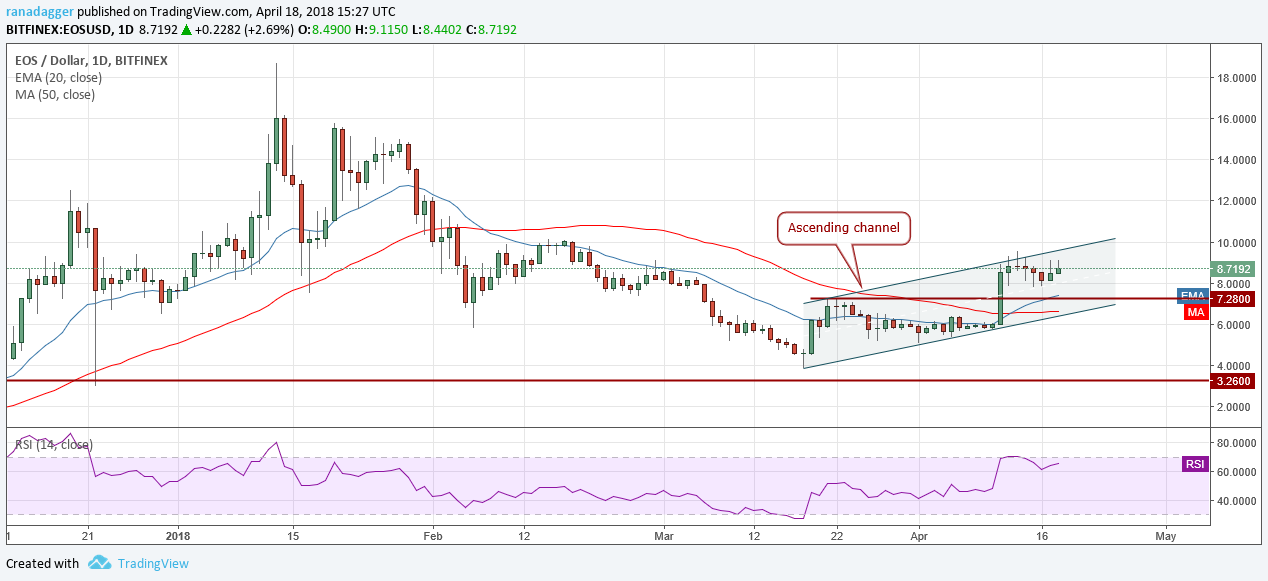
is trying to start a new uptrend. It successfully completed a retest of the breakout levels and found support at $7.8 on April 15 and April 16.

The pair is currently trading inside an ascending channel. A breakout of the channel will indicate bullishness.
The current up move can face some resistance in the $9.5 to $10 zone. Therefore, we recommend booking partial profits around the $9.5 mark and holding the rest for a target objective of $11.
The stop loss can be trailed higher to breakeven on half of the position, and the remaining half can be kept at $6, just below the support line of the ascending channel.
The market data is provided by the exchange. The charts for the analysis are provided by .
Published at Thu, 19 Apr 2018 04:22:20 +0000
Altcoin[wpr5_ebay kw=”bitcoin” num=”1″ ebcat=”” cid=”5338043562″ lang=”en-US” country=”0″ sort=”bestmatch”]