August 20, 2026

Capitalizations Index – B ∞/21M

Bitcoin Crawls Past $3,800, But You Shouldn’t Trust This False Recovery

Bitcoin crawls past $3,800, but you shouldn’t trust this false recovery

Bitcoin Crawls Past $3,800, But You Shouldn’t Trust This False Recovery

Bitcoin crawls past $3,800, but you shouldn’t trust this false recovery

The bitcoin price started Monday with a small recovery to compensate for Sunday’s massive losses, but crypto investors shouldn’t get their hopes up.

Bitcoin (BTC/USD) established its intraday high at $3,861, up around 1 percent for the 24-hour period. On Sunday, the pair dropped approximately 10 percent in just 9 hours – a dump, precisely. It started consolidating upwards after finding a new low at $3,721. At the same time, the bitcoin market reported lower intraday volume and volatility, indicating that the bearish action was still far from over.

bitcoin Price Faces Stiff Resistance above $4,200

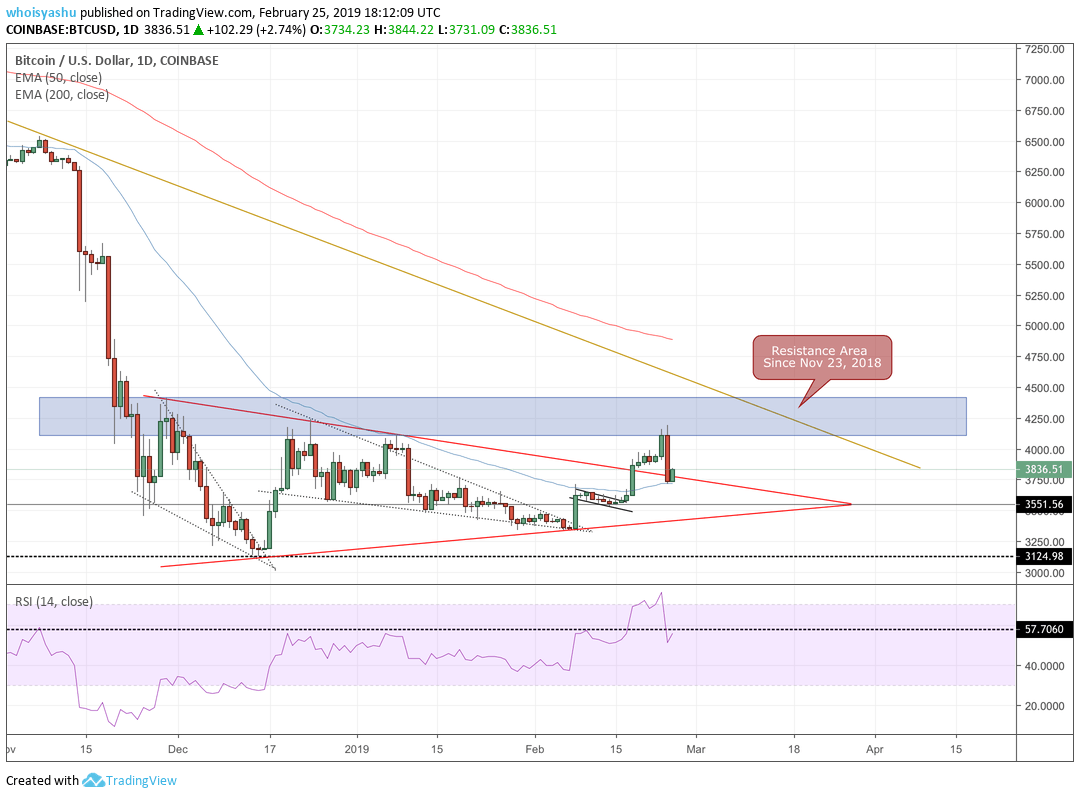
In late November 2018, the bitcoin price had broken below its so-called bottom area at $6,000. The cryptocurrency attempted its first strong upside correction on November 23 when it recovered from $3,453 to $4,419. However, it failed to extend its bullish momentum every time it came near a specific resistance area. Have a look at the daily chart below for illustration.

BITCOIN 1D PRICE CHART | SOURCE: COINBASE, TRADINGVIEW.COM

Since the first upside attempt, BTC/USD has attempted to cross above the resistance area on five separate occasions. At the same time, we can see how the 50-period moving average (depicted in the blue curve above) has also capped bullish attempts. Recently, bitcoin broke above that moving average to establish an interim bullish bias. Nevertheless, the pair met the “resistance area” that prevented the rally from extending any further.

Upon the bearish divergence action from the area, bitcoin moved back towards the 50-period EMA. Surprisingly, the blue curve switched from being resistance to being support. We can see the two daily candles in the end in the chart above supported by the 50-period EMA. We can expect it to hold the downside action for a while.

At the same time, if bitcoin breaks below the 50-period EMA, then the cryptocurrency could target $3,551 as the next potential support.

bitcoin Forming Bear Flag

BITCOIN 4H PRICE CHART | SOURCE: COINBASE, TRADINGVIEW.COM

Bitcoin is now in the first wave of a potential downside move, as evidenced by the formation of a bear flag. While there is a possibility that the price will reverse back towards the “resistance area” – as mentioned in the section above – the overall sentiment and the price action in recent months indicate that bitcoin is due for an extended bear run.

A breakdown action from where bitcoin is right now would be confirmed once the price tests the so-called flag support. At the same time, traders would see a rise in volume. It could pose as an excellent opportunity for short traders, with a potential initial downside target towards $3,551. Adventurous traders could also be eyeing the support trendline of medium-term triangle formation (depicted via a rising red trendline).

Traders Should Press Pause on Intraday bitcoin Price Strategy

We are not yet sure about how we would like to play the market. There is a clear bias conflict concerning the direction of the next price action. Consequently, our priority should be to wait and confirm a breakout/breakdown to understand the extent of our positions. Overall, going by the look of bitcoin performance in the past 24 hours, we don’t expect the ongoing bullish correction to continue.

Trade safely!

Featured Image from Shutterstock. Price Charts from TradingView.

Published at Mon, 25 Feb 2019 23:13:09 +0000

Previous Article

Austrac Joins Forces with Australian University to Develop Blockchain Solution for International Funds Transfer

Next Article

IOTA launches smart city development hackathon » CryptoNinjas

You might be interested in …

Don't ban crypto, says former fdic chief sheila bair

Don't Ban Crypto, Says Former FDIC Chief Sheila Bair

Don't Ban Crypto, Says Former FDIC Chief Sheila Bair The former chairperson of the Federal Deposit Insurance Corporation (FDIC), which insures bank deposits in the U.S., says that cryptocurrencies shouldn’t be outlawed. According to a […]

Cambridge University: Cryptocurrency Use Seeing ‘Significant Growth’

A report by Cambridge University’s CCAF reveals that the number of people using cryptocurrency today has seen significant growth and rivals the population of small countries.


Global Cryptocurrency Benchmarking Study

The Cambridge Centre for Alternative Finance (CCAF) has recently published a research paper called Global Cryptocurrency Benchmarking Study, which examines several sectors of the global cryptocurrency industry, including exchanges, wallets, payment providers, mining and more.

The study was led by Dr.Garrick Hileman, senior research associate at the CCAF and a researcher at the Centre for Macroeconomics. According to the CCAF, it’s the first global research of its kind to systematically investigate all key cryptocurrency industry sectors based on non-public “off-chain” data.

The paper makes several key findings that challenge some of the erroneous concepts that many have regarding the cryptocurrency space and shows that digital currencies are becoming an increasingly important part of our society. Dr.Garrick Hileman wrote:

Dr.Garrick Hileman

“The growing usage and range of capabilities we document in this study indicate that cryptocurrencies are taking on an ever more important role in the lives of a growing number of people (and machines” around the world. As we show in this study, the number of people using cryptocurrency today has seen significant growth and rivals the population of small countries.”

According to Dr. Hileman, a second paper by the CCAF focusing blockchain technology will also be launched in the following weeks. The paper is centered around the use of blockchain technology by more established industry players as well as at public sector institutions such as central banks.

What’s in it

The study collected data from nearly 150 cryptocurrency companies and individuals, covering 38 countries from five world regions, including names like Peter Smith from Blockchain.info, Roger Ver from bitcoin.com and companies like Coinbase, Bitmain, BTCC, Unocoin, and others.

The CCAF carried out four online surveys from September 2016 to January 2017 and communicated with the companies and individuals involved in order to collect this data. For companies that did not contribute to the study, the dataset was supplemented with additional research and web scraping using commonly applied methods.

The 114-page report counts with four sections, each covering one of the aforementioned industry sectors: exchanges, wallets, payments and mining. There are also three appendixes; the first one is an introduction to cryptocurrencies, the second offers a more detailed intro to the cryptocurrency industry and the third covers the geographical dispersion of cryptocurrency users.

Key Findings

The CCAF highlights the following findings as the key points of the paper:

  • The current number of unique active users of cryptocurrency wallets is estimated to be between 2.9 million and 5.8 million. (The majority of which are located in North America and Europe)

Cryptocurrency wallet users donut chart

  • The lines between the different cryptocurrency industry sectors are increasingly blurred: 31 percent of cryptocurrency companies surveyed are operating across two cryptocurrency industry sectors or more, giving rise to an increasing number of universal cryptocurrency companies.
  • At least 1,876 people are working full- time in the cryptocurrency industry and the actual total figure is likely well above two thousand when large mining organizations and other organizations that did not provide headcount figures are added.
  • Average security headcount and costs for payment companies and exchanges as a percentage of total headcount/operating expenses are similar but significantly higher for wallets.

Exchanges

  • The exchanges sector has the highest number of operating entities and employs more people than any other industry sector covered in the study; a significant geographical dispersion of exchanges is observed.
  • 52% of the small exchanges hold a formal government license compared to only 35% of large exchanges.
  • On average, security headcount corresponds to 13% of total employees and 17% of the budget is spend on security.

Cryptocurrency exchanges chart

Wallets

  • The lines between wallets and exchanges are increasingly blurred; 52% of wallets surveyed provide an integrated currency exchange features, of which 80% offer a national-to-cryptocurrency exchange service. In contrast with exchanges, the majority of wallets do not control access to user keys.

Payments

  • While 79% of payment companies have existing relationships with banking institutions and payment networks, the difficulty of obtaining and maintaining these relationships is cited as this sector’s biggest challenges.
  • On average, national-to-cryptocurrency payments constitute two-thirds of total payment company transaction volume, whereas national-to-national currency transfers and cryptocurrency-to-cryptocurrency payments account for 27% and 6% respectively.

National-to-cryptocurrency transactions vs other transactions

Mining

  • 70% of large miners rate their influence on protocol development as high or very high, compared to 51% of small miners.
  • The cryptocurrency mining map shows that publicly known mining facilities are dispersed, but a significant concentration can be observed in certain Chinese provinces.

Cryptocurrency mining by country

Do you think cryptocurrency use is growing? Have you seen indicators of increased mainstream adoption? Let us know in the comments below!


Images Courtesy of CCAF, AdobeStock

The post Cambridge University: Cryptocurrency Use Seeing ‘Significant Growth’ appeared first on Bitcoinist.com.