
Asian Altcoin Trading Roundup: Top Cryptocurrency is Nano
The markets have continued correcting during the Asian trading session this morning. bitcoin continues with its slow sell off but the some of the altcoins seem to be accelerating downwards at a faster rate. BTC seems to have found support at $10,500 and has headed upwards slightly however it is still down around 2% on the day. Most altcoins are also down except one which is pretty rampant right now, and that is Nano.
Nano is the rebranded version of RaiBlocks and according to Coinmarketcap it is trading 26% higher on the day. From a low of just under $7 yesterday NANO (previously XRB) is nudging towards $10 today with a spurt that started a couple of hours ago. It had been down trending all week from a high of $10.02 until today when it has spiked back up to $9.05. RaiBlocks had a great run in early January peaking at $36, like most altcoins that were pumped during this period it has fallen back heavily.
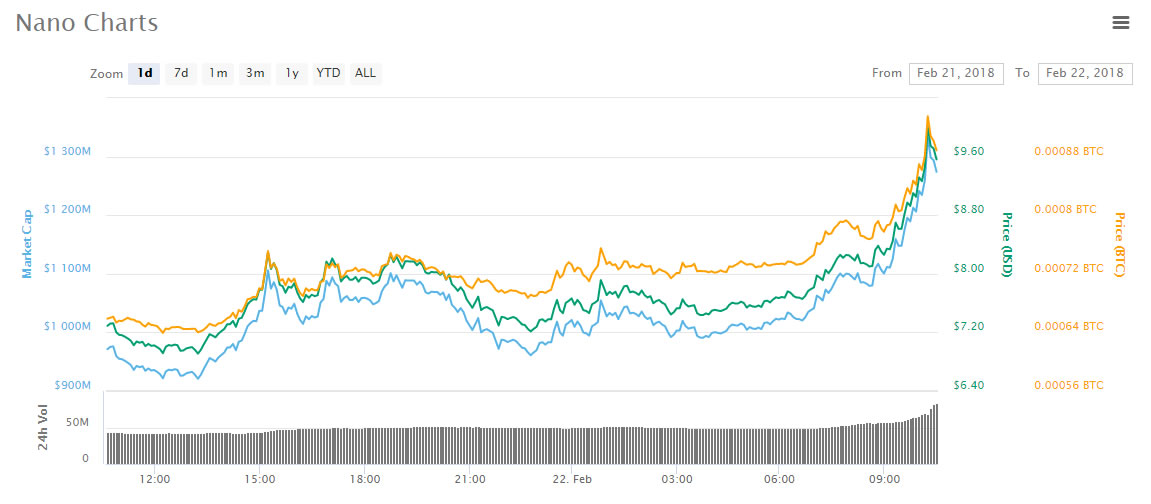
Nano touts itself as a ‘block lattice’ based network offering zero fee digital currency transactions. This makes micropayments more viable as there are no fees and transactions are instant. The fomo spike today has come on the announcement that the Nano wallet for Android is now in Beta on Google Play. An iOS version is in the pipeline.
Nano has a market capacity of $1.2 billion with Binance taking over 90% of the trade volume. In the past 24 hours $82 million has been traded and there are 133 million tokens in total with all of them in circulation. Nano is currently ranked at number 24 in the market cap charts.
Other altcoins showing positive price action this morning in Asia are Monero, up 8%, and Zcash. Outside of the top 25 Populous, Dent and Polymath are also doing well when most others are falling.
Australian Health Service Provider Asked to Pay $15,000 bitcoin Ransom Cyber attacks are a very big problem in day and age. In a lot of cases, such threats are designed to steal sensitive information from […]
While () activation is looking by the hour, is getting ready to deploy a version of the Lightning network with or without the protocol upgrade.
The blockchain technology company, perhaps best known for its bitcoin mining pool of the same name, successfully sent real bitcoins over a test version of the Lightning Network this week. Interestingly, Bitfury’s implementation of the technology is compatible with the current bitcoin protocol and is therefore functional even without SegWit.
“This is a major accomplishment by our technical team and an important step forward for the Lightning Network and the growth of bitcoin,” Valery Vavilov, CEO of The Bitfury Group, said in a statement.
Lightning Network
is a highly anticipated second-layer scaling solution that allows for cheap and instant (micro)payments. Cleverly leveraging bitcoin’s basic scripting capabilities, Lightning users should be able to make a virtually unlimited number of transactions, where only a minimal proportion of them are recorded on bitcoin’s blockchain, thereby boosting bitcoin’s scalability. Meanwhile, all users remain in control of their own bitcoins at all times, maintaining the trustless properties of bitcoin itself.
“The Lightning Network has the potential to solve bitcoin’s scalability issue and provide instant payment functionality. By demonstrating that the Lightning Network can function now, Bitfury has cleared the way to increased transaction processing and further adoption of bitcoin,” Vavilov said.
Bitfury’s Lightning is based on, which is being developed by.
For its demo, the Bitfury software team created two Lightning transactions. One of these is a straight transaction from one Lightning node to the next, effectively simulating a payment channel between two users. Since it was only a test, Bitfury only made one transaction — but it could have made thousands back and forth at no extra cost.
The other test was a single-hop transaction, which better simulates the main purpose of the Lightning Network. Users pay each other through a mutual third party, without requiring any trust in this third party. While the Bitfury software team only made one transaction on this channel as well, it could, once again, have made thousands back and forth between all three parties, at no extra cost.
Since Bitfury’s test took place on the main net, and are recorded on bitcoin’s blockchain and can be seen by any typical block explorer.
Tests and SegWit
Bitfury’s is not the first successful test of the Lightning Network. Several companies, including Lightning Labs, Blockstream, ACINQ as well as Bitfury itself have experimented with their implementations of the technology. But since most of these companies are working on versions of Lightning that rely on Segregated Witness, these tests were limited to bitcoin’s testnet and Litecoin. Likewise, major wallet service Blockchain has sent “” transactions over bitcoin’s main net. But while Thunder resembles the Lightning protocol, it isn’t quite as trustless or decentralized.
As such, Bitfury is the first company to get a version of the Lightning Network up and running on the current bitcoin protocol.
“We released this first experimental version of the Lightning Network for bitcoin because we think the Lightning Network is an essential technology for bitcoin and would love to see it made available as soon as possible,” Vavilov said. “We are proud that our developers found a way to adopt the Lightning Network for bitcoin without SegWit. It’s a huge step forward for bitcoin scalability.”
Regardless, the CEO noted that he is hopeful that SegWit will activate on the bitcoin network. With currently getting close to its activation threshold, it seems increasingly likely that SegWit could be live within a month. This would allow for a version of the Lightning Network that offers an improved user experience.
Vavilov:
“The Lightning Network will be the most effective when used with SegWit, which is why we are fully committed to SegWit’s implementation, and we will continue working on a version of the Lightning Network that is compatible with SegWit.”
Bitfury, which started out as a bitcoin miner, has grown to become one of the largest private infrastructure providers in the Blockchain ecosystem. Part of this effort, the company has been supporting the development and implementation of the Lightning Network for well over a year. Bitfury previously also co-designed and successfully, a payment-routing solution for the Lightning Network.
Government Shutdown Continues Over Trump’s Border Wall – Who Will Dominate Cross-Border Payments? Opinions expressed in this article are those of the author alone. While some conservatives are focused on fomenting national security with barriers, […]