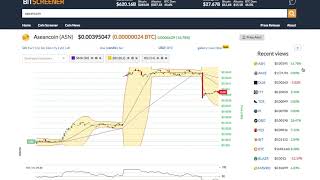
Aseancoin (ASN) Price Alert, Chart & News on OhioBitCoin.com
More detail: https://ohiobitcoin.com/coins/aseancoin
Ascension Coin (Symbol: ASC) is a Proof-of-Work (PoW) and Proof-of-Stake (PoS) hybrid with a rate of 20% per year. Developed by an Asian plutocracy’s financial organization and an ASEAN politician, ASN aims to promote the economic growth of this bloc. Over 700,000,000 people utilized the ASN for transactions and applications in exchanging import and export of commodities and tourism services among ASEAN countries with China, USA, Europe and other countries in the world. The coin is a digital money with the secure algorithm for improving the community. ASC has a breakthrough in the technology of processing the SHA256 algorithm that produces 900,000,000 ASNs with cold wallets connecting with blockchain upgrades and cloud computing. It assists to faster currency flow and raises the maximum security for transactions.

A “covert” use of so-called ASICBOOST technology was to the Core mailing list by contributor Greg Maxwell Wednesday. This would allow “a major manufacturer” to unfairly profit from centralization.
While Bitmain was not named by Maxwell, community sources subsequently confirmed the company’s involvement.
In case there was any dispute, I confirmed with a source that the mining hardware manufacturer discussed in gmaxwell's post is Bitmain.
Exploitation of this vulnerability could result in payoff of as much as $100 million USD per year at the time this was written (Assuming at 50% hash-power miner was gaining a 30% power advantage and that mining was otherwise at profit equilibrium). This could have a phenomenal centralizing effect by pushing mining out of profitability for all other participants, and the income from secretly using this optimization could be abused to significantly distort the bitcoin ecosystem in order to preserve the advantage.
The Core developer also proposed solutions to prevent the attack becoming a major problem, in a move praised by Tone Vays as “a huge confidence boost” for the SegWit supporters.
Wu: Bitmain Statement ‘Soon’
Wu meanwhile stated Bitmain would provide a statement “soon.”
Someone made a probability math wrong. Go back and check it. A statement from Bitmain will come soon.
Previously, suspicion had already fallen on the Unlimited supporter, with community members noting he had about ASICBOOST. They added Wu’s BU support could be linked to the Bitmain operation.
While ASICBOOST was originally invented by Sergio Lerner among others, who also contributes to SegWit concepts, Maxwell stated that none of the technology’s creators were “aware” of the exploit.
“Reverse engineering of a mining ASIC from a major [manufacturer] has revealed that it contains an undocumented, undisclosed ability to make use of this attack. (The parties claiming to hold a patent on this technique were completely unaware of this use.),” he continued.
On the above basis the potential for covert exploitation of this vulnerability and the resulting inequality in the mining process and interference with useful improvements presents a clear and present danger to the bitcoin system which requires a response.
In Summer 2016, KnCMiner declared bankruptcy over the bitcoin block reward halving causing them unsustainable overheads.
This statement from bankrupted KnCMiner's CEO over a year ago explains today's news:
Mastercard has opened up their own blockchain to allow payment transactions to be carried out between selected banks and merchants, but this process uses fiat currency and not bitcoin or other cryptocurrencies.
Quite a few companies have taken a keen interest in what blockchain technology has to offer, and one of these corporate entities is Mastercard, the massive credit card provider. Mastercard has spent the last few years developing its own blockchain, and now the as an alternative method of paying for goods and services. The major difference found in the Mastercard blockchain is that it does not use its own cryptocurrency. Instead, it uses real world money.
Mastercard Blockchain Open for Business
The Mastercard blockchain is now open for specific banks and retailers to use as a payment processing system. So far, participation in this blockchain is by invitation only. The last week has been a busy one for Fortune 500 companies and blockchain technology. IMB opened up earlier in the week. Probably the most intriguing aspect of the Mastercard blockchain is that it does not use its own cryptocurrency, which is something that even the IBM blockchain does.
Justin Pinkham, a senior vice president at Mastercard Labs, says:
We are not using a cryptocurrency, and we are not introducing a new cryptocurrency, because that introduces other challenges—regulatory, legal challenges. If you do a payment, then what we can do is move those funds in the way that we do today in fiat currency.
Why the Mastercard Blockchain Could be Very Successful
Some people may look at the and shrug, but there are some factors in why it could be very successful. The first such reason is that Mastercard is lord and master of a vast financial empire, so to speak. It has a settlement network that counts 22,000 banks and financial institutions from all over the world. Few other entities have such a global reach. Another important factor is that the Mastercard blockchain only uses fiat currency, which reduces costs as there’s no need to convert one form of cryptocurrency into another and then, eventually, cash.
This reduction in cost is also amplified by reducing fees for cross-border payments. Normally, a payment that crosses national borders would have to pass through different sovereign banks, racking up fees with each step. The Mastercard blockchain would remove those steps entirely, thus making the payment less expensive and probably faster. Eventually, Mastercard’s blockchain could be used for other items, such as luxury goods to provide “proof of provenance.”
Overall, this is an interesting development. Could the lack of a cryptocurrency tie-in fire a shot across the bow of other blockchains? One also wonders how the energy use for a single transaction on the Mastercard blockchain compares to current credit card transactions and bitcoin. A Dutch bank that the average energy cost for a bitcoin transaction was 200kWh, and the cost for an Ethereum transaction was 37kWh. By comparison, a credit card transaction only incurred an energy cost of 0.01kWh.
Do you think the Mastercard blockchain will have a major impact? Does the fact that it does not use a cryptocurrency have long-lasting ramifications? Let us know in the comments below.
Images courtesy of Wikimedia Commons, Pixabay, and Flickr.
Re: █ ★☆★777Coin★☆★ █ ✔ Full Range of Games ✔ Instant Withdraw ✔ Free mBTC! “With e-currency based on cryptographic proof, without the need to trust a third party middleman, money can be secure and […]