August 13, 2026

Capitalizations Index – B ∞/21M

Apple Publishes Revised Cryptocurrency, ICO Guidelines for App Store

Apple publishes revised cryptocurrency, ico guidelines for app store

Apple Publishes Revised Cryptocurrency, ICO Guidelines for App Store


Apple publishes revised cryptocurrency, ico guidelines for app store
Advertisement

Get exclusive fiat and cryptocurrency analysis on OhioBitcoin.com. Click here now!

Apple has revealed its revised guidelines in a dedicated section for iOS and MacOS apps centered on the cryptocurrency space.

As bitcoin prices peaked near $20,000 in December 2017, Apple unveiled a new section of guidelines specific to cryptocurrencies and ICOs on December 20th.  For instance, apps facilitating any exchange or transfer of cryptocurrencies like bitcoin were mandated to abide in compliance with all federal and relevant state laws of its offering. Under the mandated rules.

On Monday June 4th, Apple expanded on those crypto-centric guidelines with several key inclusions into specific functionalities like wallet storage and mining for apps on its App Store platform.

To keep its hardware, think iPhones, from draining battery or computing power, Apple has now forbid app developers from including any 3rd party advertisements that run cryptocurrency mining. The move comes at a time when ‘cryptojacking’, a malware attack wherein malicious attackers scrumptiously hijack a computer or a phone’s computing power to mine cryptocurrencies, is a growing menace.

“Apps, including any third-party advertisements displayed within them, may not run unrelated background processes, such as cryptocurrency mining,” the updated policy reads.

Apple has also outlawed apps from mining cryptocurrencies on the device altogether.

An excerpt from the revised guidelines states:

Apps may not mine for cryptocurrencies unless the processing is performed off device (e.g. cloud-based mining).

ICO Norms

In sticking with the original mandate, only mainstream banks and similar financial institutions will be allowed to develop and publish apps enabling crypto futures trading and initial coin offerings, Apple said.

“Apps facilitating Initial Coin Offerings (“ICOs”), cryptocurrency futures trading, and other crypto-securities or quasi-securities trading must come from established banks, securities firms, futures commission merchants (“FCM”), or other approved financial institutions and must comply with all applicable law,” read the unchanged policy first unveiled in December.

Wallets, Exchanges and Rewards

Four years ago, Apple removed every single bitcoin wallet application on its App Store, including popular wallet app Blockchain. The technology giant reversed its stance soon after, despite pulling moves like removing multi-cryptocurrency wallet Jaxx after its disapproval of Dash in 2016.

Speaking to CCN at the time, Jaxx CEO Anthony Di Iorio revealed Apple had stuck to approving a select six cryptocurrencies, namely: bitcoin, Ethereum, Dogecoin, Litecoin, Ripple and the then DAO token.
Apple publishes revised cryptocurrency, ico guidelines for app store
Apple has previously blocked apps for supporting cryptocurrencies it disapproves of.

In July 2017, Apple ‘approved’ Dash as a cryptocurrency.

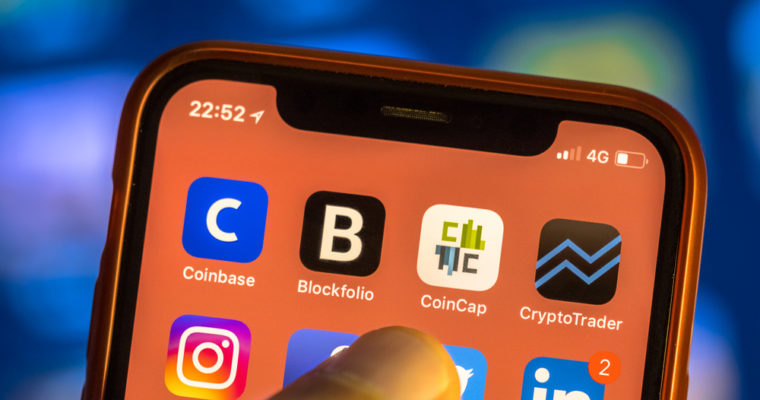
Six months after crypto exchange Coinbase’s app became the number one trending app on the App Store, Apple has now apps to provide wallet services under a caveat. “Apps may facilitate virtual currency storage, provided they are offered by developers enrolled as an organization,” the policy states.

Similarly, Apple is also allowing apps to facilitate crypto transactions “on an approved exchange, provided they are offered by the exchange itself.”

Finally, the world’s most valuable company has also mandated that apps do not offer cryptocurrency as rewards to users for completing tasks.

It states:

Cryptocurrency apps may not offer currency for completing tasks, such as downloading other apps, encouraging other users to download, posting to social networks, etc.

Images from Shutterstock.

Follow us on Telegram.
Advertisement

Published at Mon, 11 Jun 2018 17:06:19 +0000

bitcoin Services

Previous Article

ServAdvisor crowdsale opens 15. Sep 2018

Next Article

Dogecoin Uprocket Tank Top – Ladies Doge Coin Bitcoin Up Rocket Reddit Upvote Tank – Fashion Shirt Space Nasa Parody Rocket T-Shirt S M L XL

You might be interested in …

Taiwan’s New Central Bank Chief Uncertain of State Cryptocurrency

News – CCN Taiwan’s New Central Bank Chief Uncertain of State Cryptocurrency The new governor of Taiwan’s central bank has expressed “uncertainty” over cryptocurrencies’ function as a payment instrument. In a meeting with lawmakers this […]

A Beginner’s Guide to Claiming Your “Bitcoin Cash” (and Selling It)

BCH101sm.jpg

Please note: Everything in this article is just advice, based on our best understanding of the current situation. Everything is still very uncertain and subject to change: Be extremely careful!

bitcoin Cash (sometimes referred to as Bcash, and mostly using the tickers BCH or BCC) launched today. Anyone who held bitcoin at 12:20 p.m. UTC should have an equivalent amount of BCH attributed to their bitcoin private keys.

In our beginner’s guide to surviving the BIP 148 split, which was subsequently updated to also cover the bitcoin Cash launch, we explained how to secure your private keys so you could be sure to access your BCH. At the time of writing that article, much was still uncertain about how this event would play out.

Much is still uncertain, but to the extent that the situation can be understood at present, this article explains how you can claim — and potentially use — your BCH.

Author’s note: If you want to play the BTC/BCH markets as soon as possible, and you are fine with taking risks and/or you really know what you are doing, this article is probably not for you — it’s a beginner’s guide.

Take Your Time

The good news is that, if everything went according to plan, bitcoin Cash enforces strong replay protection. This means you shouldn’t be able to accidentally spend your BTC when you mean to spend BCH, or vice versa.

As such, if you don’t care about BCH at all right now, you don’t need to do a thing. You can just keep using bitcoin as you always have. If you ever change your mind (and don’t lose your bitcoin private keys in the meantime), you can still claim your BCH at any point in the future.

Likewise, if you want to hold on to your BCH long-term, you also don’t need to do anything right now. You can keep using BTC as if nothing happened; just make sure to never lose your private keys.

Now let’s assume you do care about BCH right now, at least enough to want to sell your share.

If you followed the advice outlined in our beginner’s guide, the good news is that you should be in full control of your bitcoin private keys. This means you now hold BTC as well as BCH.

The bad news is that it’s not necessarily easy or safe to claim your BCH straight away. If you are not careful, you may accidentally expose your private keys while claiming your BCH. And because these are the same private keys that secure your BTC, this could lead to your BTC being stolen. Needless to say, you want to avoid this! You almost certainly stand to lose much more from losing your BTC than you stand to gain from, say, selling your BCH fast.

Therefore, you are going to want to take your time and make sure you understand what you are doing well enough to do it without exposing your private keys. Your BCH isn’t going anywhere. And in part because the situation is still developing, even this article may contain accidental errors …

Claim Your Coins

In our previous beginner’s guide, we explained how to secure your private keys and recommended different wallet options. Here, you can find, per option, how to access your BCH.

Full Node Wallet

Our first recommendation was to use a full node wallet, like Bitcoin Core or Bitcoin Knots. These wallets store your private keys in a dedicated folder on your computer. You can make a backup of this folder using the menu in your wallet. Once you’ve done this, you should be able to import this backup into a bitcoin Cash full node, like Bitcoin ABC.

However, to be on the safe side at this point in time, we are not fully comfortable recommending any bitcoin Cash software. It is all very new, developed within a short timeframe, and the peer review done on all this software has probably not been as extensive as it usually is within the bitcoin space. It is therefore probably wise to not import your private keys in such software right away; instead, wait to see if there are any reports of problems.

Furthermore, some bitcoin Cash full node wallet software, like bitcoin ABC, conflict with bitcoin software, such as bitcoin Core. It is therefore not recommended to install a bitcoin Cash full node wallet on the same computer. Instead, it’s best to install it on a completely different computer. It is on this computer that you can import your wallet backup and have access to your BCH.

If you are not exactly a beginner, there is one alternative option. NBitcoin developer Nicolas Dorier created a splitting tool, which allows you to split your BTC from your BCH. However, this tool requires you to work in the command line of your operating system; if you know how to do this, you probably don’t need this article.

Paper Wallet

Our second recommendation was to use a paper wallet. This advice was given in the context of storing your coins long-term in particular. But if you want to access your BCH, of course you can do this right away.

Unfortunately, however, not many wallets actually support directly importing your private key(s) — and less so for BCH. One wallet that does allow for this option in bitcoin is Electrum. Therefore, the BCH version of Electrum, dubbed “Electron Cash,” should allow you to do this, too.

However, Electrum itself has issued an official warning concerning Electron Cash. Electron Cash is not properly vetted and therefore not guaranteed to work as advertised. This is a big risk, and we recommend against using it for now. (This may change in the future.)

That said, if you do choose to opt for this solution (at your own risk!), make sure to at least take two additional precautions. First, run the software on a different computer as the computer you run Electrum on, if you already run Electrum. (In fact, it’s probably best to use it on a different computer than the one where you hold any bitcoins or any other sensitive data, for that matter.)

Additionally, first move the BTC from your paper wallet to a new bitcoin address (like a new paper wallet) before you do anything with BCH. That way, even if the Electron Cash wallet manages to steal your private keys, the damage should be limited: these private keys won’t hold any BTC anymore. (Make sure not to send BTC to this address later on either, though.)

Hardware Wallet

Our third recommendation was to use a hardware wallet, as listed on bitcoin.org. Two of these hardware wallets in particular, Trezor and Ledger, have gone through the effort of offering you access to your BCH. So if you have one of these wallets, you’re in luck: this is probably the safest and easiest way to access your BCH.

Ledger has published a blog post explaining how to access your BCH, which you can find here.

Trezor has also published a blog post on how to claim your BCH, which you can find here. Update: Trezor has removed BCH for now, due to a bug in their bitcoin Cash backend server. Don’t worry, your funds are secure.

The third hardware wallet, Digital Bitbox, has published an FAQ on how to access your BCH. However, note that this wallet recommends using Electron Cash, which is not guaranteed to be secure. See the above section on paper wallets for more details.

The last hardware wallet, KeepKey, has also published a blog post on Bitcoin Cash. At the time of writing, it seems you won’t be able to access your BCH quite yet; keep an eye on their blog for updates.

Other bitcoin.org Wallets

If you didn’t take these three recommendations, perhaps you used one of the other wallets listed on bitcoin.org.

Once again, whichever of these wallets you used, your BCH should be safe and there’s no rush to claim them. But actually being able to claim them may differ a bit from wallet to wallet.

Most wallets use a recovery phrase. This phrase essentially holds your BTC private keys, and therefore also your BCH private keys. As such, you should be able to access your BCH by inserting this phrase into a dedicated BCH wallet.

However, at this point in time there are no BCH wallets available yet that allow this and which we can confidently recommend using. If BCH becomes somewhat of a success over time, this will probably change. It’s probably best to just wait until this is the case. (If it ever becomes the case.)

Until then, you can just keep using BTC without worrying about your BCH.

Other (Non-bitcoin.org) Wallets, Exchanges, etc.

If you did not follow our advice, and instead stored your BTC in any other wallet, or on an exchange, or anywhere else, you may or may not still be able to claim your BCH. In this case, you’ll have to figure out for yourself whether this is the case or not, and how to do so.

Using (or Selling) Your BCH

Once you have claimed your BCH, you can use it however you please. Just like any other (alt)coin, you could for example sell it for BTC, or perhaps spend it somewhere, or move it to another wallet, etc.

However, there are still three factors to keep in mind before doing so.

The first factor is privacy. Your addresses are identical for BTC and BCH. This means that whenever you spend your BCH (for example, to send them to an exchange), you do not only reveal your BCH addresses but also your BTC addresses. This can in turn reveal a lot about your current holdings as well as your past and future transactions, and can by extension even reveal such data about people or entities you have transacted with. Make sure you are comfortable with giving up this data if you are going to send your BCH to an exchange or anywhere else. (There may be more privacy-friendly options for selling your BCH for BTC in the near future, but these aren’t ready yet.)

The second factor is mostly theoretical at this point, but worth mentioning nonetheless:  security. When you spend from a BCH address, you do not reveal your private key, but you do reveal your public key (which is not the same as your bitcoin address). This strips away one layer of cryptographic security, even for your BTC (or BCH) addresses. It shouldn’t mean (and hopefully doesn’t mean) that your BTC are insecure right now, but there is an increased chance that your BTC aren’t secure at some time in the (far) future when this particular cryptographic standard is weakened. It is therefore best to move your BTC to a new address at some point within the next couple of years.

The third factor was already mentioned but bears repeating: if you’re using insecure software to claim your BCH, your BTC may be at risk. This is why it’s probably best to move your BTC to a new address before you even start meddling with BCH. That way, if you do mess up with insecure BCH software, you shouldn’t lose your BTC. (Though note that this doesn’t necessarily hold up if you send your BTC to a new address from the same seed. You may in that case even want to create a whole new wallet with a new seed.)

Additionally, if you move your BTC to one of your own addresses before touching BCH, you reduce the risk of replay attacks — but as mentioned, if all goes well this shouldn’t be a factor in the first place.

So, to Recap …

1. You don’t have to do anything if you don’t want to, and there is no rush. If your private keys are secure, your funds are secure.

2. If you want to use your BCH in any way, it’s probably best to first move your BTC to a whole new address that you control, or even an address generated from a whole new seed. (But don’t lose your old private keys or seed: these still hold your BCH!)

3. Once you know what you’re doing, move your BCH either to a new address you control or perhaps to an exchange to sell, or whatever it is you want to do with your “free money.”

This article will be updated as the news develops.

The post A Beginner’s Guide to Claiming Your “Bitcoin Cash” (and Selling It) appeared first on Bitcoin Magazine.