April 28, 2026

Capitalizations Index – B ∞/21M

5 Million Bitcoin May Have Been Lost Forever – Trustnodes

5 million bitcoin may have been lost forever – trustnodes

5 Million Bitcoin May Have Been Lost Forever – Trustnodes

5 million bitcoin may have been lost forever – trustnodes

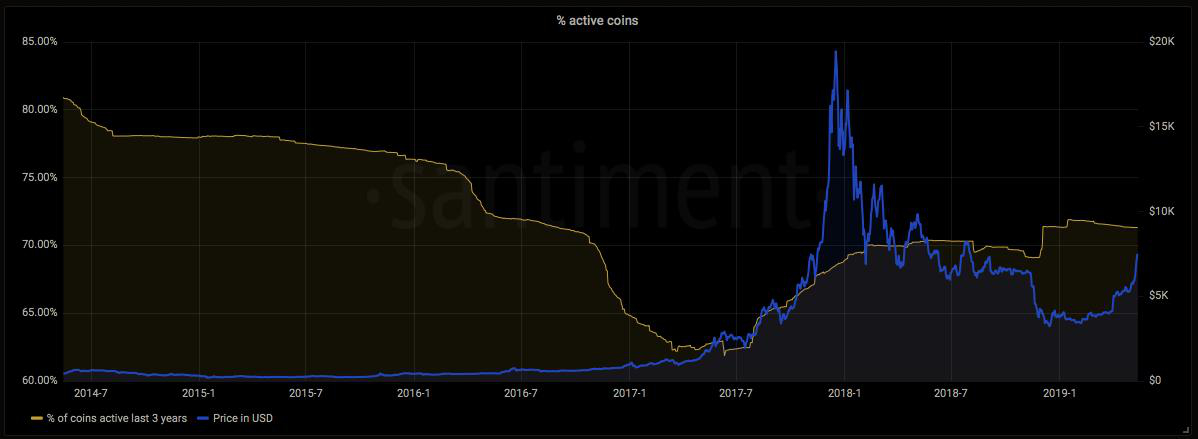
The percentage of bitcoin in circulation reached a low of 60% during summer 2017 and now stands at 70%.

Suggesting about 30% of all coins mined so far, circa 5 million, may have been lost forever.

In 2014, 80% of all coins circulated in a three years time-frame according to blockchain data from Santiment’s Valentin Mihov who says as coins are getting lost and locked, the percentage has dropped.

It is suggested Satoshi Nakamoto mined one million bitcoin which has not moved since. In addition, there may be small amounts of coins that are lower in value than the current transaction fee.

Such dust coins can likewise be considered as lost with circa 25,000 BTC at dust like values on-chain.

Far more important might be small amounts on exchanges that are effectively forgotten with an estimate there difficult to provide.

Then we’ve all heard that story of the hard-drive full of bitcoin thrown away because initially bitcoins were mineable on your laptop by just clicking a button. So they were kind of given out for free and didn’t have much value.

Just how many were discarded at that point is not very clear, but there were also coding errors where bugs would send the coins to an unrecoverable address. The known sums there are small though, about 2,000 BTC or so.

Then there’s the lost of private keys due to potentially many reasons. Someone must have forgotten it in their pocket, for example, and perhaps washed it out.

Now obviously people take a lot more care, but for some aspects there isn’t much you can do, like dust which is small in individual cases but adds up when combined.

Meaning bitcoin doesn’t quite have a fixed quantity, but a decreasing quantity. There are however a lot of zeros behind one bitcoin, but at some point it may be the case that even 1 satoshi is a rarity.

In a millennium perhaps because for the next century, new coins will continue to be generated, although at a decreasing rate with inflation falling not far from zero in 2024 and to less than 2% next year.

Copyrights Trustnodes.com

Published at Tue, 14 May 2019 14:10:42 +0000

Previous Article

Australia’s Cancer Faker Used Defrauded Funds to Secretly Trade Crypto

Next Article

Major Retailers Like Whole Foods Accept Bitcoin, Is This Enough To Convince No-Coiners?

You might be interested in …

Bitcoin is Still Illegal in These 6 Countries

As the bitcoin revolution continues to spread throughout the world, there are still some places where buying or using bitcoin is illegal and can get you in trouble.


bitcoin Still Illegal in Some Countries

As bitcoin’s popularity continues to grow throughout the world, some governments are beginning to realize its benefits and potential and are integrating bitcoin and cryptocurrencies in their economy, rather than trying to punish those that use it with restrictive policies and exaggerated taxes.

Japan, for example, has recently passed a law that makes bitcoin a legal form of online payment, removing taxes and setting up a regulatory framework for bitcoin-based businesses. Australia has also taken a stance in favor of cryptocurrencies and removed the double-tax that was penalizing average bitcoin users.

However, not all countries are as forward thinking especially when it comes to cryptocurrencies. Believe it or not, bitcoin is still illegal in some countries, which says a lot about bitcoin as a disruptive technology.

To be clear though, the world’s first decentralized cryptocurrency is not illegal because it poses any risk to the citizens of the countries we will list. Rather, it provides an alternative, open, P2P monetary system — and an exit for some  — which is seen as a threat to their centrally-controlled, legacy monetary system.

All of the countries listed below banned bitcoin in 2014, following the Mt. Gox disaster. As bitcoin begins to gain traction throughout the world, it’s possible that these countries may eventually change their stance on bitcoin and digital currencies.

Vietnam

Although bitcoin can be freely used by citizens, the State Bank of Vietnam issued a statement in February 2014 warning against the use of bitcoin and prohibiting credit institutions to deal with the cryptocurrency.

The statement reads:

All bitcoin exchanges that allow users to trade anonymously, therefore, can be used to launder dirty money, sell drugs, hide from paying taxes, exchange and pay for illegal activities.

In December 2016, the government of Vietnam stated that it will consolidate cryptocurrency regulations as its current provisions “fall short.”

Iceland

bitcoin’s legality in Iceland is not very clear. According to a statement issued in March 2014 by the Central Bank of Iceland, dealing with bitcoin may violate the Icelandic Foreign Exchange Act, which specifies that Icelandic currency cannot leave the country and that foreign currency cannot be used in the country.

iceland

bitcoin mining is legal in the country and so is transacting with bitcoin, but apparently if those Bitcoins cannot be purchased from a foreign exchange or have to be mined in Iceland. This leaves a lot of room for questions. The statement reads:

There is no authorization to purchase foreign currency from financial institutions in Iceland or to transfer foreign currency across borders on the basis of transactions with virtual currency. For this reason alone, transactions with virtual currency are subject to restrictions in Iceland.

Bolivia

In May 2014, the country’s central bank, El Banco Central de Bolivia, officially banned any and all currencies not issued and/or regulated by the government, specifying bitcoin, a few other altcoins and any other currencies that do not belong to a state or economic zone.

The statement reads:

It is illegal to use any kind of currency that is not issued and controlled by a government or an authorized entity.

Ecuador

Ecuador not only banned bitcoin and all other cryptocurrencies, but it did so while establishing guidelines for the creation of their own virtual currency.

The National Assembly of Ecuador passed a bill that amends the country’s monetary laws in July 2014, banning cryptocurrencies and allowing the government to issue and transact in its asset-backed “electronic money.”

Kyrgyzstan

In Kyrgyzstan, using bitcoin as a form of payment is illegal, although no law prohibits users from buying, selling and using. In August 2014, the National Bank of the Kyrgyz Republic, issued a statement in which it noted that the use of bitcoin and other cryptos as a form of payment is illegal given that the only legal tender in the country is the country’s Kyrgystani Som (KGS).

The statement reads:

Under the legislation of the Kyrgyz Republic, the sole legal tender on the territory of our country is the national currency of Kyrgyzstan som. The use of ‘virtual currency’, bitcoins, in particular, as a means of payment in the Kyrgyz Republic, will be a violation of the law of our state.

Bangladesh

bitcoin is not legal in Bangladesh. Transacting with any type of decentralized cryptocurrency can get you up to 12 years in jail and it has been so for almost three years.

In September 2014, the Bangladesh Bank issued a statement regarding the use of bitcoin and warning that it is punishable by law. Bank officials said that anyone found guilty of dealing with bitcoin or any other cryptocurrency could be jailed for up to 12 years under current anti-money laundering laws. The central bank went as far as to request citizens not to “spread information about it.”

The statement reads:

bitcoin is not a legal tender of any country. Any transaction through bitcoin or any other cryptocurrency is a punishable offense.

Do you believe these countries will change their stance on bitcoin and build a regulatory framework around it? Let us know in the comments.


Images courtesy of Shutterstock

The post Bitcoin is Still Illegal in These 6 Countries appeared first on Bitcoinist.com.