Crypto markets in massive correction; XRP, Stellar, Cardano, bitcoin Cash, BSV and Tron getting smashed.
A crypto correction has been on the cards for some time and it has finally arrived this morning. dumped almost a thousand bucks and shrunk by $32 billion in a matter of hours.
After spending most of the day in the $8,000 range plunged to a low of $7,175 in less than an hour. The triggered a market wide selloff with getting hit harder as usual. At the time of writing had recovered a little to $7,300 but further losses are expected. Analysts are eyeing the $6,400 level as support and a new buying zone.
slid back to $240 in a 7 percent slide which was not as severe as many of the others. Over the week ETH is still in a strong position having passed $200 for the first time since November last year. Such a rapid surge is always followed by a pullback which is what we are seeing today.
The top ten is awash with red at the moment as all of the come crashing back down. Many are getting hit hard including XRP, and dumping 14 percent each. Also in bad shape are Cash, , and Coin all dropping over 10 percent a piece.
Losses are even more severe in the top twenty where SV has been smashed 18 percent. is also in with a 16 percent dump while , Dash, and NEO have all lost over 10 percent on the day. Only Tezos has survived as it actually adds a little today while all around it have collapsed.
FOMO: Chainlink Alone in The Green
Only one is bucking the trend today and making a gain. Chainlink has added 7 percent on the day to reach $0.884. The mainnet launch on on May 30 appears to be the only thing driving momentum for LINK at the moment. The only other cryptos in the green right now are stablecoins as everyone is dumping their alts.
There are too many double digit dumpers to mention but those getting hurt the most are IOST, Golem, Pundi X and Ontology.
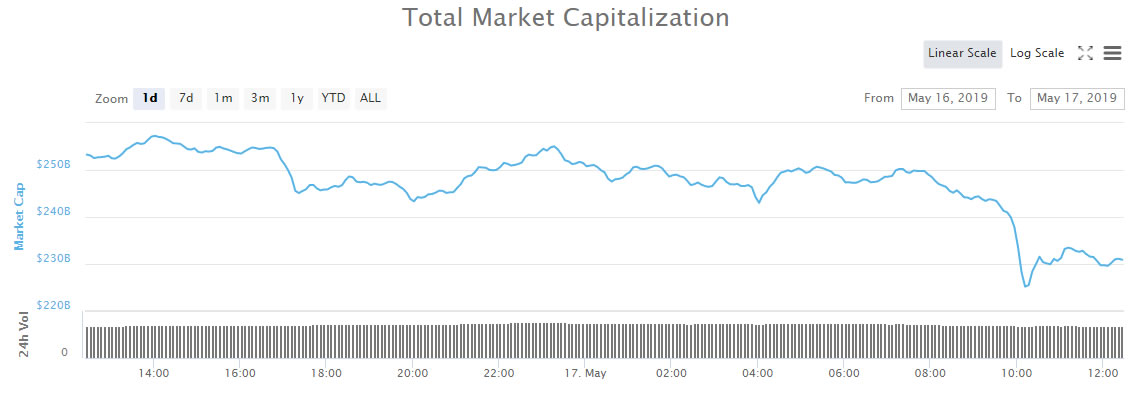
Total market capitalization 24 hours. Coinmarketcap.com
A whopping $32 billion has been dumped out of crypto markets as they fell back to $225 billion a few hours ago. The epic 12 percent slide is one of the largest dumps of the year but it has not been entirely unexpected. At the time of writing markets had recovered back to $230 billion which is still 20 percent higher than this time last Friday.
Market Wrap is a section that takes a daily look at the top during the current session and analyses the best-performing ones, looking for trends and possible fundamentals.
Elon Musk joins Dogecoin bandwagon; steps down after being ‘elected’ its ‘CEO’ April Fools’ Day saw the cryptocurrency community, including major crypto-projects and proponents, embracing the whimsies of the day. Elon Musk and his affair […]
Remember that time I said BTC-USD likely won’t see a new all time high (ATH) any time soon? Looks like I was wrong. Shortly after posting my previous BTC-USD analysis, in a matter of one hour, the price of BTC-USD not only broke its record high, but it surpassed it by $200 after ultimately settling in the $3200s. As of this morning, BTC-USD pushed another ATH of $3440 on Bitfinex marking a $600+ in less than a week. Let’s take a look at what these moves can possibly mean for BTC-USD and if these moves are sustainable.
Starting in the $160s, BTC-USD has been on a massive, multi-year bull run:
Figure 1: BTC-USD, 3 Day Candles, Bitfinex, Macro Bull Trend
If we plot the trend using $3440 as the top of this trend, a lot of historic support and resistance levels start to make a lot more sense within the context of the market. Our move to the $1800s marked a test of the 50% retracement line, our battle over the $2600s marked the various tests of the 23.6% retracement line and now our ultimate sudden rush to new highs can be seen as the 100% retracement line.
Keeping the same Fibonacci Retracement Lines and zooming into our daily trend, a few observations immediately pop out:
Figure 2: BTC-USD, 1 Day Candles, Bitfinex, Macro Bull Trend, Zoomed In
There is an obvious price increase on the long-term trend;
Our recent run from $1800, however, has seen decreasing volume on every leg up;
The multi-period MACD and current MACD histogram both show Bearish Divergence; and
The RSI is showing Bearish Divergence.
If we take a closer look to the market post-$1800s, we see a similar trend of divergence even on the smaller timescales:
Figure 3: BTC-USD, 6 Hour Candles, Bitfinex, Current ATH
The uptrend in price is, once again, accompanied on decreasing volume;
The 6HR is strongly diverging bearishly;
The RSI is showing strong bearish divergence; and
The 6HR Bollinger Bands show several candles fully formed outside the upper band (shown in the circle).
For those who are unfamiliar with Bollinger Bands: Simply put, they are a strong tool used to visualize market volatility. Typically, when a market is near the edge of the upper band, it is considered “overbought,” and when it nears the edge of the lower band it is considered “oversold.” When a market punctures a band it will typically yield a pullback to a trend within the bands, and when a candle is completely formed outside the bands it is usually a strong sell or buy signal — a sell signal in our case. You can think of the Bollinger Bands like a set of rubber bands: the tighter you stretch a rubber band, the harder the reaction. Typically, this is the case for markets that puncture the bands and especially for those that fully form candles outside the bands.
Looking at our current Bollinger Band trend, one might be tempted to say, “BTC-USD appears to be pulling back within the 6-Hour Bands — looks like a healthy move upward is still in the cards.” However, if we zoom out and look back through the history of BTC-USD and its interaction with the 1-Day Bollinger Bands, we can see a clear market trend.
Figure 4: BTC-USD, 1 Day Candles, Bitfinex, Bollinger Band Trend
Above are several historic examples of BTC-USDs reaction to a puncturing of the 1-Day Bollinger Bands. More often than not, a puncturing of the bands — whether the lower or upper band — is greeted with a market pullback. The stronger the break of the bands, the stronger the pullback. The strongest breaks of the bands have a very strong tendency to return to the middle line of the Bollinger Bands (the dashed line) before continuing its trend up or down.
If there is so much damning evidence of a pullback, why does the price keep rising? Fear of Missing Out (FOMO) is unpredictable and irrational. FOMO can push markets well beyond what Technical Analysis can predict and often defies market indicator signals. With all the hype surrounding the recent hard fork, and the influx of money coming from people cashing out their bitcoin Cash where does this leave us? There is a mountain of evidence suggesting this market level is unhealthy and highly overextended; it needs either to consolidate considerably or retrace. BTC-USD is tightly wound and there is very little, if any, sign of health within its most recent market moves.
I’m not saying the market won’t continue to the pump even higher than it is currently — Goldman Sachs has a price target of $3600, after all. However, with each hike in the BTC-USD price, we are increasing the likelihood of a strong pullback and ultimately a return to the center of the Bollinger Bands.
Summary:
On all relevant timescales, BTC-USD is showing strong signs of an overextended market.
The Bollinger Bands have several candles fully formed outside the upper bands on the 6 HR, 12 HR and 1 Day Candles.
Historically, when the 1 Day Bollinger Bands are punctured, there is a market pullback.
Trading and investing in digital assets like bitcoin, bitcoin cash and ether is highly speculative and comes with many risks. This analysis is for informational purposes and should not be considered investment advice. Statements and financial information on bitcoin Magazine and BTC Media related sites do not necessarily reflect the opinion of BTC Media and should not be construed as an endorsement or recommendation to buy, sell or hold. Past performance is not necessarily indicative of future results.
Cointelegraph.com News International Crypto Standards: Will They Come From the Community or Governments? International standards for crypto are on their way, but they may not stop government regulation more info…