July 4, 2026

Capitalizations Index – B ∞/21M

Ethereum Price Jumps to 8-Month High After Bitcoin Plunges $645

Ethereum price jumps to 8-month high after bitcoin plunges $645

Ethereum Price Jumps to 8-Month High After Bitcoin Plunges $645

By CCN: bitcoin’s breathtaking rally has dominated the headlines in recent weeks, but today it’s the second-largest cryptocurrency’s turn to enjoy the spotlight. The ethereum price surged as high as $281.77 on Thursday, launching ETH to an eight-month high.

Ethereum Price Finally Joins the Crypto Party

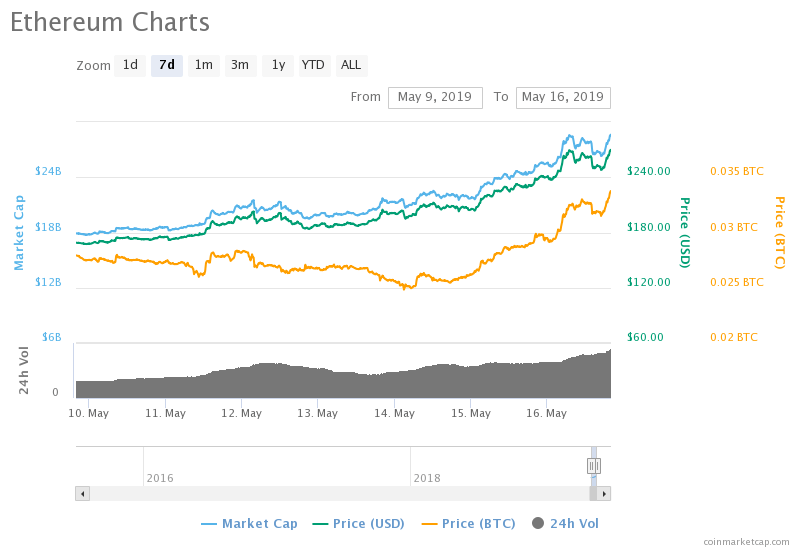
The cryptocurrency asset witnessed massive capital influx into its market when its frontrunner bitcoin began to correct from its overbought territory. The inverse correlation signified that bitcoin investors were hedging into the ether market, a theory further validated by ETH’s 16% appreciation against bitcoin in the last 24 hours, as shown in the chart below.
Ethereum price chart

The ethereum price rose more than 15% against bitcoin. | SOURCE: COINMARKETCAP.COM

The bitcoin price, as CCN reported, doubled during a breakneck 45-day bull run, bringing its gains for 2019 to an impressive 119.26%. The move allowed the cryptocurrency to break above several crucial resistance targets, the last being $8,000, to reclaim a nine-month high of $8,391 on Bitstamp.

The ethereum price, meanwhile, held relatively flat. The cryptocurrency failed to catalyze a massive rally like bitcoin did – at least until May 11 when it suddenly popped more than 20%. The surprise upside movement matured into a full-fledged interim bull run, and ETH ultimately soared 63.59% in just six days.

Notably, the bitcoin price corrected lower today, plunging more than 7.5% to an intraday low at $7,746. As of the time of writing, BTC/USD stood at $7,941 for a daily loss of around 2%.

Hardly Any New Money is Entering Ethereum

Ethereum’s sudden boom prompted many in the crypto media establishment to give credit the cryptocurrency’s improving fundamentals. The blockchain project received boosts from both Microsoft and JPMorgan, each of whom has interfaced with ethereum to various degrees. However, the majority of new money that entered the ETH markets came from other cryptocurrencies – not fiat.

The volume report of the past 24 hours showed that ETH/USD markets accounted for just 5.5% of all ethereum trading. Similarly, euro markets recorded just 1.13% of overall ETH volume.

More than 50% of all ethereum trading volume came from BTC and tether (USDT) markets, suggesting that traders were merely cashing in on arbitrage opportunities between bitcoin, ethereum, and various altcoins rather than bringing new money into the cryptocurrency market.

Disclosure: The author holds bitcoin, bitcoin cash, ethereum, litecoin, XLM, and BNB in his portfolio.


Published at Thu, 16 May 2019 19:40:22 +0000

Previous Article

CoinBene Weekly Report –13 May to 17 May 2019 – CoinBene Global –

Next Article

$32 Billion Gone In Biggest Dump of The Year

You might be interested in …

Malaysian Government to Introduce Regulatory Framework for Cryptocurrencies

After China and South Korea started cracking down on cryptocurrencies and altcoin exchanges, a new report states that the Malaysian government is preparing a regulatory framework for cryptocurrencies. 


More Cryptocurrency Regulations


A few months ago, news emerged that the Chinese regulatory body imposed bans and regulations regarding cryptocurrency activities. The ban mainly focused on Initial Coin Offerings or ICOs, because regulators feared that some of them may have been fraudulent. Regulators demanded that the token sale operators refund their investors and immediately cease activities until further notice.

Shortly after the Chinese financial regulatory body banned ICOs, South Korea’s Financial Services Commission declared a country-wide ban on all ICOs and token sales. Some experts believe that the bans were appropriate so regulators can better understand the ICO market and its mechanism. The Chinese government regulators also warned certain bitcoin and cryptocurrencies exchanges to close down their operations until proper regulatory mechanisms are properly installed. Regulators do not only want to protect consumers but they also want to stop money laundering and terrorist financing operations with appropriate KYC/AML procedures.

Malaysia's  Regulatory Framework

Malaysia’s  Regulatory Framework

Recently, an article by Reuters suggested that Malaysia is also planning to introduce its own regulatory framework for cryptocurrencies. Governor Muhammad Ibrahim stated in a financial summit that through the new regulatory framework, individuals that convert cryptocurrencies into fiat money will be declared “reporting institutions”. This would require financial institutions to properly audit each exchange from cryptocurrencies to fiat, in order to appropriately detect any illegal activities.

Ibrahim stated:

This is to prevent the abuse of the system for criminal and unlawful activities and ensuring the stability and integrity of the financial system,

He also added:

Any information that we have that is relevant to the security of our friends in the region, we will share. My expectation is that will be reciprocated,

Malaysian regulators fear that cryptocurrencies may be used to finance terrorism-related groups and its operations. There have been previous incidents were terroristic groups used bank transfers to finance their illegal activities.

What are your thoughts on Malaysia’s upcoming regulatory framework for cryptocurrencies? Do you think that cryptocurrency users may benefit and be protected by the framework? Let us know in the comments below!


Images courtesy of Pixabay, The Malaysian Reserve

The post Malaysian Government to Introduce Regulatory Framework for Cryptocurrencies appeared first on Bitcoinist.com.