
The developers who created the bitcoin Cash-centric wallet Yenom have revealed the team has been working on an interesting protocol for the BCH ecosystem. On Oct. 21, Yenom developer Shun Usami published a wallet scheme called the Deep Link Payment Protocol, a communication system that allows users the ability to simply click a link on a website to pay for a product in bitcoin cash.
Also read:
The Deep Link Payment Protocol
developers Shun Usami, Taiki Uchida and Aoi Serikawa have a new wallet scheme for the global bitcoin Cash network. The proposal called the (DLPP) is a deep link scheme system tethered to a wallet application with a callback URL. The concept is similar to the a URI formula that allows users to pay for products by simply clicking a link. In essence, the deep link scheme proposed by the Yenom programmers offers a communications equivalent between the wallet and other applications.
“When the wallet application completes the requested behavior, the wallet pings the callback URL,” explains Usami’s proposal.

Other Examples of Payment Protocols Indicate Far Less Room for Error
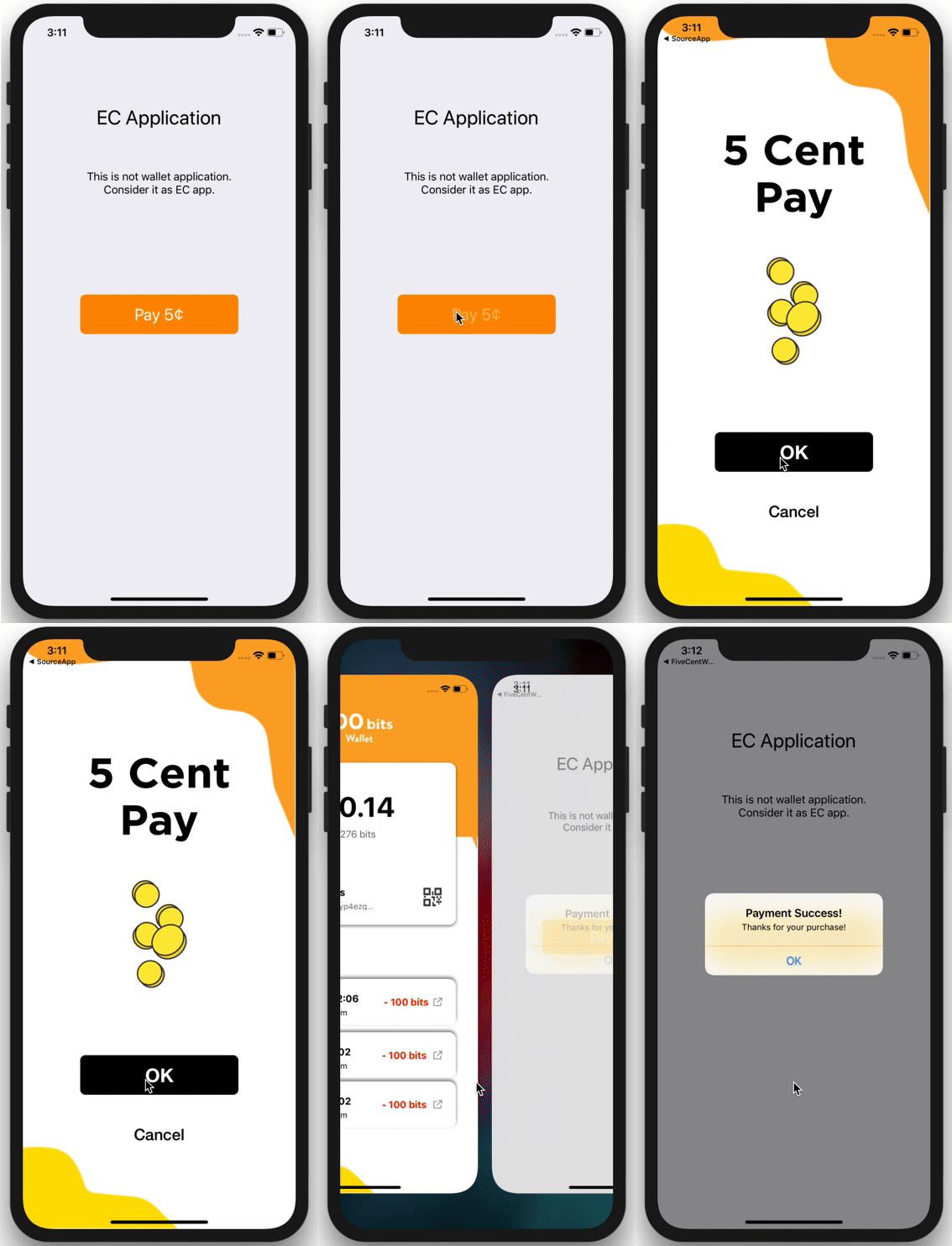 The DLPP specifications detail that the current experience with mobile wallets is not user-friendly and cryptocurrency payments take far more steps than they should. For instance, traditionally cryptocurrency wallet owners have to copy the address, open the wallet, paste the address, type the precise amount, and then authorize the payment. With the DLPP scheme, the payment link is opened inside the wallet software, and all the user has to do is confirm the payment. The Yenom developers believe the protocol is simple and an alternative design method similar to could also be used. An instance of this method being used in the wild is Bitpay’s payment protocol (a version of BIP , and ), and Bitpay recently the method has led to far better efficiency.
Additionally, the Yenom programmers explain the protocol specifications allow forward compatibility. “Adding optional parameters can be done by simply adding them — Adding required parameters or a destructive change can be done by simply changing the type name to new one,” the DLPP scheme details. As long as the mobile clients don’t act on a URL callback without consent from the wallet owner, the protocol can essentially remove three of five steps that are usually required by traditional wallets. According to the Yenom team, a DLPP reference implementation is coming soon.
What do you think about the Deep Link Payment Protocol proposed by the Yenom developers? Let us know what you think about this idea in the comments section below.
Images via Shutterstock, Twitter, hackmd.io, and Yenom
Want to create your own secure cold storage paper wallet? Check our section.
The post appeared first on .
With the development of digital technologies, investors have more and more opportunities to pump money into various projects. Currently, the crypto market sees the growing interest in stablecoins — cryptocurrencies pegged to a stable asset, such as gold or fiat currencies. While not any exchange is ready to trade this kind of currency, some are enhancing popularity of stablecoins by adding support for them. The prime example is which is actively to list more stablecoins in addition to the three it already supports.
Until recently, issued by Tether Limited was stablecoin number one. But now its status is experiencing challenge, as other stablecoins are entering the crypto arena. Over 50 active stablecoin projects have already emerged around the world, and more are expected to debut.
Recently, Tether experienced a downturn, followed by a sudden investor exodus that took more than $300 million out of the market. At the moment of writing, the price of USDT makes up $0,98 per coin, which is 0,11% lower than 24 hours ago. Tether has quite a controversial nature, that’s why not all crypto enthusiasts are ready to trust this coin.
New Leaders in the Stablecoin Sprint
Currently, arch-rival of Tether is Paxos Standard’s coin which is pegged to the US dollar and uses the Ethereum ERC20 protocol.
Paxos Standard (PAX) was created by Paxos, a financial technology company on a mission to modernize finance by mobilizing assets at the speed of the internet. Paxos was the first virtual currency company to receive a charter from the New York State Department of Financial Services. Launched in September of this year, PAX is fully collateralized 1:1 by the U.S. dollar.
Charles Cascarilla, CEO and co-founder of Paxos, said:
“Paxos Standard gives financial markets the power to transact in a fully USD-collateralized asset with the benefits of blockchain technology and oversight from financial regulators. We believe that Paxos Standard represents a significant advancement in digital assets, leveraging the oversight and stability of the traditional financial system and enabling a frictionless global economy…In the current marketplace, the biggest hindrances to digital asset adoption is trust and volatility. As a regulated trust with a one-to-one dollar-collateralized stablecoin, we believe we are offering an asset that improves on the utility of money.”
Recently, Paxos Stable token was added to OKEx and Huobi. The stablecoin offers all the Tether’s capabilities plus decentralised accounting function and the supervision of financial regulators as a fully regulated asset, that’s why some experts see PAX as a major alternative to USDT.
Being the leading stablecoin of the chasing pack behind Tether, PAX is currently traded at $1,01 and has a market capitalisation in the amount of $41.94 million, according to . Over the seven day period of time, Paxos Standard Token is -3.16 percent against the USD.
Tether still has a market capitalisation of $2 billion, which is several times more than its nearest challenger. However, Pax has all chances to catch up the leading stablecoin, well, time will show.
The post appeared first on .

![Re: [wts] authentic gopro cameras | cheap | safe |](https://ohiobitcoin.com/storage/2017/04/usV0gD.jpg "Re: [wts] authentic gopro cameras | cheap | safe |")