
April 26, 2026

Capitalizations Index – B ∞/21M

Yale Economists Share Strategies to Strongly Forecast Bitcoin Returns

Yale economists share strategies to strongly forecast bitcoin returns

Yale Economists Share Strategies to Strongly Forecast Bitcoin Returns


Yale
Advertisement

At the time when the cryptocurrency industry has recorded a loss of more than $30 billion, two Yale economists believe traders can strongly forecast the volatile market using “potential predictors for cryptocurrency returns.”

Aleh Tsyvinski and Yukun Liu published a new study, titled “Risks and Returns of Cryptocurrency,” after researching factors that could accurately predict the cryptocurrency returns. The study found that cryptocurrencies have low exposure to the macroeconomic factors that usually influence stock, currency, and commodity markets. However, there are still some strategies that are common to both traditional and cryptocurrency price trends.

To find them, Tsyvinski and Liu analyzed the historical data of top coins, including bitcoin, Ethereum, and Ripple, and eventually determine two key factors that could predict the market’s next trend. They are called “Momentum Effect” and “Investor Attention Effect”.

Momentum Effect: Up means Up, Down means Down

The Yale economists investigated the daily and weekly frequencies of bitcoin, Ethereum, and Ripple price actions, and what they believe to be a meaningful tool to predict bitcoin price trends – the “time-series cryptocurrency momentum.”

In general, the momentum effect compares trends with their timeframes. For instance, a substantial price weekly rally – over 20% – should be taken as a sign to purchase the cryptocurrency. A trader, then, should hold the asset for at least a week before selling it at a profitable margin. Similarly, an extended downside momentum – again weekly – should be taken as a sign to quickly exit the market, before the risk intensifies.

“Momentum is actually something simple,” Tsyvinski told CNBC. “If things go up, they continue to go up on average, and if things go down, they continue to go down.”

Investor Attention Effect: Social Trends

The Yale study constructed the deviation of Google Searches for the keywords “Google,” “Ripple,” and “Ethereuem” and compared the weekly outcome with their respective price data. The average increase in the social media queries for each asset indicated that the price of the asset will increase in the coming weeks.

Similarly, negative investor attention consorting with keywords like “bitcoin hack” predicted a decrease in price.

A Twitter-based research also assisted the study. Tsyvinski and Liu that the increase in the number of posts about bitcoin on Twitter predicted an upside in the coming weeks.

“A one-standard-deviation increase in the Twitter post count for the word “bitcoin” yields a 2.50 percent increase in the 1-week ahead bitcoin returns,” the paper revealed.

Data Output of bitcoin, Ethereum and Ripple

The study compared the statistics of bitcoin on the daily, weekly, and monthly basis, and also compared to those of currencies, stocks, and commodities. It found that “at the daily frequency, the mean return [was] 0.52 percent and the standard deviation [was] 5.55 percent; at the weekly frequency, the mean return [was] 3.79 percent and the standard deviation [was] 16.64 percent; at the monthly frequency, the mean return [was] 21.60 percent and the standard deviation [was] 69.46 percent.”
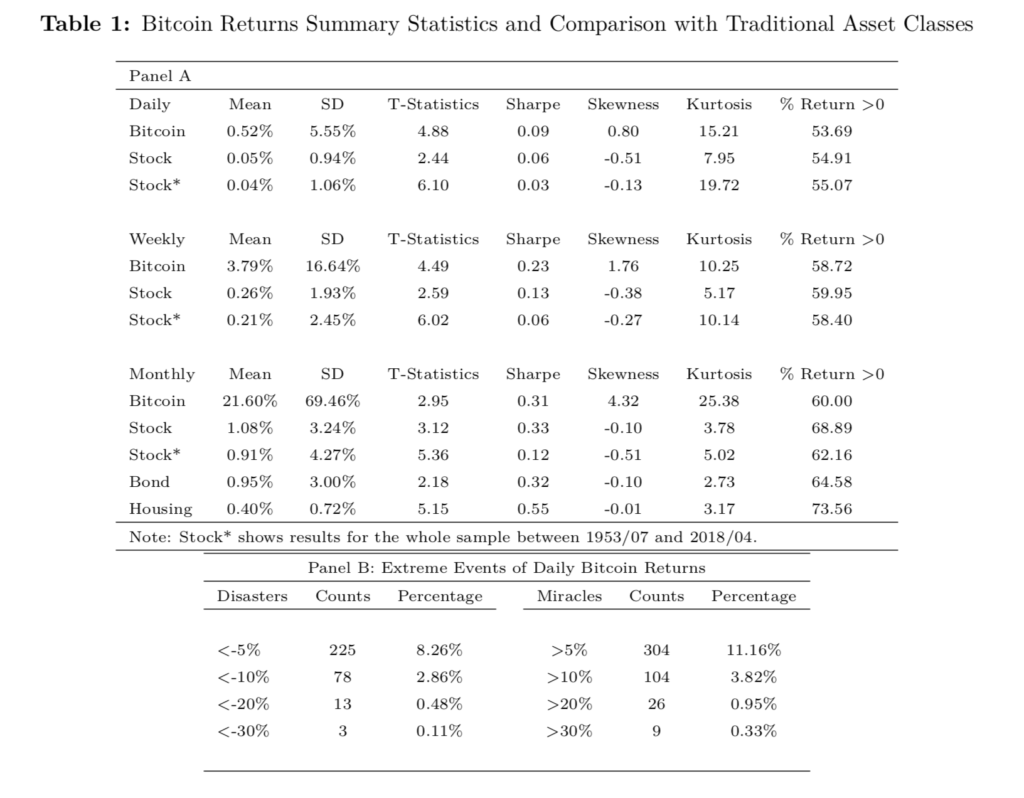
Yale economists share strategies to strongly forecast bitcoin returns
Pictured: an image excerpt from the yale study, “risks and returns of cryptocurrency. ”

Overall, the magnitude of the outcomes derived from bitcoin statistics was higher than those for traditional asset classes.

As for Ripple and Ethereum, their returns had a higher mean return and standard deviation than those of bitcoin. However, their Sharpe ratios, the average profit earned, was somewhat comparable to the Sharpe ratios of bitcoin returns.

Featured image from Shutterstock.

Follow us on Telegram or subscribe to our newsletter here.
Join CCN’s crypto community for $9.99 per month, click here.
Want exclusive analysis and crypto insights from Hacked.com? Click here.
Open Positions at CCN: Full Time and Part Time Journalists Wanted.

Advertisement


Published at Thu, 09 Aug 2018 17:11:21 +0000

Altcoin News[wpr5_ebay kw=”bitcoin” num=”1″ ebcat=”” cid=”5338043562″ lang=”en-US” country=”0″ sort=”bestmatch”]

Previous Article

Great crypto better than iota?

Next Article

50 ICO Projects Show Interest in Thailand’s New Crypto License

You might be interested in …

Bitcoin Cash Network Shrugs off Mempool Backlog With Relative Ease

Network congestion is a problem most users would associate with bitcoin or Ethereum. Both of these networks have seen their fair share of issues in this regard. bitcoin Cash saw its transaction backlog grow quite spectacularly this morning. For several hours, someone – or a group of people – were flooding the network with very low-fee transactions. As a result, there was a minor delay in transactions, although things were well within the acceptable limits.  Why any of this is happening right now, has yet to be determined.

bitcoin Cash has not been subject to major spam attacks as of yet. bitcoin, on the other hand, seems to get clogged up with transactions every other week. Keeping this in mind, it’s not surprising to see so many people flock to BCH in recent weeks. This has caught the attention of whoever is responsible for the current “spam” on the BCH blockchain. More specifically, there have been a ton of new transactions to fill up the blocks rather quickly. A rather worrisome development, although things were handled relatively well.

bitcoin Cash Handles the Business

The big question is why anyone would flood the BCH network with low-fee transactions. At a price of 1 Satoshi per byte, inflating overall fees would be rather difficult. After all, users can easily pay double that and not have their transactions delayed. Even with the higher fee, Bitcoin Cash remains a lot cheaper than BTC right now. With this cost in mind, it would cost approximately $16,000 to flood the network for an entire day. That doesn’t seem like much money, thus it is possible this is a well-orchestrated attack. For now, there is no solid evidence to back up such claims.

Unlike what one would expect, this issue has not caused many problems. The bitcoin Cash mempool has been cleared relatively quickly and things are returning to normal. If this was an attack, it was a very weak attempt at causing permanent damage. If such an issue were to affect bitcoin, the fees would skyrocket and transactions backlogged for 24 hours or more. Having a larger block size can be rather beneficial in this regard. It also shows how BCH is better at scaling compared to bitcoin, at least for now.

Whether or not this is a prelude to more attacks, remains to be seen. No one will be surprised to see issues like these arise again in the future. The “fight” between BTC and BCH supporters is far from over Although it’s not exactly a turf war, hostilities are not entirely uncommon either. Attacking a network with low-fee transactions is despicable We don’t know if that is what has happened to bitcoin Cash, though. In the end, the issues seem largely resolved, which is a positive sign.

Header image courtesy of Shutterstock

The post Bitcoin Cash Network Shrugs off Mempool Backlog With Relative Ease appeared first on NewsBTC.