September 25, 2026

Capitalizations Index – B ∞/21M

World Gold Council: Cryptocurrencies Pale Compared to Gold

World gold council: cryptocurrencies pale compared to gold

World Gold Council: Cryptocurrencies Pale Compared to Gold

World gold council: cryptocurrencies pale compared to gold

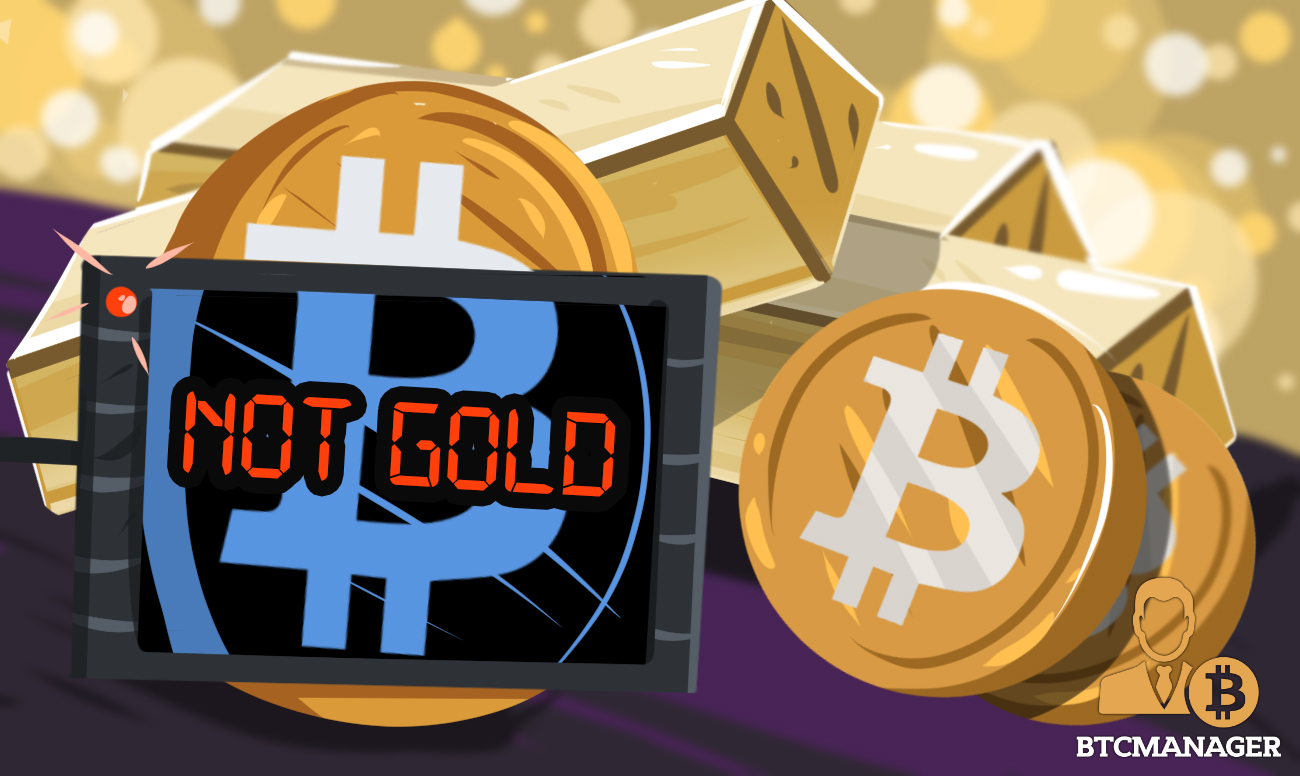
Answering whether or not cryptocurrencies can potentially replace gold, Adam Perlaky, Manager of Investment Research at World Gold Council, compared recent stats of both assets. In a blog on May 2, 2019, he opined that cryptocurrency is a promising technology, but far from being a match to gold.

Innovative Technology, But…

There have long been discussions about the potential of cryptocurrencies, especially bitcoin,  becoming an asset that can surpass gold as an investment. It was reported in January 2019 that the Winklevoss twins had expressed their confidence in bitcoin taking over gold in terms of value as well as significance.

Addressing similar opinions of the crypto community and questions related to these, Adam Perlaky wrote in his blog post that gold and cryptocurrencies are separated by huge differences and that cryptos do not pose any such characteristics, either in theory or in practice, to be able to replace gold. He justified his thoughts by comparing cryptocurrencies and gold under properties such as volatility, liquidity, regulatory compliance, demand, supply, safety, etc.

The extreme volatility of cryptocurrencies, he wrote, “disrupts its use as a medium of exchange and discourages strategic investments .” Furthermore, gold trades $150 billion a day, which is 100 times more than that of bitcoin trades, and it has existed since 600 BC, while cryptos are merely a decade old. Also he noted that the lack of regulation has brought down the trust in cryptocurrencies.

As a conclusion, Perlaky wrote that while cryptocurrencies and blockchain technology might have a huge role to play in the future, cryptos cannot replace gold and “gold should remain a component in all investment portfolios.”

Bitcoiners Investing in Gold

The fear of missing out on the cryptocurrency bull run is very real amongst investors, as has proved to be the fear of losing it all during the crypto blood bath. On January 28, 2019, BTC Manager reported that CEO of Van Eck Associates, Jan Van Eck, had revealed that their survey of 4,000 bitcoin traders found that following the bitcoin price slump, most crypto investors had started seeking resort in gold investments and considering it as their number one investment.

The result of the survey could be considered proof that cryptocurrencies are actually far behind gold when it comes to value, trust, and significance. But the question still remains as to what the future holds for cryptocurrencies, as they are not exclusively investment assets. 

Like BTCMANAGER? Send us a tip!
Our bitcoin Address: 3AbQrAyRsdM5NX5BQh8qWYePEpGjCYLCy4

Published at Mon, 06 May 2019 10:00:59 +0000

Previous Article

Dominant Bitcoin Slips on Monday, Drags Cryptocurrency Index Down $8.7 Billion

Next Article

Crypto Market Nearing Key Support: Bitcoin Cash, XLM, EOS, TRX Price Analysis

You might be interested in …

Blue - legends never die // jurassic world

Blue – legends never die // Jurassic World

Blue – legends never die // Jurassic World SPOILER!!! DONT WATCH THIS IF YOU HAVENT SEEN JURASSIC WORLD 2!! _________________________________________________ Movie: Jurassic World 1 + 2 Song: Legends never die – [Alan Walker Remix] | […]

The Birth of BCH: The First Crazy Days of “Bitcoin Cash”

BCH1-3.jpg

August 1 saw the birth of a brand-new cryptocurrency: “Bitcoin Cash,” sometimes referred to as “Bcash” and using the currency tickers “BCH” or “BCC.” bitcoin Cash shares a history with bitcoin, but yesterday it forked off to form its own blockchain and currency.

Here’s the story so far.

The Fork

bitcoin Cash, initially defined by the Bitcoin ABC software implementation, was set to fork on August 1 at 12:20 p.m. UTC. Though in reality, because of how bitcoin nodes measure time, the actual fork happened a little bit later.

Starting right when bitcoin block 478,558 was found around 12:35 p.m. UTC, bitcoin miners and bitcoin Cash miners started looking for a different kind of block, each following their own protocol. Unsurprisingly, a bitcoin miner was the first to find one, marking the first block that was rejected by all bitcoin Cash nodes. This effectively realized the “split,” even though no new bitcoin Cash block had yet been found.

Since there weren’t very many bitcoin Cash miners on a network that did maintain bitcoin’s mining difficulty requirements, this first BCH block did not come fast. It took almost six hours, at about 6:15 p.m. UTC, until Chinese mining pool ViaBTC found the first bitcoin Cash block. This, for many, made the “split” official.

At the time of writing, the fork seems to be more or less successful, depending on how “success” is defined in this context. While there were some concerns about the peer-to-peer network — bitcoin ABC nodes initially appeared unable to reach one another — these problems have seemed to resolve over time. And safety precautions like replay protection and wipeout protection seem to be enforced as well.

That said, infrastructure support for BCH is still very limited. Very few wallets and other bitcoin services have adopted the new cryptocurrency so far — this could of course change in the (near) future.

Hash Power Issues

The bigger problem is probably that hash power on the bitcoin Cash chain started out low and has remained low. As a result, confirmation times are extremely slow, often taking hours.

This should improve over time, especially because bitcoin Cash implemented a new difficulty algorithm designed to adjust back to normal faster. However, even with this algorithm, it could take weeks before blocks are found at typical ten-minute block intervals.

Additionally, this difficulty adjustment algorithm could incentivize odd miner behavior. It has been speculated, for example, that miners intentionally mined no blocks for over 12 hours today, as that would help them get back to normal faster. And, notably, similar incentives would exist even once difficulty readjusts to normal on the bitcoin Cash chain.

Market Behavior

As expected, price discovery has been very volatile during these first couple of days. And perhaps more importantly, price discovery is still very limited, for three reasons in particular.

First, as mentioned above, many bitcoin users are still having difficulties accessing their BCH because not many wallets support the new currency. And even if wallets do support it, accessing BCH requires users to give up some level of privacy, security, time and more.

Second, hardly any exchanges have enabled BCH deposits yet. With some exceptions, only users who held BTC on exchanges that credited users with BCH at the time of the fork were able to sell their BCH. All users who controlled their own private keys have had to wait or find someone to sell to themselves.

And third, because bitcoin Cash blocks are slow and the chain insecure, even when exchanges do allow BCH deposits, it can take hours if not days to credit an account.

At time of writing, HitBTC is the only cryptocurrency exchange that allows BCH deposits within a reasonable timeframe. As such, it’s arguably the first “real” BTC/BCH exchange. However, since HitBTC is not a very established name, many may still be hesitant to send their funds to this exchange. (Nor does bitcoin Magazine recommend that you do so.)

Despite all these factors, trading has started, and the market has seen some early price action. Since its launch, the BCH exchange rates on different trading platforms have bounced between some 0.05 BTC per BCH and 0.4 BTC per BCH.

Disclaimer: The author of this article received BCH and has not sold all of it yet.

The post The Birth of BCH: The First Crazy Days of “Bitcoin Cash” appeared first on Bitcoin Magazine.