September 12, 2026

Capitalizations Index – B ∞/21M

Will there be a SWIFT – Ripple Partnership Soon?

Ethereum World News
Will there be a SWIFT – Ripple Partnership Soon?

Ripple’s high popularity has recently earned it the privilege of occupying a kind of honor seat in the cryptocurrency ecosystem. Every day more and more users follow not only the news of this company’s strategic alliances but also the technological advances and even the price fluctuations that its XRP token experiences over time.
Will there be a swift – ripple partnership soon?XRP: The token that runs on the Ripple Blockchain

In fact, this controversial cryptocurrency has gained so much traction that it even “took” Ethereum’s place for several hours as the second most important cryptocurrency within the global market cap.

However, despite Ripple’s conceptual philosophy, many users have speculated about what the future of startup might be, and lately, there has been a rumor that SWIFT, the ultimate representative of the traditional money transmission system, would be in danger of being replaced by Ripple or even thinking about using its technology.

Ripple + SWIFT: A Rumour With Solid Foundation

One of the reasons for this rumor is Ripple’s presence at the Sibos Conference: An event organized by SWIFT and to be held in Sydney next week. Generally, in Sibos, the most important exponents of the world of finance meet to discuss strategic areas regarding the development of technologies applied to the economy.

Tick, tock…

Looks like the Youtubers and Intelligent thinkers are putting it all together now.

It’s not “Just” SAP. Ripple doesn’t have to say a word at Sibos.. Just be looked at in awe as their clients unveil.

This could be the biggest Spring clean Banking has ever had! https://t.co/Fkug2s8sSb

— Daisy Edwards (@DaisyEdwardsOz) October 20, 2018

"There is no Universally Accepted CCP for Int’l Payments"
"By using #Ripple, AMEX speeds the time to market, lowers their cost and delivers a better customer experience."
And then there's #Ripple with #XRP! Fides => SWIFT => #Ripplehttps://t.co/pLsMakJ0P5https://t.co/f23CJlbrl4 pic.twitter.com/8tdjaJCMuE

— Erik van Dijk ⚡ (@ErikvanDijk) October 19, 2018

Ripple to acquire SWIFT.
That’s possible, anything is possible. There are so many co-incident clues, no doubts.
You can’t disagree with my speculative assumption.

— Steven Diep (@DiepSanh) October 18, 2018

Ripple’s exponential growth and strategic partnerships with several banks make it possible to reach this conclusion. The recent announcement of xRapid’s launch with several global clients already using it, allows both technologies to be compared with clear advantages for Ripple in several aspects.

However, it is important to note that until now neither of the two companies has mentioned any interest in working together, and while it may be possible that an agreement of this magnitude is handled with a high degree of confidentiality, there is always some leak that lets the community tie up loose ends.

So far there has been no indication of this.

SWIFT: Looking at The Blockchain Before It Was Cool

What is known is that SWIFT is highly interested in using blockchain technologies to increase its platform’s effectiveness.
Ripple vs swift

SWIFT’s interest in the use of such technologies is not new. As early as 2015, SWIFT announced that it would provide financial support to the Linux Foundation. With this alliance, the Hyperledger project would become a platform “sponsored” by SWIFT.

Then, in 2016, SWIFT started a series of studies to analyze the feasibility of using blockchain technologies on its platform.

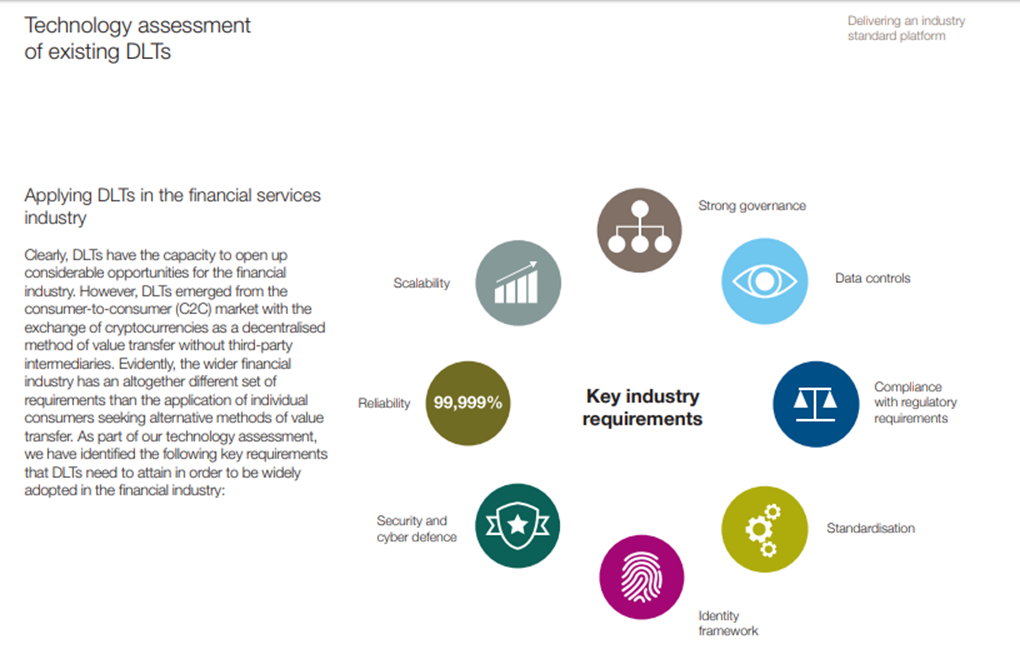
The study yielded interesting results that already showed SWIFT’s interest in using this type of technology even though Ripple was not a project of particular importance in the ecosystem:

 “Our analysis has confirmed that DLTs have the potential to bring new opportunities and efficiencies to the financial industry with their key strengths including the ability to create:

Trust in a disseminated system;

Efficiency in broadcasting information;

Complete traceability of transactions;

Simplified reconciliation; and

High resilience.

However, despite the benefits, there were tough obstacles that had to be overcome for SWIFT to start contemplating the imminent possibility of migration.

Ripple and SWIFT or Ripple vs SWIFT?

As early as 2017, SWIFT announced that it would conduct a series of preliminary studies in a Proof of Concept blockchain. 33 banks participated in this test  “designed to validate whether the technology can help banks reconcile their international Nostro accounts in real time.”

The results were defined as “extremely positive.” On March 8, 2018, SWIFT published a report showing the results of its DLT proof of concept for Nostro reconciliation. An idea they defined as “one of the largest and most ambitious proofs of concepts run with the emergent technology.”

According to the results, the tests went “extremely well:” although some problems remained. The report concluded that it was too early for SWIFT to adopt DLTs as a standard.

“The PoC went extremely well, proving the fantastic progress that has been made with DLT and the Hyperledger fabric in particular,” said Damien Vanderveken, Head of Research and Development at SWIFT. The DLT sandbox enabled us to control access, to define and enforce user privileges, to physically segregate confidential data and store it only with the relevant parties while supporting a strong identity framework by linking all participants to their BIC, and having all keys signed by a SWIFT certification authority “.
Will there be a swift – ripple partnership soon?SWIFT currently controls a System used by more than 11000 institutions in 200 countries, and although Ripple has had an accelerated growth, its market share is minimal compared to that of SWIFT.

It is very likely that instead of a commercial partnership SWIFT is looking to be a direct competitor to Ripple; however, any idea is mere speculation. Despite this, any effort by either Ripple or SWIFT to bring together two markets that until recently were considered antagonistic is something to be admired.

Competition is good, so are alliances. At the end of the day, it is the ecosystem that wins with all this.

The post Will there be a SWIFT – Ripple Partnership Soon? appeared first on Ethereum World News.

Blockchain on Medium
Humancoin — Secure Charity Donations

Will there be a swift – ripple partnership soon?

Humancoin is a revolutionary platform bringing about the synergy of philanthropy industry, retail e-commerce and cryptocurrency markets…

Previous Article

Wozniacki Becomes First Female Athlete to Launch Personalised Crypto Token

Next Article

Blockchain Project Vulcano Announces Successful Relaunch

You might be interested in …

Let's Talk Bitcoin! #347 – The Cycle Repeating

On Todays Episode of Let’s Talk bitcoin, Stephanie Murphy and Jonathan Mohan sit down with Adam B. Levine to discuss…

  • All Time High, Accelerating Prices – Bubble or Validation?
  • Tokens Celebrities and “Best Practices”
  • In-Browser Mining, Winners and Losers
  • Nationstates and the Adoption Cycle

This episode was edited by Matthew Zipkin, featuring music by Jared Rubens and The New Time. This episode was sponsored by EasyDNS.com

BIP91: The SegWit Activation "Kludge" That Should Keep Bitcoin Whole

BIP91: The SegWit Activation "Kludge" That Should Keep Bitcoin Whole

bitcoin’s long-lasting scaling debate appeared to be heading toward a climax lately, with two proposals gaining significant traction. At one end of the fence there is Bitcoin Improvement Proposal 148 (BIP148), a user activated soft fork (UASF) originally proposed by the pseudonymous developer “shaolinfry.” On the other, there’s SegWit2x, an agreement forged between a significant number of bitcoin companies and miners.

The good news is that both of these proposals have a short-term solution in common: both plan to activate Segregated Witness (SegWit) this summer. The bad news is that the activation method of the two has differed, which could lead to a coin-split.

As of today, it seems this schism will be avoided — at least initially. The SegWit2x development team plans to implement BIP91, a proposal by Bitmain Warranty engineer James Hilliard that cleverly makes the two conflicting activation methods compatible.

Here’s how.

BIP141

The current implementation of Segregated Witness is defined by BIP141. This version is included in the latest Bitcoin Core releases, and is widely deployed on the bitcoin network. BIP141 is activated through the activation method defined by BIP9. This means that 95 percent of all blocks within a two-week period need to include a piece of data: “bit 1.” This indicates that a miner is ready for the upgrade. As such, SegWit would be activated if the vast majority of miners are ready for it.

Or that was the intention. So far, only some 30 percent of hash power is signaling support for the upgrade. There is a lot of speculation as to why this is the case, but it almost certainly has nothing to do with (a lack of) readiness.

That’s why other activation methods are increasingly being considered.

BIP148

BIP148 is a user activated soft fork (UASF), specifically designed to trigger BIP141.

On August 1st, anyone running bitcoin software that implemented BIP148 will start rejecting all blocks that do not include bit 1, the SegWit signalling data.

This means that if a mere majority of miners (by hash power) runs this software, they will reject all blocks from the minority of miners that does not. As a result, this majority of miners will always have the longest valid chain according to all bitcoin nodes on the network. Consequently, all deployed BIP141 nodes will see a chain that includes over 95 percent of bit 1 blocks, meaning SegWit would be activated on the network.

However, if BIP148 is not supported by a majority of miners (by hash power), bitcoin’s blockchain could split in two. In that case, there would effectively be two types of bitcoin, where one activated BIP148 and the other did not. This may resolve over time — or it may not.

SegWit2x

SegWit2x (also referred to as “SegWit2MB” or “the Silbert Accord”), is the scaling agreement reached by a numer of bitcoin companies and over 80 percent of miners (by hash power), drafted just before the Consensus 2017 conference.

For some time, the details surrounding SegWit2x were not very specific. As the name suggests, all that was really known was that SegWit was included in the agreement, and that it included a hard fork to double bitcoin’s “base block size” to two megabytes.

And, of course, SegWit was meant to be implemented using a different activation method. Like the original BIP141 proposal, SegWit2x was to be activated by miners through hash power. But where BIP141 requires 95 percent hash power support, SegWit2x would only require 80 percent. Moreover, SegWit2x readiness would be signaled using another piece of activation data: “bit 4” instead of “bit 1.”

This makes SegWit2x largely incompatible with BIP141, and especially with BIP148: Different nodes would be looking at different activation bits, meaning they could activate SegWit under different circumstances and at different times; and that would mess up SegWit-specific block relay policy between nodes, potentially fracturing the network.

BIP91

Now, it seems BIP91 has provided the solution.

BIP91 is a proposal by Bitmain Warranty (not to be confused with Bitmain) engineer James Hilliard which was specifically designed to prevent a coin-split by making SegWit2x and BIP148 compatible.

The proposal resembles BIP148 to some extent. Upon activation of BIP91, all BIP91 nodes will reject any blocks that do not signal support for SegWit through bit 1. As such, if a majority of miners (by hash power) run BIP91, the longest valid bitcoin chain will consist of SegWit-signaling blocks only, and all regular BIP141 SegWit nodes will activate the protocol upgrade.

Where BIP91 differs from BIP148 is that it doesn’t have a set activation date, but is instead triggered by hash power. BIP91 nodes will reject any non-SegWit signalling blocks if, and only if, 80 percent of blocks first indicate within two days that’s what they’ll do.

This indication is done with bit 4. As such, the Silbert Accord can technically be upheld — 80 percent hash power activation with bit 4 — while at the same time activating the existing SegWit proposal. And if this is done before August 1st, it’s also compatible with BIP148, since BIP148 nodes would reject non-bit 1 blocks just the same.

This proposal gives miners a little over six weeks to avoid a coin-split, under their own agreed-upon terms. With a SegWit2x launch date planned for July 21st, that should not be a problem… assuming that the miners actually follow through.

The post BIP91: The SegWit Activation "Kludge" That Should Keep Bitcoin Whole appeared first on Bitcoin Magazine.