Will the Binance Move into Aussie Newsagents be a Boon for Crypto Adoption?
Global crypto exchange giant has announced that it will be helping to facilitate the of in at real-world locations. The venue stated that crypto users would be able to get exposure to the number one digital asset in more than 1,300 newsagents across the country.
The highlights the exchange’s commitment to expanding the number of fiat gateways to the economy. However, details of the purchase process might mean that the service is used less people than many of those braying for the fall of government-issued currencies would like.
Binance Lite Becomes the Firm’s First Fiat-to-Crypto On-Ramp in Australia
The new service being launched by the global exchange giant will be called Lite. It represents first time the hugely successful yet relatively new venue has managed to open a fiat-to- service in the nation of Australia.
According to a report in , the exchange’s Chief Finance Officer, Wei Zhou, stated the following of the its latest move:
“ Lite Australia further expands digital currency by providing easier ways to buy []… Australia has been at the forefront of innovation, and we hope Lite Australia can play a role to help further this cause.”
The decision by to work with Australian newsagents has a lot in common with the plan, announced , to allow French tobacco shops to sell vouchers for purchases, much like they do for pay-as-you-go mobile phone top ups.
However, in order to remain compliant with Australia’s financial regulations, those wishing to use Lite must first register for the service. This requires a full account verification process (KYC/AML) meaning that the service will be less appealing to those wishing to preserve financial privacy.
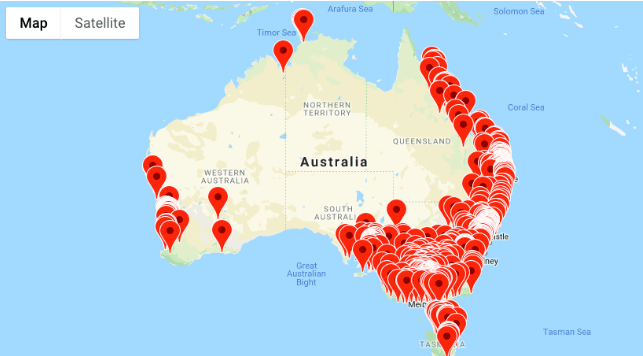
Once this step is complete, the customer can buy at any one of more than 1,300 newsagents across the nation. A full map of locations offering Lite, provided by Labs, is featured below:
Binance: Making the Right Moves to Promote Crypto Adoption Worldwide
As one of the largest venues in the industry, has been right at the forefront of promoting around the world. Already in 2019, the now-Malta-based exchange has announced a couple of initiatives to help make taking up positions in crypto easier than ever.
The first of these was the that the main global exchange would begin to accept credit card payments in January. Such an extension to accepted payment methods is obviously a net positive for the space since it offers people an additional way to buy digital assets. However, investing in , Ether, Coin, or any other highly volatile and speculative asset on credit is certainly not recommended.
Elsewhere, is working towards delivering on one of the most often-repeated, unofficial goals of – to bank the unbanked. The exchange opened Uganda in of last year. It has since seen massive numbers of accounts opened, which is certainly encouraging for on the largely-unserved-by-crypto African continent.
According to Medium , also has plans to open a fiat-to- exchange in Singapore at a for-now undisclosed date.
The idea of “,” a cryptocurrency sponsored by the U.S. government and managed by the Federal Reserve, has been around for quite some time. “Imagine that the Fed, as the core developer, makes available an open-source bitcoin-like protocol (suitably modified) called Fedcoin,” a Federal Reserve VP already in 2015. The idea gained traction also in Europe in connection with the financial crisis in Greece, and was notably discussed in a “” context by former Greek Minister of Finance .
Earlier this year, Nobel Prize–winning economist Joseph Stiglitz he believes “very strongly” that the U.S. could and should move to a digital currency and get rid of physical currency. While Stiglitz is persuaded that “the main use of bitcoin has been to circumvent tax authorities and regulation,” he appeared to be in favor of digital currency technology for government.
“The technology underlying bitcoin could fundamentally change the way we think of money,” said , a finance professor at Duke University’s Fuqua School of Business, in the . “It is only a matter of time before paper money is phased out.”
Phasing out physical cash — the reserve of drug dealers and black marketers — would be one of the main advantages of a national cryptocurrency, according to Harvey, since it would make it far more difficult for criminals to hide and launder money if all transactions could be recorded on the government’s blockchain.
The potential for privacy isn’t considered a desirable feature for state-owned cryptocurrencies. On the contrary, as Harvey argues, the introduction of digital currencies would be partly motivated by the desire to eliminate the anonymity of cash. On the other hand, even in a future Fedcoin-like, all-electronic economy, it’s easy to predict that there would be a strong black economy on the side, powered by privacy-oriented cryptocurrencies, including bitcoin, ether, Monero and other emerging alternatives able to offer .
“Despite the negative press about bitcoin being used for illegal transactions, bitcoin is not anonymous, and criminals who use it often do not understand that their transactions are being recorded,” notes Harvey. In fact, while a bitcoin address isn’t explicitly associated with its owner, blockchain network analysis can often de-anonymize bitcoin users. To support law enforcement, companies like and offer sophisticated blockchain network analysis tools and services to trace bitcoin transactions back to their participants and de-anonymize users.
In , Harvey defined Fedcoin as “a digital USD currency where the complete history of all transactions is visible to the Fed via a Fed blockchain.” That blockchain technology, initially thought of as a libertarian means to escape government control, could become a killer app for governments to have complete control over the citizens, and enforce compliance and tax collection, seems surreal to say the least.
Indeed, as Saifedean Ammous, an economics professor at the Lebanese American University, toldbitcoin Magazine, “The importance of bitcoin is that it makes monetary policy and payment settlement according to predetermined software, free of third-party control. This defeats the point of having a central bank, and is anathema to central banks’ mission, to control monetary policy and supervise money flows.”
In the presentation, Harvey cited economist ’s 2016 book “The Curse of Cash,” which proposes to gradually phase out cash, eventually leaving only small notes and coins in circulation, and move to electronic money, perhaps “a government-run version of the virtual currency bitcoin.”
While Rogoff is not persuaded that the “potentially disruptive” technology of today’s cryptocurrencies is sufficiently mature, he thinks a next-generation “bitcoin 3.0” could be a precursor to a government-controlled digital currency. “If the private sector comes up with a much better way of doing things, the government will eventually adapt and regulate as necessary to eventually win out,” says Rogoff.
Ammous disagrees with this sort of argument. “The only thing central banks can do with bitcoin is accumulate it as a monetary reserve asset. At some point, central banks around the world will start asking themselves if they might be better off holding bitcoin, with its apolitical monetary policy, than other countries’ national currencies.”
Central banks have as much to learn from bitcoin’s operation as horses have to learn from car engines. It’s a technology meant to displace central control of money.
“The Fedcoin idea was by David Andolfatto, Vice President, Federal Reserve Bank of St. Louis, at the that I organized at the Bundesbank in Frankfurt, 2015,” Paolo Tasca, of the, told bitcoin Magazine.
“The idea of dispensing with cash in favor of alternative, more efficient means of payments is not new. Pre-1900 utopian thinkers devoted a lot of effort to finding a way to allow people to get rid of what Robert Owen called the ‘insane money-mystery.’ In more recent years, economists have also begun to study the implications of living in cashless societies, especially referring to the role of central banks and to the conduct of monetary policy.”
Other governments and central banks are considering their own versions of Fedcoin. Sweden’s central bank, the Riksbank, whether the country should introduce a purely digital form of government-backed money, perhaps using distributed ledger technology (DLT). The proposed e-krona would be a digital complement to cash guaranteed by the state, and work as a means of payment, unit of account and store of value. It’s worth noting that usage of cash in Sweden is declining, and that the country could go entirely cashless in five years.
The Riksbank isn’t the only central bank to consider issuing its own digital currency. The central banks of , , and others are considering similar moves. A recent issued by the Bank of Canada, which considers a possible bitcoin standard similar to the gold standard, is especially interesting. A published by the Bank of Finland, which describes bitcoin as a revolutionary, marvelous economic system, could indicate that the bank is considering with interest the possibility to someday launch its own digital currency. Even China’s central bank is a digital currency.
“Other central banks (Bank of England, Bank of Canada and European Central Bank, among others) are studying the idea of a Central Bank Digital Currency (CBDC) as a non-ordinary monetary tool that could improve the central banks’ ability to stabilize inflation and the business cycle, and as a new payment channel that could permit tracing the network of payments and record the payment history of each individual,” added Tasca.
Another reason for governments to like the idea of a national cryptocurrency, according to both Harvey and Rogoff, is the possibility to strengthen the power of monetary policy to help manage the economy, for example by making it easier to impose negative interest rates.
Harvey notes that, were the Federal Reserve to adopt its own cryptocurrency someday, it will become a major (and far less volatile) competitor to bitcoin and other digital currencies. “In fact, it’s not clear whether [F]edcoin would want that competition, and the Fed is in a position to impose a regulatory environment that tilts the playing field,” warns Harvey.
Cointelegraph.com News BlockShow Asia 2018 Starts in Singapore BlockShow Asia 2018 begins in Singapore today, where experts in blockchain tech and crypto will discuss issues and challenges affecting the industry more info…