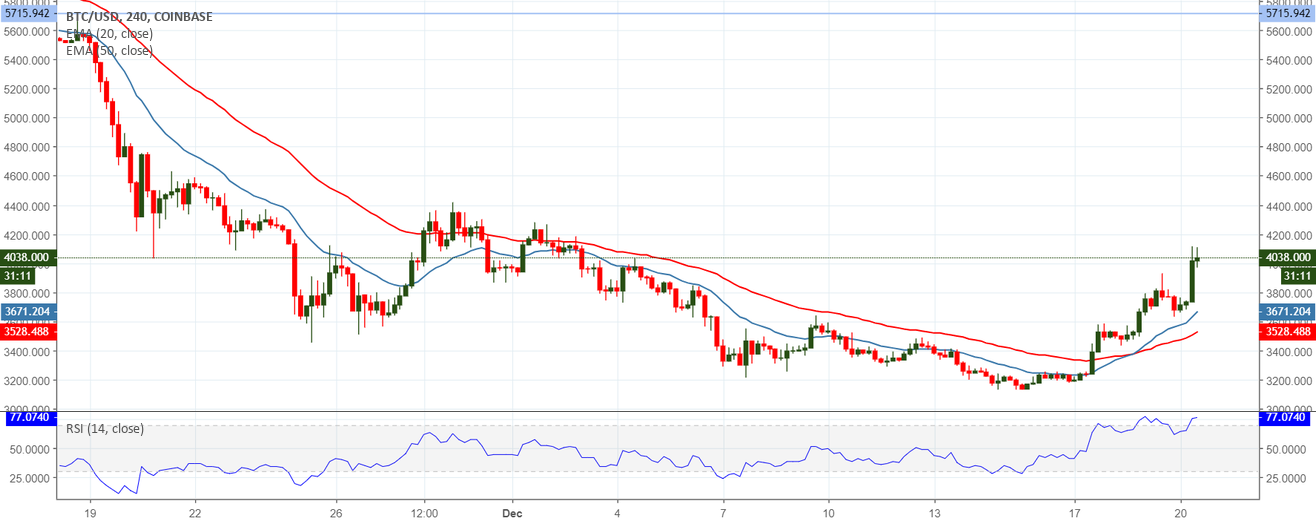
If coming out of Wall Street are anything to go by, it looks like 2019 is shaping up to be the year of the institutions for and .
However, the arrival of the institutions as they stampede over that hill represents a double-edged sword. On the one hand, prices will almost certainly pump in the short to medium term, even if just by association alone.
On the other hand, we appear to be in the process of welcoming into our beds the very enemy that was set up to defeat – the old, deep-rooted bloodlines of the financial elite.
Join CCN for $9.99 per month and get an ad-free version of CCN including discounts for future events and services. Support our journalists today. Click .
So yes, the institutions are absolutely coming to crypto, and if you think that’s a good thing, then this may be a good time to ask where your loyalties actually lie.
Cryptocurrency’s Overton Window Threatens to Get Smaller
Gemini, the crypto exchange founded by the Winklevoss twins, is touting its status as a “regulated” platform to lure institutions. | Source: Shutterstock
The Overton window refers to the range of ideas that are permitted to be discussed in the public sphere. The topics outside the window aren’t necessarily banned or censored – they’re just buried so deep that most people don’t know they exist. Not until years later when you stumble across them in some shady corner of the internet, usually presented in the form of a rouge-colored pill.
As has already been witnessed in the , when people have a vested interest to protect, they will quite happily make adjustments to the length and breadth of the Overton window to keep its range of view to their liking.
Deleting unfavourable comments from a crypto isn’t all that surprising, especially given how much rabid coin holders want to protect their investments. But there’s ample evidence to suggest that the rampant censorship on r/ began only when the institutions arrived.
Those institutions are the – Blockstream. They include AXA Venture Partners, an investment wing of AXA Group – the second largest financial services firm in the world. Blockstream has helped guide the development of since 2016, and if you didn’t already know that, then it may be because the Overton window has been set up specifically so that you don’t.
Without veering into the , the censorship of r/ offers a taste of how the ‘old money’ institutions react to ’s open-source, decentralized ideals. They laugh, then proceed to .
Recuperation: Absorbing bitcoin Without Killing It
It’s hard to believe that Facebook was once hailed as a technological messiah. Will crypto suffer a similar fate? | Source: JOEL SAGET / AFP
“Whoops! The web is not the web we wanted in every respect.”
Those words were uttered by Sir Tim Berners-Lee , as the man who invented the World Wide Web bemoaned the fact that the original dream of the internet had not come to fruition.
Berners-Lee was comparing the early 1990s notions of what the internet promised to be – free, open, anonymous, decentralized – with the internet we’ve come to know today – censored, controlled, tracked, and spied upon, thanks to the collusion of governments and big tech corporations.
Note: the internet didn’t need to be destroyed to have its disruptive potential neutralized; it only had to be brought round to the accepted way of doing things. This is a process which has happened often enough to gain its own name – recuperation, defined as:
“…the process by which politically radical ideas and images are twisted, co-opted, absorbed, defused, incorporated, annexed and commodified within media culture and bourgeois society, and thus become interpreted through a neutralized, innocuous or more socially conventional perspective.”
Some enthusiasts were predicting a fate of recuperation for the crypto space back in 2014, such as this early miner by the name of .
Zooming in on the internet analogy, in 2011 was being hailed as a technological messiah for the inadvertent role it played in helping to in Egypt. Fast forward a few years, and Mark Zuckerberg’s social network has become one of the in internet history.
Crypto is the Cure: But Will We Take Our Medicine in Time?
’s future success or failure as a tool of freedom will not come down to the efficiency of its technology, but whether or not people can step up to the responsibility of being their own caretaker. | Source: Shutterstock
The only way to avoid the snare of the banksters, the globalists, the mainstream, the man – whoever it may be – is to become independent and self-sufficient enough that we no longer need to buy what they’re selling. Under those conditions, no amount of propaganda or salesmanship would have an effect, since there would be no gaping hole left in our lives for them to fill.
The ears of libertarians should be picking up about now, and rightly so. The plight of libertarianism as a political ideology is very analogous to the plight of in its quest to liberate the masses from financial bondage.
The fate of libertarianism depends not on its efficacy as a system of governance, but rather on the ability of the average citizen to live up to its ideals. Likewise, ’s future success or failure as a tool of freedom will not come down to the efficiency of its technology, but whether or not people can step up to the responsibility of being their own caretaker.
In today’s culture of dependence, the prospect of either of these eventualities coming to fruition seems slim. The education required to foster this new mentality of independence isn’t found in the public school system. If the sudden increase in is anything to go by, then as is often the case as we look through history, we may first need to suffer catastrophe before we can see where we’ve gone wrong.
Perhaps a catastrophe similar to, or worse than, the one which caused a cipher named Satoshi Nakamoto to commence work on in 2008.
“03/Jan/2009 Chancellor on brink of second bailout for banks.”
bitcoin’s Future is Not Set – its Fate is what it makes for Itself
It’s unlikely that the established financial order will just saddle up and play along with the quasi-anarchist rules set up by a freakish band of coders and cypherpunks.| Source: Shutterstock
Look, if the institutions arrive and all they do is use to diversify and boost their , then all is well. Prices will increase through increased demand and exposure, and all of us early adopters will reap the benefits of this in the long run.
It’s unlikely, however, that the established financial order will just saddle up and play along with the quasi-anarchist rules set up by a freakish band of coders and cypherpunks. Yes, they’ll use the technology, but that doesn’t mean they’ll play by its rules.
This has been seen already as firms like and turn to creating their own – based on their own private protocols, . Strangely enough, this could turn out to be the most amicable solution between the cryptosphere and the institutions – they have their ‘cryptos,’ and we keep the real thing.
Disclaimer: The views expressed in the article are solely those of the author and do not represent those of, nor should they be attributed to, CCN.
Published at Sat, 16 Mar 2019 21:52:53 +0000