April 6, 2026

Capitalizations Index – B ∞/21M

Why Comparing Bitcoin with Centralized Systems Based on Transaction Rate is Wrong

Why comparing bitcoin with centralized systems based on transaction rate is wrong

Why Comparing Bitcoin with Centralized Systems Based on Transaction Rate is Wrong


Bitcoin apples and oranges
Advertisement


On the bitcoin network, whether it is a transaction worth $100 or $1 million, it costs the same miner’s fee to process the payment.

On October 16, a $194 million payment was moved on the bitcoin network with a mere $0.1 fee nearly instantaneously. Through legacy banking systems, weeks of paperwork, days of settlement system, and a significant load of compliance work is required to clear a payment of that size.

The research of Nic Carter, a Partner at Castle Island Ventures and the co-founder of Coinmetrics.io, found that comparing bitcoin to other cryptocurrencies and centralized systems like PayPal based on transactions per second (TPS) is inaccurate.

Why bitcoin Comparison isn’t All That Simple

As shown by the chart below created by Carter, centralized systems like credit card network operators and bitcoin target a different market. While credit and debit card network operators mostly focus on processing small payments at a large capacity, the users of bitcoin tend to rely on the network for larger payments.
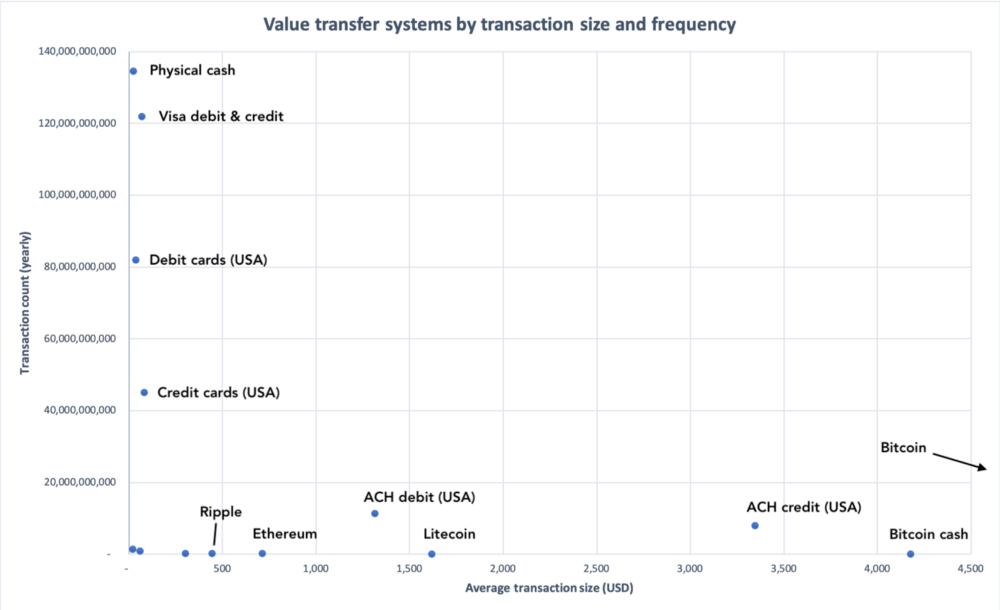
Why comparing bitcoin with centralized systems based on transaction rate is wrong

bitcoin transactions tend to be quite large. It’s hard to know the precise number, but your average transaction will be in the thousands of dollars, possibly tens of thousands. Your median transaction is well over $100,” Carter explained.

Multi-million dollar payments are quite frequently moved on the bitcoin blockchain network, and on some occasions, as seen in the $194 million BTC payment processed last month, large net-worth investors settle substantially large payments that are rarely settled using credit cards.

In November 2015, Chinese billionaire Liu Yiqian purchased a painting worth $170 million with his American Express credit card. That is, a payment $24 million smaller than the BTC transaction settled last month. Yet, due to the rarity of the transaction, the $170 million credit card purchase was reported by mainstream media outlets and national television networks, because it is not normal for an average credit card user to purchase anything larger than $10,000 to $100,000.

“What critics miss when they fixate on TPS is the simple fact that the users of these systems tend to have a good idea of what they want from them. Low-stakes, small value transfers with some reversibility guarantees work just fine on Venmo, Paypal, or Visa. Yes — these don’t work for the unbanked, but then again virtually no financial infrastructure does. This stuff takes a long time to build, as does the trust in the system.”

Based on one metric that is TPS, bitcoin could seem like an inferior network to centralized protocols. But, bitcoin can process significantly large payments on the network with relative ease, which centralized systems simply cannot do due to compliance and regulatory requirements.

TPS is Not the Only Measurement

While TPS can be used as a measurement, it is one of many measurements that can be utilized to evaluate and compare payment networks.

Carter noted:

“So, in short, value transfer systems vary along at least three major axes, not just one. The response to ‘Our system does 500,000 TPS” is “at what cost?’ Are you deferring settlement? Do you have a single validator? Do you require that transactors be part of the US-controlled financial system?”

Featured Image from Shutterstock

Follow us on Telegram or subscribe to our newsletter here.
Who is Buying Bitcoin? Take the survey here and help us with our study.

Advertisement


Published at Tue, 13 Nov 2018 02:40:41 +0000

Previous Article

NEM Price Rebounds to Two-Month High Following Coincheck Relisting

Next Article

Don’t PANIC About Crypto! Bitcoin | Ethereum Falls Below $300 | BCC Considered Dead

You might be interested in …

Img_1929

IMG_1929

IMG_1929By btckeychain on 2013-08-26 10:29:38[wpr5_ebay kw=”bitcoin” num=”1″ ebcat=”” cid=”5338043562″ lang=”en-US” country=”0″ sort=”bestmatch”]

After Second Hack This Year, South Korean Exchange Youbit Closes Down

After Second Hack This Year, South Korean Exchange Youbit Closes Down

South Korean exchange Youbit announced on its website today that it is closing down after a hack early Tuesday, December 19, 2017, that resulted in the loss of 17 percent of its assets.

The exchange, previously known as Yapizon, did not indicate how many bitcoins or other cryptocurrencies were stolen or what the total fiat value of the attack amounted to, but it was enough to lead to bankruptcy.

This was the second hack the exchange suffered this year. A prior attack in April 2017, resulted in the loss of 3,816 bitcoins, worth around $5 million at the time.

Youbit said hackers broke into its hot wallet, the online account used to pay out cryptocurrencies instantly. While hot wallets offer greater convenience, they also put funds at greater risk because they are connected to the internet.

The remaining coins were kept offline in a cold wallet, the exchange said, resulting in no additional losses. The exchange indicated that customers could withdraw up to 75 percent of their balances, and the rest would be tallied out after the final settlement.

Korea Internet & Security Agency (KISA), the state agency that responds to cyberattacks, is investigating the incident, as reported in Reuters. KISA has maintained that North Korean hackers were behind the first hack.

Chris Doman, threat engineer at software security company AlienVault, told bitcoin Magazine, he suspects BlueNoroff, a subgroup of North Korea’s cyber crime group Lazarus is responsible for the second Youbit attack. Lazarus is known for the November 2014 hack on Sony Pictures Entertainment, one of the biggest corporate breaches in history.

While attacks by Lazarus have mainly been aimed at social disruption, recent reports indicate the group is increasingly going after money. With the value of bitcoin surging to all-time highs, exchanges are becoming a lucrative target.

“The first time I saw them target a bitcoin company was in May this year — the same month they unleashed WannaCry,” Doman said in a statement shared with bitcoin Magazine.

The exchange that Doman was refering to is South Korean bitcoin exchange Bithumb. Around that same time, WannaCry ransomware attacks were encrypting user’s computers and offering to de-encrypt them in exchange for bitcoin. Analysis of the techniques used in the WannaCry attacks show strong links to Lazarus.  

Doman added, “They’ve also used related malware to opportunistically mine Monero coins on compromised servers. Clearly they have a large interest in cryptocurrencies as an easy method for economic gain, as well as an opportunity to economically weaken their enemies.”

Although Youbit is one of the smaller bitcoin exchanges, the hack underscores the risk involved in leaving funds on an exchange, where control of those funds is handed over to a third party and is only as safe as whatever security measures that exchange chooses to use.

Throughout the history of bitcoin, hacks have amounted to painful losses. When bitcoin exchange Mt. Gox began liquidation proceedings in April 2014, the company announced that approximately 850,000 bitcoins were missing, an amount valued at more than $450 million at the time. In August 2016, the bitcoin exchange Bitfinex announced hackers stole approximately 120,000 BTC, worth $72 million at the time.

The post After Second Hack This Year, South Korean Exchange Youbit Closes Down appeared first on Bitcoin Magazine.