November 2, 2026

Capitalizations Index – B ∞/21M

What Volatility? How Facebook's Historic Loss Became Crypto's Gain

What volatility? How facebook's historic loss became crypto's gain

What Volatility? How Facebook's Historic Loss Became Crypto's Gain

July 26 might be forever remembered as one of the darkest days in Facebook’s history – or, at the very least, for its shareholders.

An otherwise unassuming Thursday, the day saw the social media giant lose more than $120 billion in market value, the biggest loss in one day for any U.S. traded company. According to Bloomberg, the loss is a direct result of the company’s second-quarter report on sales and user growth figures, which fell short of analyst projections, along with months of scandals and criticism regarding data privacy.

But if the social media giant was already having its worst day ever, crypto advocates were there to make it (maybe) just a little worse.

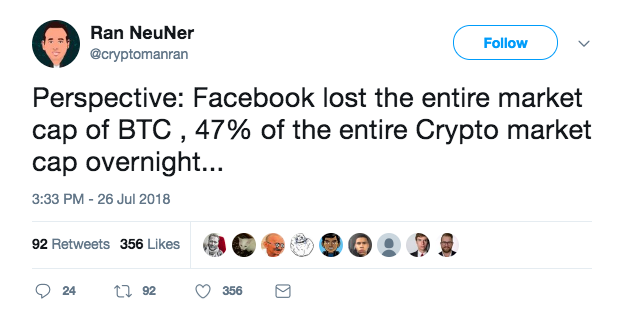
If you’re wondering how Facebook’s loss could possibly be associated with cryptocurrency, the answer is simple: it all started with a comparison between the values of bitcoin and Facebook.

What volatility? How facebook's historic loss became crypto's gain

Of course, crypto supporters would not let it go as cryptocurrencies have long been criticized for being volatile by traditional market views.

What volatility? How facebook's historic loss became crypto's gain

What volatility? How facebook's historic loss became crypto's gain

The seemingly tenuous nature of Facebook’s stock price led some to draw comparisons with the volatility seen in cryptocurrency markets. As Romain Dillet put it, bitcoin “feels like a stable asset” by comparison.

What volatility? How facebook's historic loss became crypto's gain

What volatility? How facebook's historic loss became crypto's gain

Interestingly, as many can still recall the feud between Facebook’s CEO Mark Zuckerberg and the Winklevoss brothers from the award-winning movie The Social Network, members in the crypto community also gave a shout-out to Cameron and Tyler Winklevoss brothers, who are now among some of the biggest crypto investors as well as co-founders of Gemini, a New York-based cryptocurrency exchange,

In the words of one observer, the reversal of Facebook’s market fortunes represented a dose of “sweet revenge.”

(The Winklevoss brothers, as CoinDesk reported Thursday, suffered a blow as the SEC once again shot down their bid to have a bitcoin exchange-traded fund (ETF) listed.)

What volatility? How facebook's historic loss became crypto's gain

What volatility? How facebook's historic loss became crypto's gain

What volatility? How facebook's historic loss became crypto's gain

What volatility? How facebook's historic loss became crypto's gain

Not everyone was buying the Facebook stock and cryptocurrency comparison, however.

Some Twitter users who said they believe that conflating Facebook and cryptocurrency is a meaningless exercise.

What volatility? How facebook's historic loss became crypto's gain

What volatility? How facebook's historic loss became crypto's gain

As of the time of writing on Friday, Facebook’s stock hadn’t seen much of a recovery, according to data from Google. Yet the plunge seems to have been arrested, offering, at the very least, a possible reprieve from the crypto-critics.

Facebook image via Shutterstock

The leader in blockchain news, CoinDesk is a media outlet that strives for the highest journalistic standards and abides by a strict set of editorial policies. CoinDesk is an independent operating subsidiary of Digital Currency Group, which invests in cryptocurrencies and blockchain startups.

Published at Fri, 27 Jul 2018 19:00:09 +0000

Features[wpr5_ebay kw=”bitcoin” num=”1″ ebcat=”” cid=”5338043562″ lang=”en-US” country=”0″ sort=”bestmatch”]

Previous Article

Bunny Token?! “To the MOON!” $bunny ICO Review

Next Article

What Volatility? How Facebook's Historic Loss Became Crypto's Gain

You might be interested in …

Bitcoin market hour

BITCOIN Market Hour

bitcoin Market Hour EN English (UK) EN English (IN) DE Deutsch FR Français ES Español IT Italiano PL Polski SV Svenska TR Türkçe RU Русский PT Português ID Bahasa Indonesia MS Bahasa Melayu TH ภาษาไทย […]

Deutsche Bank Strategist: Reign of Fiat Money Will Soon End, Will Bitcoin Take Over?

Deutsche Bank lead strategist Jim Reid believes the reign of fiat money could soon end and cryptocurrencies like bitcoin could take over the global financial market.

In a recently released research paper, Reid delve extensively into the unstable fiat currency system and firmly stated that the fiat currency system will highly likely come to an end in the upcoming years.

Reid stated:

“Central banks and governments which have ‘dined out’ on the 35 year secular, structural decline in inflation are not able to prevent it rising as raising interest rates to suitable levels would risk serious economic contraction given the huge debt burden economies face. As such they are forced to prioritise low interest rates and nominal growth over inflation control which could herald in the beginning of the end of the global fiat currency system that begun with the abandonment of Bretton Woods back in 1971.”

Will bitcoin Evolve Into a Competitor Against Fiat Currency

In his paper, Reid essentially criticized the centralized nature of fiat currencies and the ability of governments, authorities, and central banks to manipulate virtually aspect of paper money, including inflation rates. Due to the existence of centralized authorities within the fiat currency system, Reid emphasized that it is vulnerable once it loses its leverage over the global economy, likely triggered by the emergence of decentralized currencies like bitcoin.

“It’s possible that inflation becomes more and more uncontrollable and the era of fiat currencies looks vulnerable as people lose faith in paper money,” added Reid.

He further noted that cryptocurrencies like bitcoin, despite the growing interest from the traditional financial industry in blockchain technology, have the potential to take over fiat currencies and operate as the global monetary system, given their open structure and decentralized systems.

As security and bitcoin expert Andreas Antonopoulos previously explained, bitcoin has an advantage over fiat currencies because it is voluntary. It does not enforce any regulations and policies through violence, and it does not require a certain group of individuals and businesses to use the digital currency for leverage. Anyone can choose to use bitcoin as a currency, a store of value, and a safe haven asset at their will and demand.

For this reason, Reid stated that there exists a possibility of cryptocurrencies eventually competing against national currencies and the fiat currency system.

“Although the current speculative interest in cryptocurrencies is more to do with blockchain technology than a loss of faith in paper money, at some point there will likely be some median of exchange that becomes more universal and a competitor of paper money,” Reid noted.

Long-Term Growth of Bitcon as a Global Currency

The long-term price targets of prominent financial analysts like Max Keiser at $100,000 assume that bitcoin will evolve into a major global currency and penetrate the market of gold. If bitcoin can compete with fiat currencies in the upcoming years, the market valuation of bitcoin would likely be able to reach a few trillion dollars, which is an optimistic long-term indicator for bitcoin investors.

The post Deutsche Bank Strategist: Reign of Fiat Money Will Soon End, Will Bitcoin Take Over? appeared first on NEWSBTC.