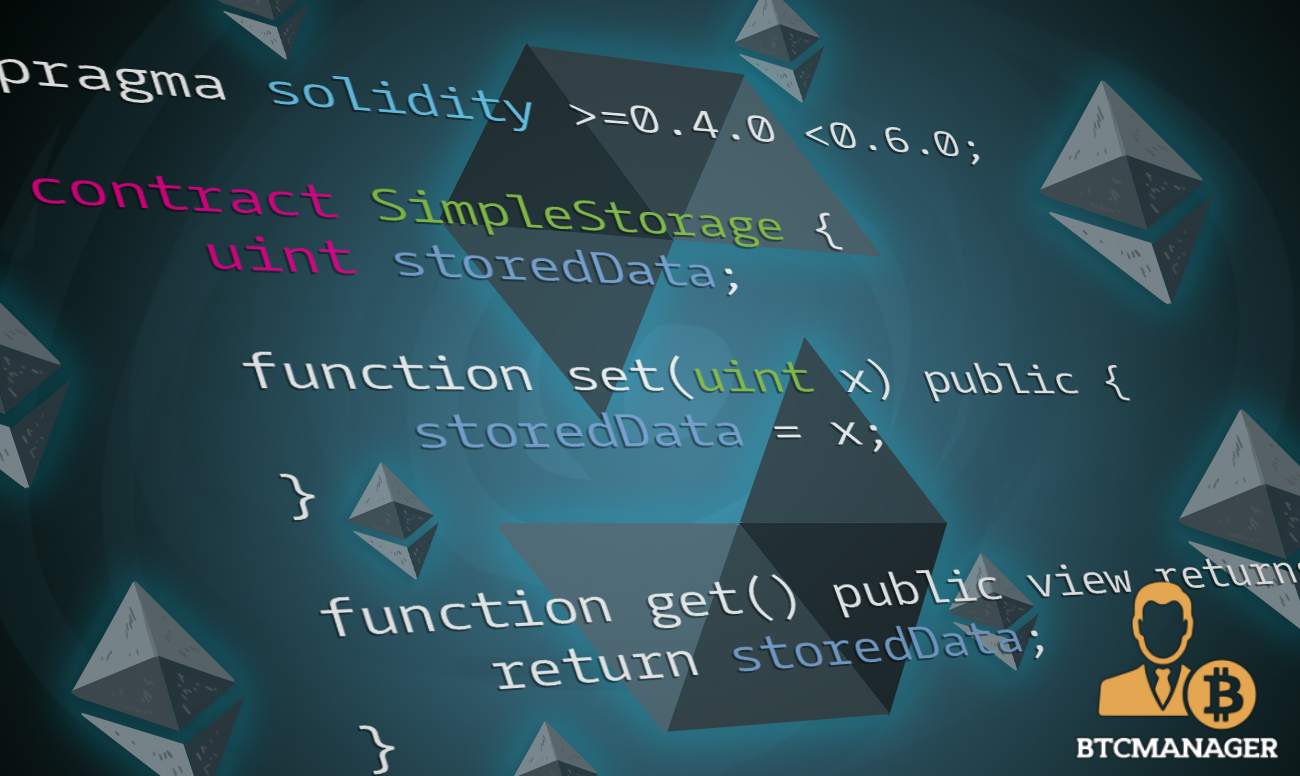
Behind the infrastructure of many decentralized technologies are tools, or “kits,” that compose the overall nature of the technology. In many cases, developers have existing frameworks or programming languages used to create such infrastructure. Programming languages can be understood as the palette of colors needed to paint a portrait. As such, the painting is essentially only as strong as creativity limits itself, but different palettes allow for completely different types of paintings. Programming is similar, and if one is to take Ethereum’s “” language as a palette, the paintings created are .
Ethereum’s Solidity language is the basis for a new type of financial programming where you can essentially create your own . Smart contracts are Ethereum’s take on decentralized and virtual agreements between different parties. The concept behind the Ethereum vision is to create a new type of ecosystem where parties can communicate with one another through a near-perfectly decentralized method where the middle man is cut out in most cases.
Smart Contracts and Structure
Prior to understanding what Solidity does and how it can revolutionize the development atmosphere for almost all decentralized systems, it’s important to understand the core concept of and what they are built to establish.
In traditional workflows, one usually has a contract that is written to bind multiple parties together in a certain fashion. Let’s say someone has a payment contract written between them and another debt collector that once signed says they’re going to pay him $100. That’s simple enough, right?
The concept behind Ethereum is that one can virtualize making things more efficient with smart contracts. Simply take the previous example of the debt obligation and virtualize it. One then has immutable and transparent systems where obligations are never subject to fraud or potential miscounting.
Smart contracts are built between two parties, however, the two parties can be a party of 1 signing with a party of 50, and vice versa. Another core concept behind smart contracts is that it opens the door to new opportunities in the financial offerings section. The concept of initial coin offerings () was made possible because of the immutability and transparency within smart contracts. With smart contracts you can subsequently issue a native token from the Ethereum standard of , subsidiaries of the ether asset.
Design and Flow
When designing the basis of Solidity, the Ethereum team wanted to emphasize usability and simplicity. The reasoning for this to enable the toolkit for as wide a range of people as possible. The main claims made by Ethereum state that the concept of Solidity is designed to be close to JavaScript for decentralized applications, otherwise known as dApps.
JavaScript is famous among developers because as an experienced programmer, picking up JavaScript is relatively easy as it encompasses the main concepts and design of modern languages. Similarly, the basis for Solidity was designed to be as as possible. Very limited knowledge of markup languages like HTML may cause a roadblock for those looking to learn Solidity at least at first glance, however, once developers get the hang of it, it’s fairly simple to navigate.
Advertisement
advertisement
Although technically one can create their own basic programs with Solidity such as high-level loops, calculators, and whatnot, the language was specifically tailored to work for smart contract programming and decentralized application development. This means that a user doesn’t get to extract its real usability until a developer starts applying its usage to smart contract development. If one were to eliminate the smart contract integration, you’re left with a very weak language.
Without getting too in-depth, if readers wanted to create a smart contract called “myContract,” a developer has to establish its instantiation through “contract myContract.” Through this example, one gets the feel for the flow of Solidity. It maintains a lot of design and preprogrammed keywords that will integrate with the Ethereum platform that directly coordinate with the Ethereum Virtual Machine (EVM).
Solidity and Decentralized Applications (dApps)
While those experienced with blockchain and cryptocurrency understand the core of how decentralized systems work, beginners may have a hard time establishing exactly what dApps are and their relation to Solidity.
Decentralized applications simply applications running off of networks rather than sole systems or users. Think of it like this: When creating an application for Mac, the network that governs the back-end of the application is Apple, or a single entity. When creating a dApp, the network governing all of its processes are those on the Ethereum network, therefore creating a “distributed” system for apps.
Smart contracts are virtualized agreements that establish a direct connection to the Ethereum blockchain. dApps are applications that use smart contracts to connect to the blockchain, making them decentralized. Solidity is simply a tool used to make the connection between a static application and distributed back-end.
Solidity is not a smart contract, and not a dApp, it is a programming language used to create smart contracts that can then subsequently link applications to a blockchain. Upon learning Solidity, a developer can create decentralized applications that interact with blockchains.
Traditional centralized applications maintain connections to singular databases that function in a static, peer-to-database. Decentralized applications are distributed and function in a method for a plethora of reasons. The main advantage is to maintain up-time and limit any potential centralized costs or errors.
Competitors and Roadmap
New versions of Solidity are being established daily, however, this has caused some controversy within the community. Solidity is a new language meaning its still subject to errors and needs a lot more development and refinement prior to it being legitimized entirely. The ease of establishing fragile environments such as Ethereum makes new developers subject to in their code, which has resulted in a lot of money being lost in created smart contracts.
The main competitors to Ethereum in terms of contracts are in many cases regarded to be the mainstream case of TRON and EOS. However, in terms of the competition to the actual Solidity programming language, there seems to be a finite amount of entities in direct tracks with it. The development kit, for example, offers competitive smart contract creation abilities, however, the contracts are programmed in C++, an already existing language. It may be some time before a natively created programming language overtakes Solidity in terms of internal smart contract development.
Category: , , , ,
Tags: , , , , , ,
Published at Tue, 15 Jan 2019 09:00:54 +0000