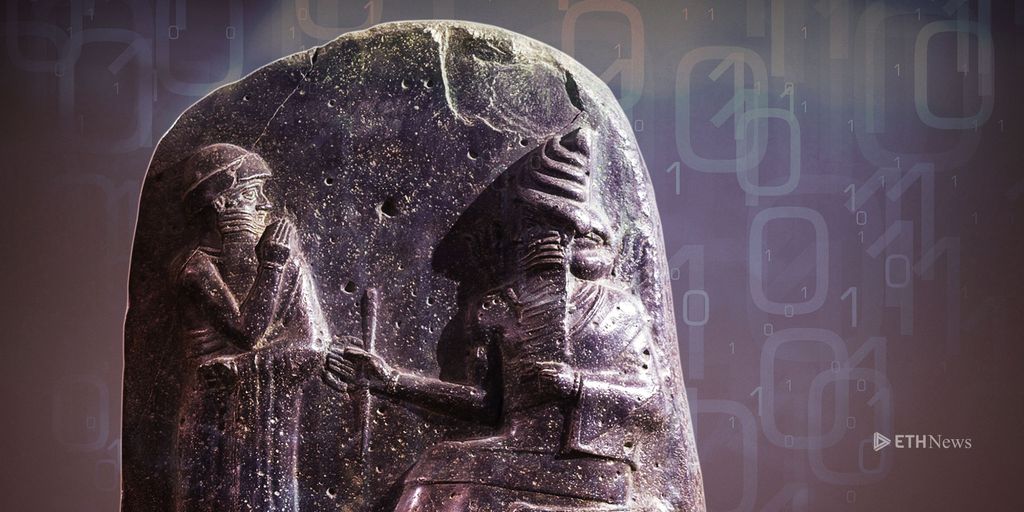
Maybe should take a page out of Hammurabi’s book – er, stele.
Governance of has many layers. It’s not just a technological experiment, but a social one. When we discuss governance, we’re talking about both the management of what happens on the and social rules (implicit or explicit) for community engagement.
As I the unfolding conversation after moderators of the for an open discussion on the role of mods, I reflected on how many aspects of governance are implicit or undefined. The community might do well to take a cue from – not to adopt laws or governance specific to society, but to better understand how different types of law function in the community.
As we’ve seen from about “law,” the term doesn’t always denote formalized rules, but can be used to name an ethos, approach, or attitude that determines community interaction. Law can be ideas and expectations that govern social action and discourse, regardless of whether these are explicitly named or stated.
The call to discuss moderating the was an attempt to clarify community expectations for what the should be and to develop provisional rules for both public engagement and the decisions of moderators. It was public statement issued by contributors, but it showcases one of the primary issues faces: As we attempt to from old authority structures, how do we govern this thing? What rules do we use? Who determines these rules? What are our expectations and what should they be?
This is where Hammurabi’s law stele comes in. A is a stone or wooden slab, often carved with text and/or images, erected as a monument in the ancient world. The Hammurabi stele is not merely a compilation of laws that reflect legal praxis during King Hammurabi’s reign, but a public monument that had a . By setting up this visual representation of the law in a public place, the king hoped to provide citizen petitioners with a lasting public resource for obtaining .
This was in no way rule by consensus or a step toward democracy (the monarch still determined the rules), but it meant that expectations for community rule were out in the open. The public might not like the rules and the laws might not even be the best, but they were known and could be appealed to in the case of a dispute.
The monument also effectively established and expressed the relationship between the law, the law-giver (in this case, King Hammurabi), and the governed community.
The community is a different animal in many ways. We have no monarch and aim to govern by rough consensus. At the same time, the moderators’ joint statement functioned, in my opinion, much like a similar to the performative communication enshrined in the Hammurabi stele.
Unlike the Hammurabi stele, this was a negotiation: Moderators set out a provisional document that explained some decisions, proposed guidance for the future, and invited the community to weigh in. And yet it seemed to me that as the community hashed out ideas for laws, something was happening beyond just the development of practical mechanisms for engagement. Expectations were being revealed and clarified. Private or previously undefined thoughts were being named. And perceptions of power dynamics were also being named.
The implicit power structures became more explicit. A big issue that came up in the conversation is that many of the moderators (and, more generally, core devs) don’t tend to think of themselves as representatives of the community more than any other stakeholders. But many in the community disagree and see them as shapers and signifiers not only of the technology, but of the community ethos.
We can continue to debate the extent to which the above is an accurate portrayal of how specific moderators and devs view their roles but, at a minimum, it shows that many stakeholders who aren’t devs or moderators see those roles as positions of power. And we have ample evidence that many contributors are leaning into ad hoc positions of leadership and are trying to develop better ways to organize the community (e.g., the and ).
Not everyone in this nebulous thing we call the “ community” has the same amount of power or responsibility. There’s work yet to be done to make an equal and equitable utopia, and this is to be expected. Breaking away from the old power structures is a gradual process and it’s not as if those frameworks just go away automatically. The distribution of power takes a lot of effort, strategy, and intentionality.
My point – at the risk of stating the obvious – is that could do with a lot more definition. We need to identify stakeholders and their roles, not to lock them into those roles, but to provide clarity about who is part of this composite entity, where people’s strengths lie, where they can contribute, and what they can expect from other stakeholders.
The community may be relatively small, but I suspect there are a lot of untapped resources. People who to the development of the technology are eager to help in other ways. But for that to happen, we need to assess the technology’s needs and what the community’s skills and resources are – and make that information accessible – so that the various kinds of stakeholders can contribute in the most effective ways.
I’m not sure we need to pull a full Hammurabi and a virtual stele on the to establish a “never-ending cycle of performance and reception” to publicly establish and enact the relationships between stakeholders. But as we work to name and shape , it’s worth remembering that “law” doesn’t have to be the antithesis of creativity or organic community. The presentation of law can be a declarative act that forges bonds, creates social cohesion, and frames a space for the spontaneous performance of genuine relation.
Published at Mon, 25 Mar 2019 20:14:04 +0000