January 26, 2026

Capitalizations Index – B ∞/21M

What Everybody Ought to Know about Blockchain Education with B9lab’s Elias Haase

What everybody ought to know about blockchain education with b9lab’s elias haase

What Everybody Ought to Know about Blockchain Education with B9lab’s Elias Haase

The massive spike in job openings in the blockchain space has created a considerable demand for quality developers. But as the industry is still so young, few applicants can fill these positions. A secondary market for costly certificates, online courses, and hackathons has thus sprung up to fill this need.

To cut through some of the noise, BTCManager caught up with B9lab founder Elias Haase to talk more about his company’s approach to blockchain education and why it matters.

Blockchain Demand

On March 8, 2019, Facebook announced 20 different job openings to augment its recent blockchain push. While some were less technical than others, the rush to bring in as many experts has reached a peak. The announcement quickly made headlines, along with the social media platform’s hushed stablecoin developments. But Facebook isn’t setting any trends, as the push for blockchain jobs has been ongoing, and ever increasing over the past few years.

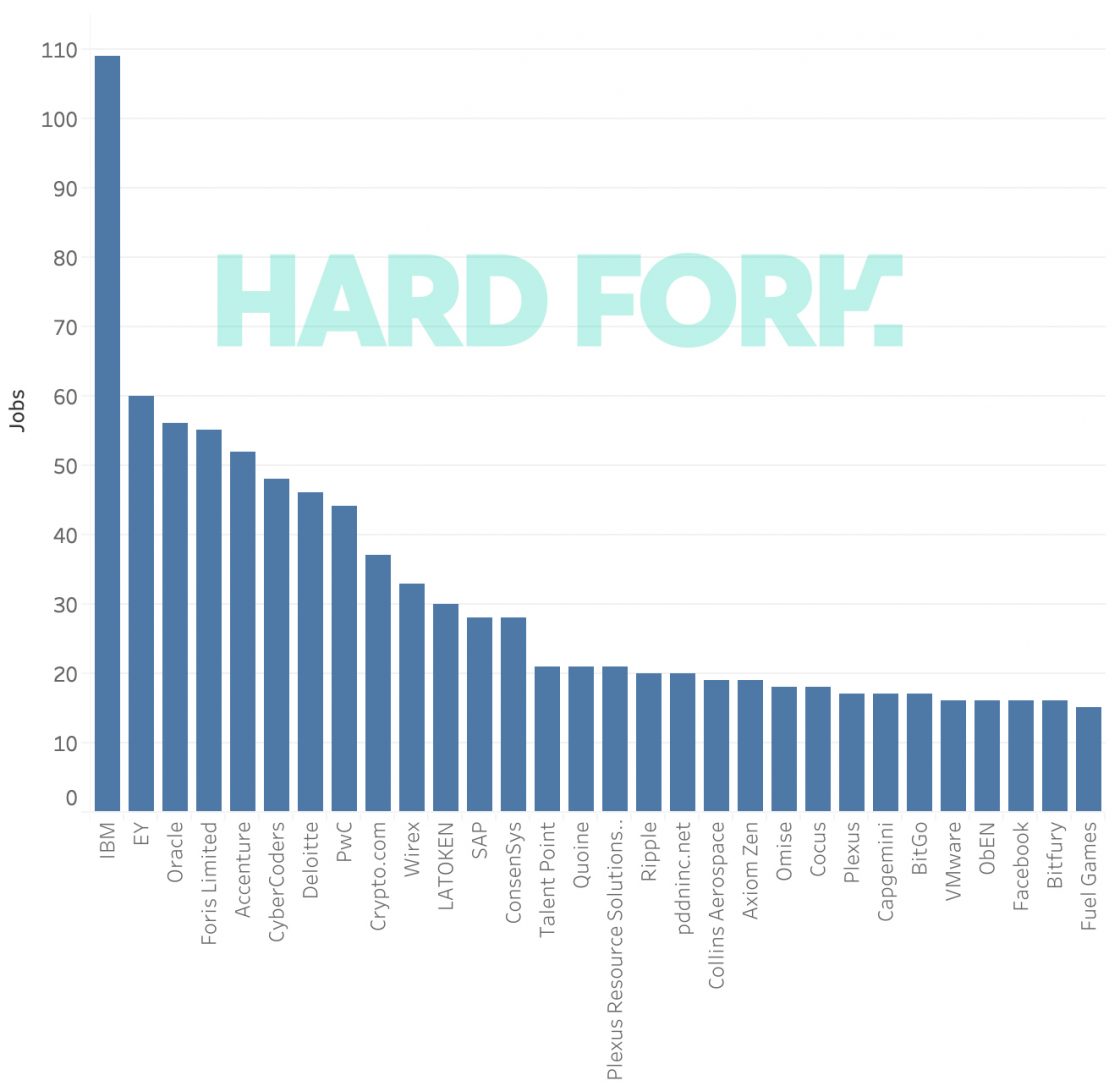
Data collected from GlassDoor, a platform that rates companies and management, indicated that IBM boasts the most blockchain-related jobs at 110, with accounting powerhouse Ernst & Young and Oracle coming in second and third respectively. Other big names include BMW, Telefónica, and Siemens. All this even before mentioning the many blockchain-specific startups all over the world.
What everybody ought to know about blockchain education with b9lab’s elias haase

(Source: The Hard Fork)

Naturally, the estimated 5,700 total jobs aren’t going to be filled overnight which is part of the reason that the average salary of a developer can command more than $150,000 a year according to 2018 reports. A job market desperate for equipped applicants has also created another demand: Education.

Adoption and Professional Prospects

Likely the biggest news that combines both blockchain developments and education has been the outpouring of university courses on the subject.

From Yale University in the United States to Globsyn Business School in India, curriculum’s are pivoting as fast as beverage companies to cash in on the crypto hype. Some schools are testing the immutability feature of the innovation, while still others are offering course work into the details of distributed ledger technology (DLT).

This has also created demand outside of the ivory tower of formal education. Online classes from Coursera, Central Blockchain Council of America, and B9lab have enjoyed record numbers of students. Many of these courses are also focused on bringing in business leaders and marketers to the sector rather than strictly developers. In an interview with BTCManager, Elias Haase, a co-founder of B9Lab, explained that non-tech executives need to know this information as much as the mid-career software developer.

Founded in 2015, B9lab’s site offers a wide variety of different course work ranging from an Ethereum Developer Course, Hyperledger Fabric 101, and a suite of programs for non-developers. “The idea is to empower business experts with the knowledge to make their own decisions about the technology,” said Haase. “It’s damaging with too many people playing to the hype, especially if it doesn’t make sense. The key is to provide healthy information to support long-term projects.”

The focus on a longer time horizon is also supported by B9lab’s network of tutors and alumni. “We have an active alumni community, who are hugely valuable,” said Haase, adding:

“They help as tutors for code review, and provide a positive feedback look for development.”

Graduates can also expect to regularly find jobs as Haase’s organization has developed working relations with the likes of Santander, SAP, and ConsenSys. With over 14,000 participants from all over the world, the first steps into the professional world are likely as freelancers and contract work, according to Haase. To further develop a dense network of crypto developers, B9lab has teamed up with Ethereum’s Department of Decentralization to build out the Community Blockstars program which kicked off in January 2019 at Goerlicon.

The aim of the Blockcstars program is to train 1,000 developers for free. Haase said that if a company decides to sponsor the initiative, course content will be built to accommodate that sponsor’s needs. Due to the course content, however, these developers will likely be prepared to work on Ethereum, not bitcoin.

Multi-Chain Development

Before turning to blockchain education, B9lab’s co-founder was paying for his and friend’s dinners with as much as ten bitcoin. “I was helping build platforms for fintech startups and crowd investment projects,” he said. “It was only natural that I stumbled upon bitcoin in 2011 and then later Ethereum.”

He began developing in-house training for other developers at his company and explained how learning about smart contracts was a “mind-blowing” experience. Of course, bitcoin never fell to the wayside, but smart contract platforms like Rootstock (RSK) weren’t quite ready to bring the technology to bitcoin and dApps were a major focus in 2015.

In the short term, Haase admits that B9Lab is still looking to bring on new material. And at time of press, interested parties can dive into Ethereum, Hyperledger, EOS, and R3’s Corda tutorials. On future developments, he said:

“Blockstars is the first step to open things up and we have a team working towards helping people to get sponsored to learn to program.”

B9lab is then focused on providing high-quality content in different languages and on keeping the courses affordable. Accessibility, for all blockchain education ventures, is critical for such global technology and as the crypto hype continues to spread, hiring trends will likely remain bullish.

Like BTCMANAGER? Send us a tip!
Our bitcoin Address: 3AbQrAyRsdM5NX5BQh8qWYePEpGjCYLCy4

Published at Mon, 11 Mar 2019 13:00:23 +0000

Previous Article

Bitcoin's breakdown.

Next Article

Brave Browser: Preview of ads developer channel enters second phase

You might be interested in …

Ivy on brick texture

Ivy on brick texture

Ivy on brick textureThis seamlessly tiling texture was created by me, from a photograph I took. I made it seamlessly tileable in photoshop. I’m making this available as a free texture map for use in […]

Bitcoin.. Sideways and choppy through march

Bitcoin..Sideways and Choppy through March

bitcoin..Sideways and Choppy through March EN English (UK) EN English (IN) DE Deutsch FR Français ES Español IT Italiano PL Polski SV Svenska TR Türkçe RU Русский PT Português ID Bahasa Indonesia MS Bahasa Melayu […]

Trade.io – Blockchain Trading Platform Makes Traders Owners and Shares the Profits

Has the post-2008 bank cleanup allowed the banks to mop up more client money? Despite tighter financial regulation, banks are behaving like teenagers with no house rules. Not only are financial services fees rising, but it is becoming harder to see what big banks are doing with their money.  In fact, about 10 percent of big money trades now take place in the ‘dark pool’—faceless financial exchanges where traders can hide their identity.

The operation of financial services on the Blockchain is proving that innovation can succeed where regulations are failing. Over the digital ledger, cryptographic proofs replace intermediaries and their high fees while a smart contract monitors compliance in real time. Conducting financial transactions over a peer network of transparent nodes is rebuilding trust in the financial system.


A self-regulating repository of the truth

Trade.io is one of the revolutionary financial exchange models providing a solution to the financial system flaws that keep regulators up at night. On a transparent  Blockchain platform, trading partners are accountable for their activity since transactions are transparent and traceable. The trading record is irreversible, making it difficult for a corrupt broker to manipulate the market to increase his commissions.

The nightmare of every regulator, systemic risk, is also reduced. Markets are protected from the contagion effect—a failure in one part of the system leading to failures in other parts of the system—by the distributed and decentralized network. Transactions reside on the computer of each party in a transaction node. The focus is on security and information protection at the individual node level. Since transactions in fiat and cryptocurrencies are done directly from the digital wallet of traders, the trade.io platform can match and process trades without gaining access to trade information.

Democratizing crypto exchanges

Trade.io aims to be a model of the sharing and trust economy. Since investors in the Trade Token, the trade.io trading currency, take an ownership interest in the exchange and profit from its success, the incentive of members to cooperate rather than cheat is high.

Trade Token holders become investors in the trade.io Liquidity Pool. Fifty percent of the revenues (or losses) of the liquidity pool are deposited (deducted) daily to the wallets of pool participants. The distribution is based on a pro-rata allocation of each member.  A member with 500-999 tokens locked on the pool will receive 10 percent profit participation, while a member with over 5,000 tokens locked-in will receive 100 percent of the profit plus a 10 percent bonus. Revenue is generated from a number of sources, including trade spreads, commissions, P2P margin lending fees and investment banking fees.  

Trading on the trade.io platform is conducted with the Trade Token. The token is more than a medium of exchange at a lower cost than traditional exchanges. It also provides membership in the liquidity pool through the trade.io wallet. The membership fee, which allows participation in the pool, is 2500 Trade Tokens. These Trade Tokens will be secured by the underlying assets pledged by the participants, which may include fiat or cryptocurrency.

For traders who lament losing their traditional trading tools in the crypto world, the trade.io Blockchain platform provides integration of MT4, the most popular trading platform.

Playing by the rules

Trade.io will be licensed as a bank and financial exchange. Different from the dystopian world of cryptocurrencies portrayed by some banks, the regulated crypto exchange is becoming the model in the US, Japan and elsewhere. The model leverages the innovation of the Blockchain while providing the security of a regulated exchange. Unique Blockchain services include P2P margin lending.

Participants can lend directly to each other through a peer-to-peer lending program. The investment banking arm of trade.io will help companies issue tokens and launch initial coin offerings (ICOs).  Investors may use the Trade Token to invest in initial public offerings (IPOs) and ICOs. Trade Token holders can also receive preferred access to ICOs, discounts and other market benefits. Trade.io has a Seed & Venture Fund to support the development of Blockchain technologies and potential ICOs.

The trade.io ICO

The initial coin offering started on Dec. 7th, 2017. Two-thirds of 500 mln Trade Tokens (Symbol: TIO)  will be available for crowd sale. The trade.io liquidity pool will be launched for trading in April 2018, followed by the investment bank in July 2018.

The post Trade.io – Blockchain Trading Platform Makes Traders Owners and Shares the Profits appeared first on NEWSBTC.