‘œOne of the great weaknesses of the human species is we have this belief of a perfect world.’
‘” Steve Keen
Interview location: Skype
Interview date: Monday 29th October
Project: Debunking Economics
Steve Keen is challenging modern economic theory which led us into the 2008 crisis. With his two books: Debunking Economics and Can We Avoid Another Financial Crisis, Steve outlines the inherent flaws in the capitalist system which are required to make them work.
bitcoin is often praised by proponents of Austrian Economics, but Steve believes that bitcoin will fail due to flaws in the protocol design. In this interview I talk to Steve about why the 2008 financial crisis happens, the flaws in the current capitalist model and what Steve like and dislikes about cryptocurrencies.
This episode is also on:

The Ledger hardware wallets with the IOTA Trinity (which they introduced in May), and Romeo Wallets and isolate user’s seeds (the key for their account) from their computer or smartphone, providing another layer of security from hackers.
Users will be able to validate transactions on their Ledger hardware wallet as part of the security protocol. The Ledger Nano S hardware wallet will enable users to protect the private keys giving access to their tokens in a state-of-the-art secure chip.
Ledger CEO Eric Larchevêque that:
“Providing the highest level of security and quality is a major focus at both Ledger and IOTA. The collaboration between the teams created an immediate synergy focused on developing a compatibility feature that allows users to access, store and manage IOTA tokens on Ledger devices.”
He also assured that they are committed to offering the most secure and usable standalone virtual wallet, and that Trinity will fulfill such commitment. Larchevêque welcomed IOTA to the Ledger platform and emphasized that both Ledger and IOTA are focused on offering their users the highest level of quality and security possible.
IOTA is said to aim for scalability and free transactions, as well as Internet of Things (IoT) application. Just for the reminder, there are some 31 billion devices that rely on the Internet of Things (IoT) in the world and that number is growing exponentially, with millions of more new sensors added every week, as the planet becomes ever-more connected. MIOTA was among a top twenty cryptocurrency in terms of market cap, via coinmarketcap.com.
In they launched on Bitfinex Exchange and hit the record breaking $1.8 billion market cap. It was memorable because the first two hours of IOTA trading was more than double the USD volume and ten times greater than the BTC volume of the last token we released, Ripple, over the course of its full trading day.
Co-founder of the IOTA Foundation David Sønstebø confirmed that hardware wallets are regarded as the safest way to store cryptocurrencies.
“At IOTA, we made a commitment to delivering the safest and most usable standalone cryptocurrency wallet. The Trinity wallet is well on its way to fulfilling that commitment, and today we are proud to announce the next step on the journey,” he said. “Ledger has earned a strong reputation for security and reliability, and this made it a natural choice for integration with Trinity. We are proud of how our community, the IOTA developers and the Ledger team have worked together to make this possible.”
Last month, the company announced its expansion to Hong Kong and the appointment of Benjamin Soong as the Head of Asia Pacific (APAC).
Eric Larchevêque, CEO at Ledger then said:
“Providing the highest level of security and quality is a major focus at both Ledger and IOTA. The collaboration between the teams created an immediate synergy concentrated on developing a compatibility feature allowing users to access, store and manage IOTA tokens on Ledger devices. We are thrilled to welcome IOTA onto the Ledger platform.”
Ledger was founded in 2014 and has earned a reputation of being a security leader in the crypto industry. The IOTA Foundation is a not-for-profit corporation registered in Germany and is known for supporting the development of the IOTA Tangle, an innovative type DLT designed to cater to the Internet of Things (IoT) industry.
IOTA, currently ranked #12 by market cap, is up 1.5% over the past 24 hours. IOT has a market cap of $1.34B with a 24 hour volume of $6.14M.
Partnering with Three Major Industry Giants
In September, three big multinationals: Bosch, Volkswagen, and Fujitsu said to to use its Tangle Technology to automate their products and services.
To interact with the IOTA Tangle technology, Bosch unveiled its new sensor XDK or Cross Domain Development Kit at the end of 2017. These sensors would instantly update Bosch products with new changes thereby taking automation to a new level.
While describing its vision for the Internet of Things, Bosch said:
“The magic quality of the IoT is the connected world it makes possible: a world that’s getting bigger as the technologies linking devices become smaller, cheaper and faster.”
IOTA then also announced the upcoming release of real-world integration with vehicle manufacturer Volkswagen. The Digital CarPass, set to be released in 2019, will see performance data tracked via IOTA blockchain technology to ensure vehicle data collection is reliable and secure.
With Japanese Fujitsu they announced developing a new blockchain based audit trail system.
The premise of this partnership is to use the IOTA ecosystem as a mode of storage that can enable this nuwave audit trail, in the process, it will be designed to improve transparency for customers, will develop a real trust in data (something that is very important) and will also improve the security of that data too.

On Oct. 25, an individual posted a live stream on the Twitch Interactive video platform to show the world how bitcoin Cash (BCH) proponents can instantly feed his chickens online using zero-confirmation transactions. Since the stream kicked off, people have processed over $300 worth of BCH transactions to feed the fowl.
Also read:
Feeding Chickens With bitcoin Cash
 Spencer Lambert, owner of the BCH-powered chicken feed system.
The peer-to-peer cryptocurrency bitcoin cash is being used to feed chickens in an unusual manner. Just recently, BCH enthusiast told the public how they can feed his chickens using BCH and watch them get fed in real time on a . To feed Lambert’s chickens, users simply need to send $0.50 worth of BCH to the coop’s address. After the money is sent, a cryptocurrency-powered dispenser flips a switch and pours out mealworms. According to Lambert, the “24/7 stream of our wonderful chicken life” uses the Handcash application coupled with an Iozeta-manufactured, cryptocurrency-enabled .
On the payment side, users simply send $0.50 of BCH with the Handcash.io handle “$CHICKEN” to start the power outlet. The Handcash wallet uses a name system, otherwise known as a “handle,” to make payments easier than using long alphanumeric BCH addresses. The process also utilizes zero-confirmation transactions, so once a transaction is broadcast, the mealworms are almost instantly dispensed. Lambert that the payments “take place in a fraction of a second, more or less instant.” He said he put up the money for the operation, adding that “mealworms don’t come cheap.”
 Lambert has referred to his Twitch channel as a “24/7 stream of our wonderful chicken life.”
Iozeta Touchless Dispenser
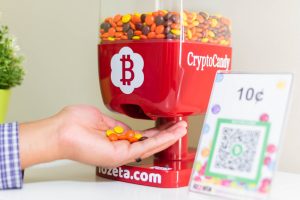 Lambert’s system uses an Iozeta touchless candy machine to dispense the chicken feed. Basically, users pay the QR code and the machine flips a switch to dispense candy, mealworms or anything else that will fit through the chute. The machine accepts bitcoin cash, litecoin, dash, and ravencoin, but Iozeta also manufactures a cryptocurrency power adapter. Paul Lambert, one of Iozeta’s co-founders, has explained how the candy dispenser works on :
Once the Cryptocandy candy dispenser detects a new payment to the cryptocurrency address you specify, it activates the ‘payment received’ light and the motion sensor, allowing for candy to be dispensed. When the customer has received the candy, the
motion sensor is again turned off.
Memochicken
BCH proponents have commended Lambert’s BCH-powered chicken feeding system on social media forums such as Twitter and Reddit. Many well-known cryptocurrency enthusiasts have also tested the system, including Coinbase CEO Brian Armstrong.
This is pretty great – i just fed some chickens with crypto
— Brian Armstrong (@brian_armstrong)
Moreover, has created an application called which the prolific BCH developer has described as a “fun but internally highly sophisticated” bitcoin app with a full event-driven architecture.
“(Post) a memo with Money Button, and pick up the real-time transaction event through Bitsocket, which then queries the Handcash handle $chicken for the receiving address, which then queries Coinbase price API for the currency exchange rate for $0.50 in BCH, and then finally send the chickens $0.50 in BCH, which triggers the already-so-cool chicken feeding Twitch stream by Spencer Lambert,” Unwriter explained after releasing the Memochicken application.
Lambert’s Twitch live stream and poultry feeding system can be seen . The chicken’s first breakfast feeding begins at 9:20 a.m. EDT every day.
What do you think about Lambert’s BCH-powered chicken coop? Let us know what you think about this subject in the comments section below.
Images via Shutterstock, Twitch, Spencer Lambert, Iozeta, and Twitter.
Want to create your own secure cold storage paper wallet? Check our section.
The post appeared first on .