
‘œI think that they don’t want to IPO right now, but they have no choice because they raised with the expectation that they would IPO, so they had to file and it had to look good, or as good as they could make it look.’
‘” Samson Mow
Interview location: Skype
Interview date: Thursday 18th October
Company: Blockstream (Samson Mow), Messari (Katherine Wu)
Role: Chief Strategy Office (Samson Mow), Director of Business Development (Katherine Wu)
The Bitmain IPO was to be the largest in history. Riding the 2017 bull run, Bitmain delivered staggering growth numbers with $billions in revenue and profit, but the bear market crash of 2018 has exposed fragilities in the business and raised many concerns with operations and strategy.
Coindesk reported this week that investors received false information around the most recent funding round, this alongside the significant questions surrounding the balance sheet, faltering innovation and the decision to support and prop up the price of bitcoin Cash is casting a shadow over the IPO.
In this interview, I discuss the IPO and the state of Bitmain with Blockstream’s Samson Mow and Messari’s Katherine Wu.
This episode is also on:

We built the Blockchain Wallet because we’re driven by a relentless passion for making crypto easy to use. We want everyone to be able to use it, not just invest in it.
We believe that owning and controlling your own private key is the single most important aspect of using crypto. Without a private key, you aren’t using crypto – you’re just speculating and you’re missing the defining part of crypto: user controlled, sovereign money.
It was enabling that exact need that underpinned the development of the Blockchain Wallet six years ago. The mission? Make it easy for every user to have their own private key, to get users away from storing funds at exchanges and “bitcoin banks”, and to enable everyone to be their own bank.
Fast forward six years and we’ve achieved a few things that we’re proud of:
Building the first cross-platform, non-custodial, and cross-chain wallet
Signing up 30 million wallets in 140 countries globally
Powering over $200 billion in consumer transaction volume and over 80 million consumer crypto transactions in the last two years alone
Championing the cause of financial sovereignty and user-control with regulators around the world. (We’ve spent thousands of hours and millions on education and outreach.)
Helping our users store millions of BTC, BCH & ETH coins and generate over a quarter of bitcoin network traffic alone
Most importantly, it’s been a honor and privilege to be the first place tens of millions of people turn in order to actually use crypto and hold their own keys.
But there’s a lot still to do.
At the end of the last bull run, we did a serious self-assessment and asked ourselves, what do users need that we aren’t delivering today? We identified four common requests and frustrations:
Better, faster ways for new users to get their first crypto and make their first transaction
More storage types, like hardware, as users’ balances increased
More assets as users want to store and use an increasingly diverse asset set
Better, more reliable sources of liquidity as trading and investing across assets continues to increase
Satisfying these demands meant building a huge extension of our platform, at scale. We’ve had our heads down much of this year doing exactly that and starting today we’re excited to begin delivering new solutions to you, beginning with two new capabilities.
First, we’re launching Swap by Blockchain: a next generation trading product with best-in-class liquidity and execution, powered by our new machine trading software platform that ensures best execution across assets. Blockchain Wallet users will now have access to exchange-like prices without giving up control of their keys or their crypto. And trade limits will increase from hundreds to thousands of dollars of crypto per trade.
While the system currently has deep liquidity drawn from a variety of sources, we plan to add more liquidity sources over time, including decentralized exchange protocols. We’ve rebuilt our risk and KYC systems, so that you can onboard with ease, in minutes. Swap ensures our users stay liquid and can trade at the best prices in the market, regardless of overall market volatility and challenges. We’ve started rolling Swap out today and everyone will have access over the next two weeks.
Secondly, we’re launching Lockbox: a hardware vault in your pocket, built in partnership with hardware leader Ledger. Lockbox is simple to use and is even more secure thanks to a locked endpoint that prevents phishing and spoofing attacks. It’s hardware made easy, with a setup that takes just a few moments thanks to our custom hardware-software integration.
With Lockbox you’re able to check your balance and receive transactions, on mobile and web, without the inconvenience of having to plug your device in every time. In an industry first, you’ll also be able to trade directly from your Lockbox while still maintaining your keys. In conjunction with Lockbox, we’re also excited to let current Ledger device owners seamlessly pair with the Blockchain Wallet and trade directly from the Ledger device they already own.
And we have more coming this year, including additional assets and new products within the Blockchain Wallet that will bring you new, faster, and better ways to get started in crypto.
We’re here to build a new financial system and the Blockchain Wallet is your passport to that new world. Store crypto, trade crypto, transact with crypto and most importantly truly own and control your crypto.
We’re dedicated to building the functionality you want, without compromising your control of your key. Your crypto is yours, and it should stay that way.

The Satoshi Revolution: A Revolution of Rising Expectations
Section 5: Saving the World Through Anarchism
Chapter 11, Part 5
In a Stateless Society, Crypto is Law and Justice
The economic analysis of crime starts with one simple assumption: Criminals are rational. A mugger is a mugger…because that profession makes him better off, by his own standards, than any other alternative available to him…. If muggers are rational, we do not have to make mugging impossible in order to prevent it, merely unprofitable….If little old ladies start carrying pistols in their purses, so that one mugging in ten puts the mugger in the hospital or the morgue, the number of muggers will decrease drastically–not because they have all been shot but because most will have switched to safer ways of making a living. If mugging becomes sufficiently unprofitable, nobody will do it.
-David Friedman, “”
The specter of aggression haunts every society. Crimes against person and property cannot be eradicated, unfortunately, because violent impulses are part of human nature, and crime can be profitable. The desire for safety and peaceful exchange is also part of human nature, however. It creates a market demand for the protection of individual “rights.”
How can society minimize and redress the violation of rights? This reduces to how individuals can address crime within an otherwise peaceful society.
Overwhelmingly, the crime against which crypto users must protect and seek redress is theft—not murder, not rape, not battery, not victimless crime, or crime against the state. Theft.
Focusing on one area of crime simplifies the problem enormously. Some argue that crypto’s remedy for theft is contained within the definition of crypto anarchism itself: the use of encryption and technology to achieve personal freedom by enabling privacy, autonomy, and self-empowerment. Encryption and technology. Most of crypto’s features provide specific protections to individuals, including irreversibility, transparency, pseudonymity, time-stamping, and private wallets.
But the protection is primarily against the state, especially against its trusted third party arm—the central banking system. Crypto anarchism needs to address private crime, the crimes individuals commit against each other. Those crimes occur at points of intersection, at points where people access or exchange with each other. Again, the solution is the free market. Safety and the redress of crime are both services, like insuring a car or retaining a lawyer. In a real sense, people realize this. They pay for the service of safety and redress through the collective bill of taxation that funds police and court systems.
Many people discuss the inadequacies of these services. But only anarchists claim the problem is that the services come from the state. People simply take it as a given: the state supervises violence. It is such a deep assumption that protecting against violence is the first and last argument the state uses to justify its existence. Without my presence, the state declares, the street would run red with blood and enemy armies would surge across the border. Odd. It is widely acknowledged that every other service required by society can be provided privately, but security cannot be addressed or redressed through voluntary exchange.
Anarchists disagree. They object to the grave mistake of granting the state a monopoly over a basic human need, which destroys the very possibility of a free society. They understand: private money and self-banking cannot co-exist in narrow parallel with central banking because the state attacks any threat to its authority. This is happening already. The state is playing catch-up in order to rein in the crypto that flows outside its control. The spread of “wild crypto” is irreversible, however, in much the same manner as the black markets that thrive despite or due to repression.
The monetary systems run in parallel only by maintaining a sharp separation. The state is a money and banking monopoly with the goal of social control; crypto is its antithesis. In close proximity, one will destroy the other. The same would be true of any free-market institution that serviced the human need for safety. The state would try to control or destroy it as a threat to its own monopoly. The state and society are either-or. Crypto anarchist and security expert Pavol Luptak . “Personally, I don’t like black & white plots, but it seems we will live either in a digitally free society or digital dictatorship. Even now, we can see an intense polarization of society splitting into the government’s controlled dictatorship and parallel free crypto societies at the same time. Unfortunately, I don’t think there is a place for some other alternatives.”
To grasp the depth of this either-or choice, it is useful to sketch a broader context for the conflict.
The State’s Monopoly of Self-Defense Leads to Totalitarianism
A society that robs an individual of the product of his effort, or enslaves him, or attempts to limit the freedom of his mind, or compels him to act against his own rational judgment—a society that sets up a conflict between its edicts and the requirements of man’s nature—is not strictly speaking a society but a mob held together by institutional gang rule.
—Ayn Rand, “The Nature of Government”
Free exchange is natural to the institutions that comprise society, including family, the marketplace, education, and art. These systems evolve spontaneously in response to human needs and desires. They are the reason why individuals band together in the first place, instead of living in isolation. Through natural networks, individuals enrich themselves, fulfilling requirements that are both physical and psychological.
The extent to which violence intrudes into natural institutions is the extent to which the institutions become their own mirror opposites. This is true of the intrusion of private crime. Domestic violence converts a home from a place of safety into one of danger. Fraud transforms a business from a place of mutual exchange into one of victimization.
It is also true of violence that is entrenched within society, as with a state. A key difference? New institutions are created by the state in order to circumvent the human instinct to defend against violence, if only by avoiding where or how it happens. These new and artificial institutions are often monopolies that displace their free-market counterparts. The extent to which such artificial institutions intrude upon society is the extent to which the benefits of society are destroyed. Taxation reduces the benefit of productivity. Central banks introduce third-party theft into commerce. Police use guns and threats to preserve the peace.
The freedom level of a society can be measured by the ratio of its artificial to natural institutions. When there are few to none, the society is called “free”; the individuals within it receive immense benefits from interacting. When artificial institutions dominate, the society is called “totalitarian”; the individuals within suffer and face unnatural choices. They can live in quiet and obedient despair. They can risk becoming outlaws on the economic or intellectual black market. They can become thugs and join with those who administer the violence. Or they can flee to a place with less entrenched violence. When these are the choices individuals confront, civil society is dead.
Those are the stakes in play on how a society deals with safety: nothing less than freedom versus the state. As long as the state can convince people that its monopoly on the use of violence is necessary to guarantee safety, then the state can justify its existence. Once the state has that monopoly, it has everything.
Crypto “solved” the embedded violence of central banking. It did so through a stunningly brilliant insight and application of political theory: the trusted third party problem. Central banks forced individuals who wished to function in modern commerce to use them as an intermediary and so to participate in the fiat money and fiat banking that defrauded them at every turn. The banks reported personal and financial data to an umbrella trusted third party—the state. Layer after layer of intermediary institutions killed not only personal freedom but also the freedom and benefits of society. Until bitcoin sidestepped the institutional violence.
Equally, crypto needs to develop ways of handling private criminals who rob, extort (ransomware), and defraud. The strategies used on state violence will not work. Bypassing trusted third parties will not work on private crimes that are peer-to-peer. What would work?
Crypto’s Greatest Political Challenge
Private crime is the Achilles Heel of crypto. Users who view crypto merely as a way to make money, rather than as a promise of freedom, want state involvement to ensure a safe haven that is modeled on central banks. Every high-profile case of private crime is used as a reason to call for regulation. The Satoshi Revolution‘s final challenge is to suggest free-market methods by which the community can address private violence. The focus is not on the unpredictable breakthroughs in technology that are destined to change how crypto deals with crime. (Prevention has been discussed previously.) The focus is on the make-up of the institutions and methods through which crypto can minimize crime and provide remedies when it occurs.
Technology is able to adapt in a snap. But this means that economic and social patterns evolve as quickly. Crypto, the blockchain, 3-D printing, and robotics are among the game-changing technologies that are reshaping the world in their own images. And this evolution will only accelerate. The transformation of politics will be extreme. It is about time. Today’s political system emerged from the Industrial Revolution and it grew over centuries of war after war. The state’s characteristics include massive bureaucracy, extreme centralization, nationalism, and crony capitalism. But a new revolution is in town. Crypto’s characteristics include peer-to-peer exchange, decentralization, a flow without borders, and the lack of governmental privilege. Politics has already changed, whether politicians know it or not.
Anarchism, liberty, does not tell you a thing about how free people will behave or what arrangements they will make. It simply says the people have the capacity to make the arrangements. Anarchism is not normative. It does not say how to be free. It says only that freedom, liberty, can exist.
—Karl Hess, “Anarchism without Hyphens”
How will crypto prevent and remedy private crime? It is difficult to say, for many reasons, including the unpredictability of technological advances. Some of the obstacles:
The state regulates or bans any threat to its authority. This is especially true of law enforcement and the use of force, which are mother’s milk. One result: few anti-crime institutions exist that have not been defined by their need to comply with laws of the state. Even private police forces mimic state ones.
People base their assumptions on what they are taught and what they have seen. If they had been taught that the food supply requires a centralized coordination by the state and they had seen nothing else, then they would laugh at the very idea of the free-market spontaneously coordinating agriculture, transportation, canning factories, and grocery stores. The same is true of the free market coordinating safety.
The state does not encourage research and development into alternative forms of justice that are outside of its control. 3D-printed guns are an example. 3-D guns allow individuals to defend themselves without surrendering their privacy to authorities. The state’s response? The pioneer of 3-D weaponry, Cody Wilson, has been arrested on what appear to be “set-up” charges.
The entrenched assumptions of the public are against crypto solutions. The assumptions include: one law must cover everyone in a geographical territory, not a mosaic that reflects personal choice; and, the primary purpose of law is punishment, not restitution.
Armed with caveats, the next step is to explore a practical method by which crypto anarchy can deal with private crime. Like crypto itself, the method has to be individualistic, decentralized, transparent, and entirely private. The best place to begin is with an analogy that has already been drawn: car insurance.
[To be continued next week.]
Reprints of this article should credit bitcoin.com and include a link back to the original links to all previous chapters
Wendy McElroy has agreed to ”live-publish” The Satoshi Revolution exclusively with bitcoin.com. Every Saturday you’ll find another installment in a series of posts planned to conclude after about 18 months. Altogether they’ll make up her new book ”The Satoshi Revolution”. Read it first.
The post appeared first on .

The majority of cryptocurrency traders recorded losses on their investments last month, according to a report we’ve covered in The Daily. In this edition, we also look at the new debit cards allowing customers in Singapore to spend cryptocurrencies anywhere Visa is accepted and the decision of a large cryptocurrency mining company to move one of its farms from Sweden to Colorado.
Also read:
Report Depicts Bleak September
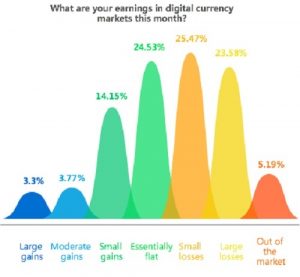 September was a busy but not an optimistic month for the crypto space, according to a report published by OK Blockchain Capital – the investment arm of OK Group, operator of cryptocurrency exchange . The monthly survey among investors found that most of them had suffered small losses (25.47%), “essentially flat” (24.53%) or large losses (23.58%). A little over 14.15% of traders made small gains, while another 5.19% remained on the sidelines. The market situation was rather bleak, the authors have concluded.
The study confirms a continued downward trend in the value of digital assets throughout September. However, the trading volume rebounded significantly toward the end of the period. According to the aggregated data, the average global daily market cap of digital assets was $211.103 billion, down 10.27% from August. At the same time, the transaction volume reached $13.526 billion, up 5.15%. The top three cryptocurrency holdings last month were BTC (23.11%), EOS (16.04%) and ETH (12.26%).
The report also lists the industry buzzwords for September, including , bitcoin mining machines, , and the Ethereum “Difficulty Bomb.” Iran’s decision to cryptocurrency mining, the ongoing court proceedings around the in India, and regulatory developments in and the are mentioned among the most important global policy news items.
Crypto Debit Cards Issued to Customers in Singapore
 Cryptocurrency platform and payment provider Crypto.com has announced it is now shipping the new MCO Visa Cards to customers in Singapore. The are linked to a mobile wallet that allows holders to buy, sell, store, send, and track cryptocurrencies, the company formerly known as Monaco explained in a post published on Medium this week.
With the wallet app, users can order an MCO card, control its usage and manage all transactions. They will also be able to freeze or unfreeze their card. The metal cards come with free ATM withdrawals and no annual or monthly fees. The cards issued by Crypto.com will enable customers to spend digital coins converted to fiat money anywhere Visa is accepted.
The service supports cryptocurrencies like bitcoin core (BTC), ethereum (ETH), Binance coin (BNB) and the platform’s own MCO token as well as major fiat currencies, including the U.S. dollar, euro, British pound, Singapore dollar, Hong Kong dollar, Japanese yen, and Australian dollar.
MGT Moves 6,000 Miners From Sweden to Colorado
 MGT Capital Investments, a company involved in cryptocurrency mining operations in the State of Washington and in Northern Sweden, has announced it concluded a hosting agreement for a new facility in Colorado. MGT has been exploring options to relocate more than 6,000 S9 Antminer devices that are currently installed in its bitcoin farm in the Scandinavian country.
“We have identified and successfully negotiated a deal with a U.S. facility that nicely suits our needs,” said MGT’s Chief Operating Officer, Stephen Schaeffer. “This location is capable of not only providing a cost-effective solution to our relocation needs, but also facilitates our growth plans for 2019,” he added, as quoted in a press release.
The facility in Colorado Springs, a former semiconductor campus, has an initial capacity of 10MW of electricity but the electrical infrastructure can support an additional 30MW of power. MGT Capital intends to complete the relocation and restart mining operations in the new location by the end of 2018.
MGT Capital Investments is one of the largest cryptocurrency mining companies in the U.S. where it operates around 6,800 Bitmain S9 miners.
What are your thoughts on today’s news tidbits? Tell us in the comments section below.
Images courtesy of Shutterstock, Crypto.com.
Make sure you do not miss any important bitcoin-related news! Follow our news feed any which way you prefer; via Twitter, Facebook, Telegram, RSS or email (scroll down to the bottom of this page to subscribe). We’ve got daily, weekly and quarterly summaries in newsletter form. bitcoin never sleeps. Neither do we.
The post appeared first on .
