March 30, 2026

Capitalizations Index – B ∞/21M

Weighing the Pros and Cons of the EOS platform

BTCMANAGER
Weighing the Pros and Cons of the EOS platform

EOS developers believe that they found a solution to the scaling problem that currently plagues most cryptocurrencies, including bitcoin and Ethereum. EOS is a smart contract platform that is scheduled to launch its mainnet in June 2018 with its development being led by noted blockchain engineer and developer Dan Larimer. He was also the founder of Bitshares and the co-founder of Steemit.

Notable Features of EOS

EOS wants to bring the best of all other smart contract technologies to one platform. As such, it offers a blockchain architecture that aims to enable the development of decentralized applications. Developers can build, test and execute their projects on the operating system-esque EOS blockchain.

Ethereum and bitcoin use the proof-of-work (PoW) consensus mechanism to verify transactions. As a result, all miners need to validate a new transaction before it can be added to the ledger. This mechanism often results in the slowing down of the network and an increase in the time taken to process news transactions. In 2014, however, Dan Larimer pioneered the Delegated Proof of Stake (DPoS) consensus mechanism as a solution to this problem.

DPOS Decentralization vs bitcoin & Ethereum #eosio #bitcoin #ethereum pic.twitter.com/99xbvQlARp

— Daniel Larimer (@bytemaster7) May 6, 2018

EOS also works on the DPoS consensus mechanism and has only 21 block producers who are responsible for validating each block. Having only 21 full nodes to confirm a transaction results in a net increase in the number of transactions that can be processed every second. Each block producer can mine only one block at a time.

They take turns to mine a new block after every half a second. If a block producer passes up the chance to mine a new block during his turn, no block is mined in that time frame.

Dan Larimer had warned that a majority of bitcoin’s mining resources could end up in the hands of a few select people, threatening the primary aim of decentralization. He proposed the DPoS mechanism allowing any node on the network to become a block producer, provided it could get the majority support or votes needed. Any such producer can also be stripped of its power and authority if it does not follow the rules of the EOS blockchain.

Criticism of the EOS ICO

The EOS project came under heavy criticism as it raised a whopping $700 million through its ICO, despite not having a working prototype of the EOS mainnet. The EOS digital coin is the fifth largest cryptocurrency by market capitalization.

Valued at ~$18 at current market prices and boasting a market capitalization of $14.57 billion, it will perhaps not be redeemed until the EOS mainnet is ready. As is standard for this space, zero utility did not seem to be a hindrance for potential investors.
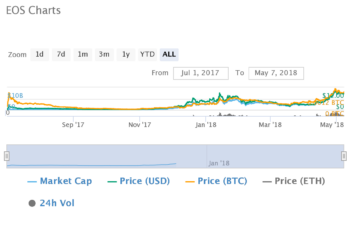
Eos price chart

(Source: Coinmarketcap)

At the time of launch, one EOS token was valued at $1 on July 01, 2017. For most of October 2017, it slipped below $1 as anxious investors waited for a prototype of the EOS blockchain.

The post Weighing the Pros and Cons of the EOS platform appeared first on BTCMANAGER.

Previous Article

Bitcoin ABC Developers Address a Vulnerability Found

Next Article

InsurePal Co-founder Tom Volk on Planet TV

You might be interested in …

Ivy Playground for Bitcoin: Experimenting With the Future of Bitcoin Smart Contracts

IvyChain.jpg

Blockchain developer Chain is releasing an open-source compiler and development environment for writing Bitcoin smart contracts using Ivy, a smart contract language developed in-house.

Chain is best known for the open-source Chain protocol and Chain Core, an enterprise blockchain infrastructure that facilitates financial transactions on scalable, private blockchain networks. An open-source developer edition of Chain Core is available to developers, with a testnet operated by Chain. Ivy was developed at Chain as a smart contract language for Chain Core. With Ivy for bitcoin, which compiles to bitcoin Script, Chain wants to make it easier for average programmers to write smart contracts for the public bitcoin network.

By design, bitcoin doesn’t include a Turing-complete programming language for smart contracts of arbitrary complexity. But this doesn’t mean that bitcoin doesn’t support smart contracts. In fact, the simple, low-level, primitive operations included in bitcoin’s native scripting language (bitcoin Script) can be exploited to write smart contracts of significant complexity. “bitcoin Script does provide a set of useful primitives — signature checks, hash computations, and absolute and relative timelocks  — and the freedom to combine those primitives,” notes the Chain news release.

However, bitcoin Script is not being fully used by software developers, which according to Chain is due to “the relative difficulty of reading and writing bitcoin Script programs, and of creating and using addresses from those programs.” In fact, bitcoin Script is a very low-level, assembly-like language, which doesn’t offer the readability and ease of use of high-level programming languages. Therefore, most bitcoin programmers limit themselves to simple applications, without pushing bitcoin Script to its limits.

The Chain developers want to change that with Ivy, a higher-level language that allows developers to create custom, SegWit-compatible bitcoin addresses that enforce arbitrary combinations of conditions supported by the bitcoin protocol, including signature checks, hash commitments and timelocks.

Earlier this year, Chain released Ivy Playground, a tool for designing, drafting and testing smart contracts on a Chain Core blockchain network with Ivy. Now, Chain is making Ivy available to bitcoin developers and releasing Ivy Playground for bitcoin, which allows developers to design, create and spend simulated bitcoin contracts. The playground includes preloaded smart contract templates for bitcoin and developer documentation.

A disclaimer states that Ivy is relatively untested prototype software and should be used for educational and research purposes only. “Do not attempt to use Ivy to control real Bitcoins,” warns the front-page document.

Besides Chain, other developers are realizing that bitcoin needs more sophisticated smart contracts and user-friendly programming environments for smart contracts. Recently, blockchain developer Blockstream introduced Simplicity, a new programming language for blockchain-based smart contracts, intended for inclusion in Blockstream’s sidechains and eventually in bitcoin. Lead developer Russell O’Connor said that “after extensive vetting,” Simplicity support could be considered for inclusion in one of the next releases of bitcoin.

In the Blockstream announcement, O’Connor noted that Ivy’s programming language development efforts may be suitable for being compiled to Simplicity. But it now appears that Ivy’s progress toward these more sophisticated bitcoin smart contracts is advancing faster than some might have expected.

The post Ivy Playground for Bitcoin: Experimenting With the Future of Bitcoin Smart Contracts appeared first on Bitcoin Magazine.