September 2, 2026

Capitalizations Index – B ∞/21M

Weekly Price Overview: NEO, April 26

Weekly price overview: neo, april 26

Weekly Price Overview: NEO, April 26

The views and opinions expressed here are solely those of the author and do not necessarily reflect the views of Cointelegraph.com. Every investment and trading move involves risk, you should conduct your own research when making a decision.

The market data is provided by the HitBTC exchange.

NEO has been an underperformer in the ongoing recovery from the lows. It has dropped to the tenth spot in terms of market capitalization.

Many believe that NEO’s potential will be fully realized only in about 3-5 years from now, so it seems to be a good idea to ‘hodl’ the cryptocurrency through the dips.

Let’s look at the charts and try to analyze its long-term and short-term potential.

Weekly chart

Neo/usd

Post listing, NEO exchanged hands below $1 for a long time. Then, at the end of May 2017, the price started to rise and hit a high of about $58 levels in August of last year.   

After such a sharp rally, it was logical to expect some profit booking, and that is what happened. Prices corrected to the 20-week EMA but managed to stay above it until early December.

The cryptocurrency again broke out of the range in mid-December, and the up move topped out around the $200 mark in mid-January 2018. The ensuing correction reached a low of just about $44 levels in early April of this year.

If history is an example, the digital currency rallies hard, follows it up with a deep correction and after a period of consolidation the up move resumes.

In the current bear phase, NEO has completed a sharp correction, we can now expect it to consolidate for a few weeks and then resume its uptrend once again. Currently, the 50-week SMA is providing support, while the 20-week EMA is acting as a resistance.

Let’s identify the important levels on the daily chart.

Daily chart

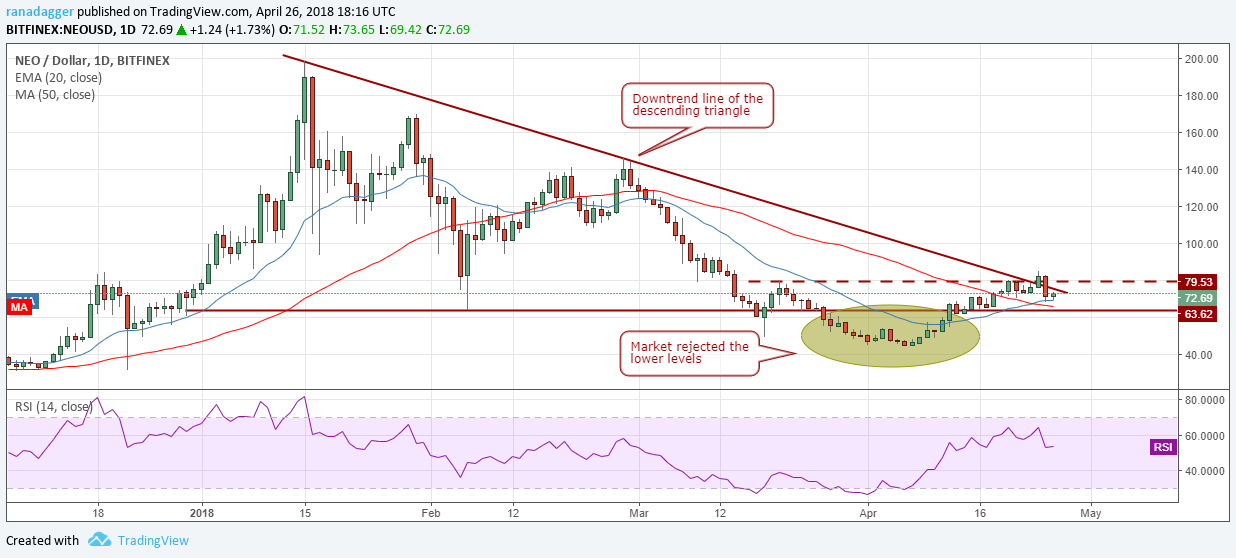
Neo/usd

The NEO/USD pair recovered smartly from the lows but is facing a stiff resistance at the downtrend line and the horizontal line around the $80 mark. Though the bulls succeeded in breaking out of $80 on April 24, they could not sustain the highs, and the price dipped back below the trendline on the very next day.

Currently, we find a rounding bottom pattern, which will complete on a breakout and close above $80 levels. This has a pattern target of $115. Another possibility is that, above $80, there is a minor resistance zone between $92.5-$95.5. Once this is crossed, the cryptocurrency could skyrocket to $140 levels.

On the other hand, if the price breaks down below both moving averages and $64, it will become weak and slide back towards the early April lows.

Can we make use of the information above?

How to trade the NEO/USD pair now

Long-term investors can expect a few weeks of consolidation, but history suggests that the next trending move should be to the upside. Therefore, they can wait and buy NEO on dips and keep a stop loss of $40.

Short-term traders can wait for a breakout above $85 to establish long positions with stops around $65 levels.

Traders who follow us and are long at $64 levels should maintain their stops on the remaining position at breakeven. Currently, the cryptocurrency is finding support at the moving average. A bounce and a break above $85 should reward the traders immensely. Hence, hold the position with the designated stops.

The market data is provided by the HitBTC exchange. The charts for the analysis are provided by TradingView.

Published at Fri, 27 Apr 2018 01:38:34 +0000

Altcoin

Previous Article

How to Trade Cryptocurrencies with the SimpleFX App

Next Article

Ex-especialista técnico do Alibaba P8 se junta à BitRabbit

You might be interested in …

BIP 91 Has Activated. Here’s What That Means (and What It Does Not)

BIP91.jpg

It looks as if bitcoin is getting Segregated Witness.

Bitcoin Improvement Proposal 91 (BIP 91) just locked in. Up to 90 percent of all hash power signaled support for this soft fork, which implies miners intend, in turn, to trigger Segregated Witness (SegWit) activation. By extension, this should make BIP 148 obsolete and August 1 a non-event.

But SegWit is not certain. In fact, on a technical level, SegWit is not any closer to activation at all.

BIP 91

Segregated Witness, defined by BIP 141, locks in if at least 95 percent of miners (by hash power) signal support for the upgrade within a two-week difficulty period. To do so, miners need to embed a piece of data called “bit 1” in the blocks they mine.

Importantly, this is technically the only way for SegWit to activate right now. And this threshold has not yet been met.

But there are alternative strategies to try and reach this threshold “indirectly” — like BIP 91.

BIP 91 is a bitcoin Improvement Proposal proposed by Bitmain Warranty engineer James Hilliard. It is compatible with the New York Agreement and backed by a number of bitcoin companies and mining pools. It is also compatible with BIP 148, another strategy to meet the BIP 141 threshold indirectly.

Miners have been signaling support for BIP 91 over the past couple of days through another piece of data, “bit 4.” Once 269 blocks within a 336-block window include bit 4, this BIP 91 soft fork gets locked in. This threshold was just met.

This means that after another 336 blocks, a little over two days from now, all BIP 91–compatible nodes will reject any block that doesn’t include bit 1.

As long as a majority of hash power enforces BIP 91, this majority should eventually control the longest valid chain according to all bitcoin nodes. And as this chain consists of bit 1 SegWit-signaling blocks only, it would in turn activate SegWit on all SegWit-ready nodes.

In that case, BIP 141 should lock in by mid-August, and SegWit should be live on the bitcoin network after a two-week “grace period” by the end of that month.

If all goes well …

What Could Go Wrong?

Although well over 80 percent of hash power has signaled bit 4 for BIP 91 activation, this doesn’t actually guarantee anything. Most importantly, it doesn’t in itself mean that these miners will signal bit 1 for SegWit.

Indeed, so far, most miners don’t. Currently, the proportion of miners signaling bit 1 is still far lower than BIP 91 activation would suggest. It is even lower than 50 percent.

Moreover, BIP 91 is probably being enforced by hardly any economically relevant nodes; that is, nodes operated by users that accept bitcoins as payment. Almost no bitcoin users on the network recognize BIP 91 or its bit 4 signaling at all, and will therefore continue to accept blocks with or without bit 1.

BIP 91 is, instead, enforced by hash power alone. This in turn means that a majority of miners (by hash power) could back out of BIP 91 with little more than reputational damage. They could continue to mine blocks that do not signal bit 1, even after BIP 91 activates in a few days. As long as these miners are in a majority, they will still control the longest valid chain: valid according to most miners, and valid to most users.

Furthermore, any minority of miners and the few nodes that do enforce the BIP 91 soft fork would then be forked off the bitcoin network. In a few days from now, these miners would mine (on top of) blocks that almost only they themselves would consider valid, while most of the rest of the entire bitcoin network would completely ignore them. These miners would be wasting their own resources.

With this week’s bit 4 signaling, a majority of miners have effectively made a statement that they intend to start to activate the SegWit soft fork within a couple of days. But for now, that’s really all it is: a very public, blockchain-based statement of intent.

Actual SegWit activation should start next week, if miners stick to their stated intent.

The post BIP 91 Has Activated. Here’s What That Means (and What It Does Not) appeared first on Bitcoin Magazine.