 5000 ETH Giveaway!We are giving away ETH to our followers. To identify your address, just send from 0.5 to 9 ETH to the address below and get from 5 to 90 ETH back!
 If you are late, your ETH will be sent back.
Address: 0x1ba70fa98521e212E687acaDa82549dAfB2017e4
RULES-
Multiple transaction rejected. ( Sending eth from same address more than one time can cause you disqualification or rejection from the giveaway ).All Late transactions will be reversed automatically. ( Our bot work automatically in case if you are late then your eth will be sent back )Beaware of other eth promos because this is the only one we’re providing on medium through twitter.
was originally published in on Medium, where people are continuing the conversation by highlighting and responding to this story.

Last week Distributed.Fund organized its first meetup in Moscow — for — with more than 80 attendees, mostly IT/tech specialists and developers. And it was a blast!
We had , Vice President of Block.one, talk about EOS.IO governance and explain the details of EOS ecosystem. The audience actively engaged in the presentation, and a lot of topics were covered: governance structure, voting, scalability and so on.
This is just a start — Distributed.Fund will keep bringing community, developers and projects together to facilitate the industry development and make a better, decentralized future — a reality.

Full video from the event will be soon available on YouTube. Special thanks to Thomas Cox, Olga Suvorova, and Eugene Luzgin for helping make the event a success!
Stay in touch with us — Distributed.Fund: |
 OUR PRODUCTS
Betrium is the solution developed by group of entrepreneurs and MIT & MIPT graduates offering the first partly decentralized worldwide betting service (betting exchange & sportsbook) with zero-commissions accepting crypto-currencies and offering platform for event organizers, developers and thirdparty service providers.
Developed by MIT & MIPT graduates, Betrium is the partly decentralized worldwide betting exchange and sportsbook that has lowest commissions, accepts cryptocurrencies and offers platform for event organizers, developers and third-party service providers.
Our Vision
The gambling industry is developing and moving towards. Gambling already takes a part in most people lives and the Market Review illustrates this. We do not respect traditional betting services due their unfair conditions and other problems described in “Problems” section. Our mission is to change that.
In Betrium bets happen off-chain and only added when the event happens and the outcome is undeniable. However the bets are broadcasted all over the network instantly for the odds to be recalculated.
That means, in contrast to competitors, we are able to provide high-speed betting service built on decentralized IT architecture. Any solution powered just by Ethereum blockchain simply can’t provide the speed required for professional betting/trading on sports.
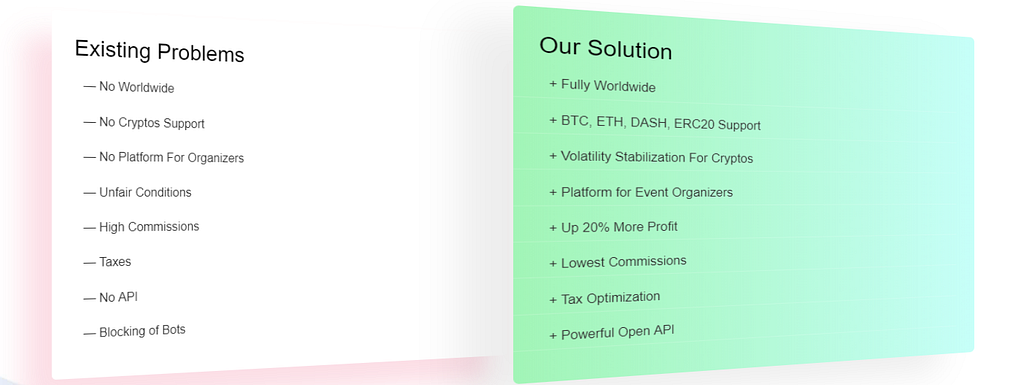 ADVANTAGESORGANIZERS EARN PLATFORM
Betrium provides unique betting creation platform for event organizers such as e-sport streamers or small sport leagues.
WORLDWIDE SUPPORT
Betrium works globally and supports crypto-currencies withdrawals all around the world. 24/7 support on 18 languages.
LOWEST COMMISSIONS
Betrium does not take comission from money deposits and withdrawals, winnings. We also do not take taxes on personal income.
BETRIUM FEATURESPlatform for Organizers
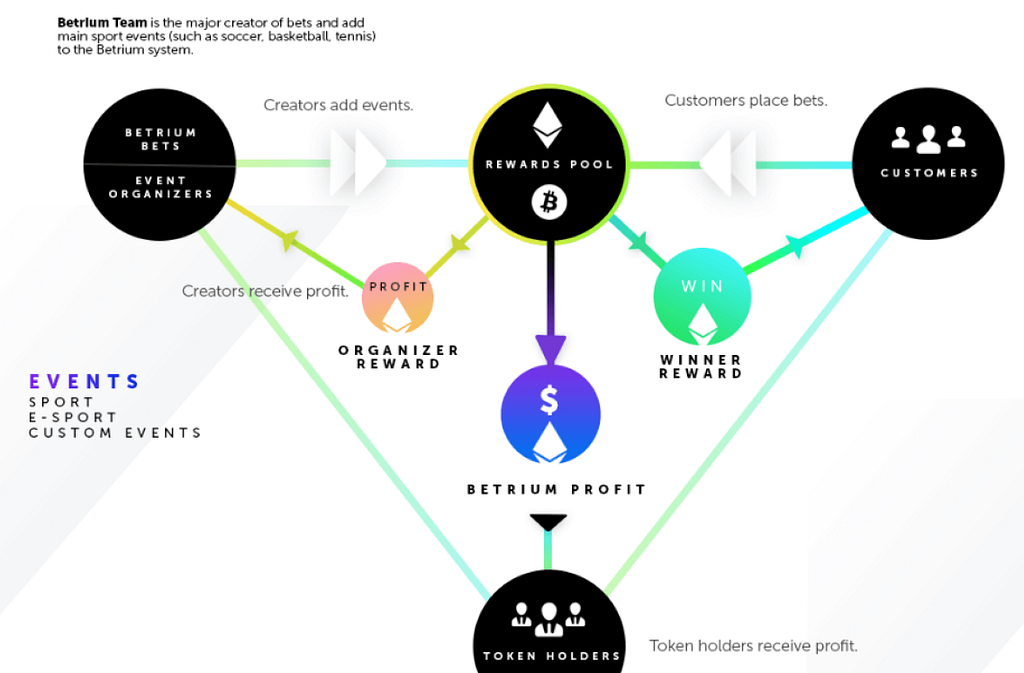
Betrium provides special partner solution for event organizers that want to earn money. Each owner of the Betrium Network account is able to create custom event and earn on betting just in few clicks. For example, e-game organizer (or player) can create the match on the Betrium, add potential outcomes and publish it. Betrium will automatically adjust the odds to make it profitable.
Powerful API
Betrium is the first to offer advanced Open API for developers, bots, third-party apps and betting service providers. Our Team develops Betrium Framework for the most popular software platforms.
Profit Sharing
Profit share: 50% of annual profit. Each BTRM token holder regularly receives a half of Betrium’s profit and that is the key element of our token growth mechanism. Therefore, the Betrium token is directly backed by Betrium financial success and has a real increasing worth.
No Volatility / Hedging
We offer crypto-currencies volatility stabilization for users. In Betrium, balances will be fixed in the virtual USD/EUR, so users are protected from losing in regular dumps. We’re going to achieve that by integrating some exchange functionality (USD/BTC/ETH) and future partnerships with different local and worldwide exchanges.
Legal Activity
Despite the fact, that Betrium’s nature can’t be regulated, our goal is to make our platform as legal as possible. We will act fully within the law under Curaçao license for online gambling. Curaçao is the most popular offshore and e-zone for such purposes and it is used by many current biggest betting providers, online casinos and poker. Moreover, in future we plan to get licenses in: Malta, UK, Germany, Australia, USA.
 DASHBOARD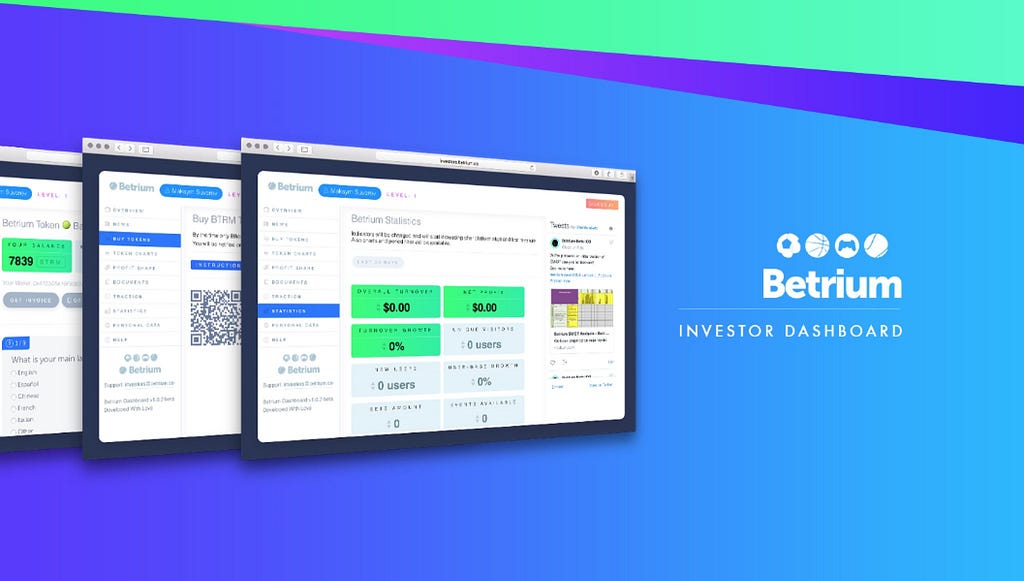
We have launched the special dashboard for investors! The solution will allow investors to manage and control profit share, to view Betrium’s statistics and achievements, to get and request different documents, track token price etc.
TOKEN DETAILS
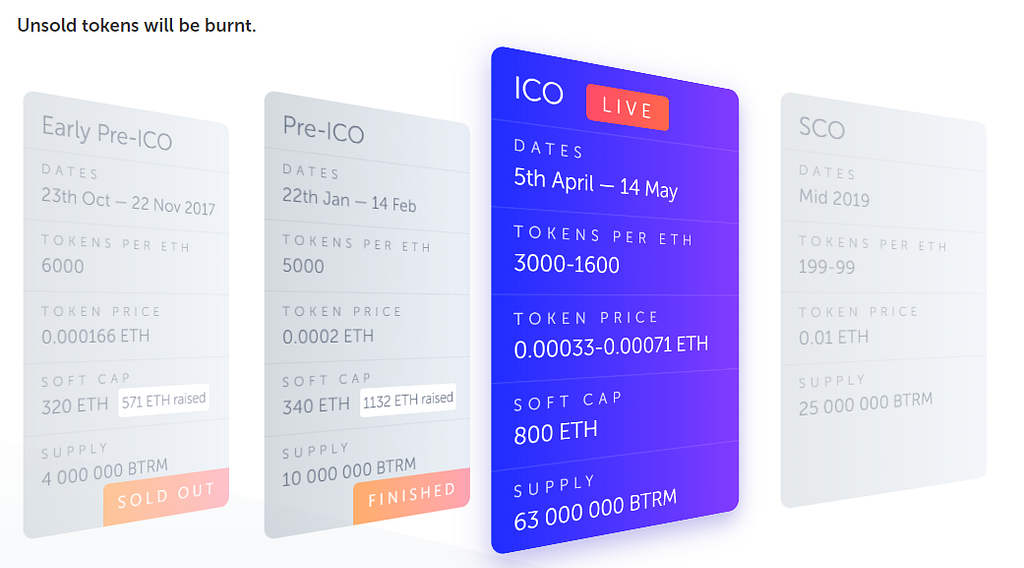
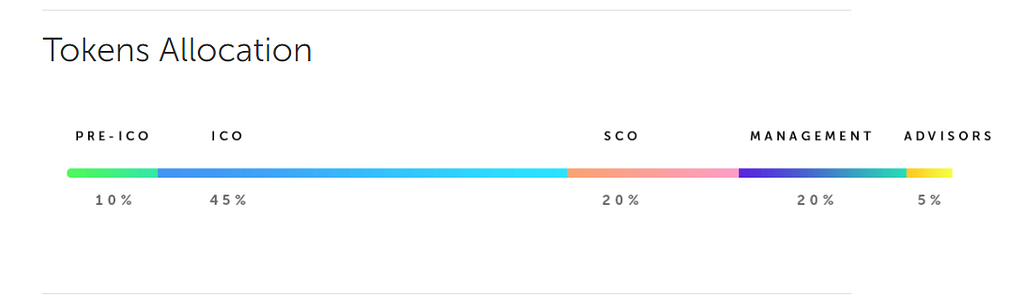
To achieve Betrium’s goals, we are launching an Initial Coin Offering to issue Betriums tokens on the public blockchain. BTRM is an ERC-20 token build on Ethereum. A total of 140m BTRM will be issued only. The tokens will be issued during the pre-ICO and ICO.
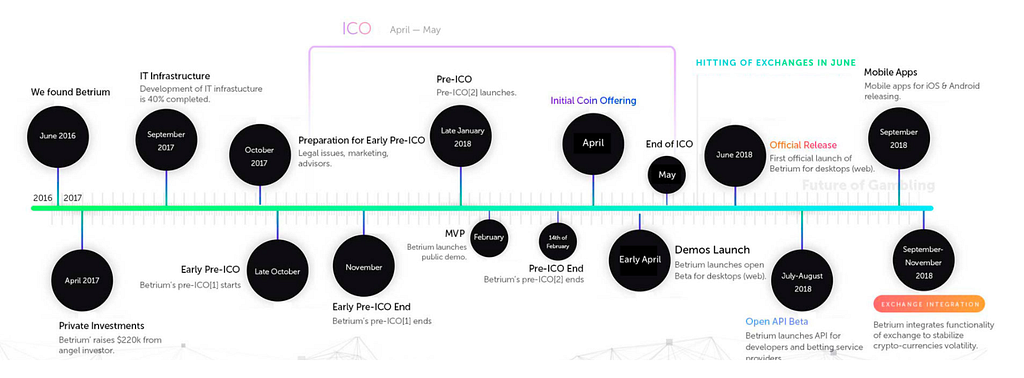
 ROADMAP
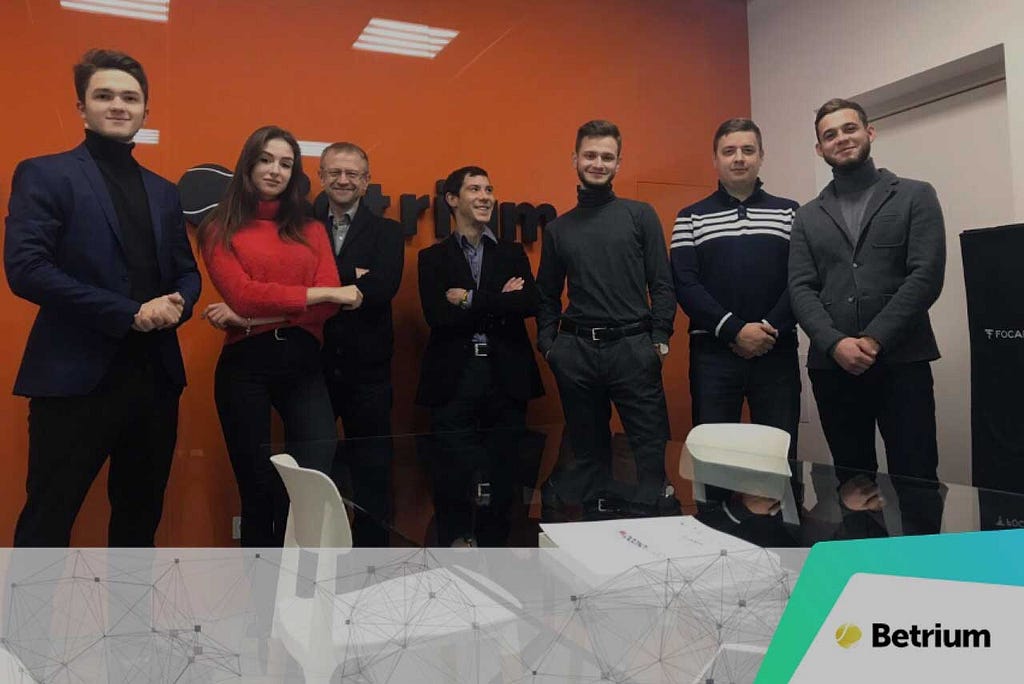
 MEET THE TEAM
 FOR MORE INFORMATIONS :
|
| | |
MY PROFILE :
[Tomicah Tillemann] [Talks at Google]
 Tomicah Tillemann
[Guest] Dr. Tomicah Tillemann
Chairman of the Global Blockchain Business Council, Co-founder of the Blockchain Trust Accelerator, Advisory board of the BitFury Group.
[Moderator] Jaka Jaksic
Senior Software Engineer of Google, Co-founder and CEO of JTechLab.
[Jaka]: I’m sure most of you guys are already familiar with blockchain and cryptocurrencies. But Tomicah, can you please just briefly explain those concepts.
[Tomicah]: Absolutely. And I should clarify that I spend most of my time explaining these concepts to audiences that maybe spend a lot of time working on high level policy issues or are C level executives in big corporations, but don’t know that much about technology. I realize that is not the case today. So I am thrilled to have an audience here that I’m sure will have incredible insights on the technical aspects of this technology beyond some of the policy and business components that we’re going to discuss today. Blockchain at its core is just a record. It’s a very simple concept to wrap your head around. Humanity has been using records for about 5,500 years, since the time of Sumerian tablets. So in that sense, this is not something that new. But it has two dimensions that are big innovations. And when you put those together, it unlocks functionality that we have never had access to before. The first thing to know about blockchain is that it is distributed. It is stored in the case of bitcoin blockchain on thousands of computers all over the world. All of those computers contain an identical copy of the record. And what that means is that they’re constantly checking each other to ensure its accuracy and integrity. So that’s one important dimension of this. The second is that it is permanent. Once a piece of data is entered in to a data block, and locked into that chain, hence the name, you can’t change it. You can update the information, but you can never erase the information. So if a government wants to wipe out the contents of a blockchain, it can’t do it. If a company wants to wipe out the contents of a blockchain, it can’t do it. They are designed to be incredibly resilient and incredibly secure. And those are very important too when it comes to this permanence that we’re talking about. When you put those two pieces together, the distributed nature of the record and the permanent nature of the record, it provides the opportunity to do some things that we’ve never been able to do before. It is an independent source of truth for any information that you put in. You can validate that something was created at the time you say it was created. Because it’s logged in the blockchain. And again, nobody can monkey with it once it’s there. You can assure that a vote has been tabulated correctly if it’s hashed to the blockchain. You can insure that a property record has been registered in the way that it’s supposed to be registered. It has the potential, by virtue of this independent, distributed, and permanent functionality, to solve a lot of problems around trust, a lot of problems around corruption, and a lot of problems around transparency. And those are big issues that we are wrestling with in the world today. And because of that, I feel it’s a very important technology for all of us to hopefully put our arms around.
[Jaka]: I agree. Do you think there’s any doubt at this point that blockchain technology is going to become mainstream?
[Tomicah]: It’s a great question. I think blockchain technology today is in very much the same place that the internet was in about 1993 or 1994. And what that means is that this could go any number of directions. There is no foreordained course for the technology. But the functionality is incredibly important. And again, the functionality enables us to do so many things that we’ve never been able to do before, that the functionality probably isn’t going anywhere. Theoretically, somebody could come along with a technology that will provide that same functionality in a way that is potentially a little bit cheaper or potentially a little bit more efficient. So that could theoretically, again, derail adoption of the technology. But in terms of what it can do, that is here to stay. And I would imagine, I would expect, that it will become a ubiquitous technology in the course of coming years.
[Jaka]: So with your experience in politics and civic institution, can you describe your vision for global adoption of blockchain and what are the key steps in this transition?
[Tomicah]: That is a big question. And we could probably spend the better part of our time here discussing that. A couple of things. First, bitcoin, which is the application of blockchain that most people are familiar with. And again, I imagine it is not a news announcement to those in this room. But blockchain was originally developed as the rails to power bitcoin, and has since been adapted into a variety of different applications. bitcoin is already gaining pretty broad global adoption. And the first place where you are likely to see blockchain applications take hold is in financial technology. IBM came out with a survey a little while ago that estimated that in the next three years, 65% of all big banks are going to be using blockchain. So this is a technology that, in that space, certainly as it relates to payments, as it relates to moving money and financial assets back and forth, has kind of already reached the tipping point. That train has left the station. So that’s stage one. That’s exciting. There is, again, a misperception that this is something that is going to happen soon. In practice, this is something that is happening right now. So don’t anticipate that it’s going to be years and years before you see those use cases rolling out. The second piece of this will happen when you see adoption in what I call it “in tech”, or institutional technology. Some people call it “gov tech”. But these are the entities that validate the facts that make up kind of the base layer of reality that we all have to agree on. And here I am going to pause and kind of zoom way back for a moment, if you will forgive me, Jaka. There was another great Talks at Google speaker, historian named Yuval Harari who asked an important question a couple of years ago. He said, why are humans in charge? Why are we the ones that around the planet and not jellyfish or orangutans? Because theoretically, it could be jellyfish or orangutans. And what he recognized is that humans are able to do two things that other species can’t do. The first is that we can cooperate flexibly. And the second is that we can cooperate at scale. So if you look in other species, you find some that can cooperate flexibly, like wolves and dolphins. You find some that can cooperate at scale, like bees or ants. But nobody else can do the two of those together. The way that we are able to do that is we come to a consensus on kind of a base layer of reality, a certain set of facts, that everyone is willing to sign up for. And once we do that, we’re able to go off and, in many different verticals, pursue our own individual agendas on the basis of those common facts. What blockchain is going to allow us to do potentially is create a new form of consensus around basic facts. And that is if, again, if we do it right, a solution that has the potential to supercharge collaboration, to supercharge cooperation in ways that we’ve never been able to work together previously. And so as you see institutions that keep track of who owns what, who voted for whom, who owns which piece of property, start to move their activities on the blockchain, you’re going to see a very big new chapter in the history of human cooperation. And that’s going to be really cool. What happens at that stage, I would suggest, is that we’re likely to see the emergence of business models that we find it difficult to even conceive of right now. But business models that take advantage of the tokenization of assets, where we take anything that we have — a chair, a car, a kilowatt of energy — and have the ability to transfer that back and forth seamlessly. If you think about the last 20 years, what you and others at Google have been working on, is really facilitating the frictionless peer to peer exchange of information. And what blockchain should enable us to do is engage in the frictionless peer to peer exchange of assets. Once we hit that tipping point, a lot of exciting things are going to happen really quickly. I’ll stop talking there. That’s a very long, complicated answer.
[Jaka]: OK. I want to ask specifically about governments, because governments traditionally are one of the latest adopters of technology. And how do you think a government might adopt blockchain, either as a currency or for administration? And when do you think it might begin to happen?
[Tomicah]: That’s another very good question. So, two pieces. First, how will governments use blockchain? I would suggest that the first iterations of government utilization of blockchain technology will be focused on how you can provide an added level of assurance around data integrity. And this is already happening. A project that we have been heavily involved in is moving the country of Georgia’s land registry onto blockchain. Why would you want to do this? Why would you care about putting a land registry on blockchain? In many parts of the world, if Jasmine has a nice piece of property by the lake, and I want it, and my cousin works for the land registry. I go and talk to my cousin, my cousin signs that property over to me. And because the registry controls the record, there’s nothing that you can do about it. You are out of luck at that point. And it would be nice to say this is an isolated phenomenon. This is not an isolated phenomenon. This is something that happens on a very regular basis. So if you work in a country or live in a country where people have those concerns, if you can take those registries and move them into a format where, even if you’ve got a corrupt official, with access to the information, they can’t go in and wipe out the evidence that it was Jasmine’s property to begin with. That’s a big deal. And citizens are going to sleep a lot better at night, especially when it is in conjunction with something as important and fundamental as your home. So those will be the early iterations, and again, that’s already happening. Georgia’s system is active. It has about 200,000 records. According to the World Bank, it is now the number one system in the world for land registration. So we’ve seen good progress there. Dubai has pledged by 2020, they want all of their government transactions to be taking place on blockchain. Ukraine has committed to moving all of their transactions onto blockchain. And you see many other countries around the world that are starting to dabble in this. In the United States, we’ve worked over the last year with about eight government agencies that are investigating different use cases for blockchain, and starting to stand up their own pilots. There is enormous potential there. And again, at a moment when we are facing a real crisis of confidence of trust in institutions, this has the potential to be a very valuable tool for governments who are working desperately to regain and win back some of the confidence of their citizens.
[Jaka]: What about the pushback of the corrupt officials? Like how do you overcome that? Do people have the power to overcome that pushback?
[Tomicah]: That’s a very good question. And you see kind of two dynamics. There are some countries — and you know, I speak now as somebody who’s spent the better part of the last decade working in nations around the world that were struggling with issues of governance and trying to get their democracies to function properly. There are some countries where the leaders in charge don’t want any transparency and don’t want any accountability. And I will be very surprised if you see many of those countries adopting blockchain technology. There is another pretty wide swath of countries where people in charge actually do want more accountability and transparency. But the systems they are working with are so dysfunctional and so broken and so corrupt, that it’s extremely difficult to impose those solutions from on high. Those are the cases where blockchain could be pretty transformational. And in some instances, I think you’re going to get rigorous pushback from those in the bureaucracy that are benefiting from the status quo. Because once they recognize that it will make it much more challenging to engage in corruption, they may be a little bit concerned. But in other cases, what we’re finding is that this is a sufficiently large transformation, that even people on the wrong side of the equation right now understand they’re better off supporting this and working to build new, more accountable, more transparent business models and lives for themselves on the other side than they are fighting this outright. So I’ve actually been surprised and impressed by the extent to which there hasn’t been more pushback at this stage of the technology’s adoption.
<to be continued…>
Reference

