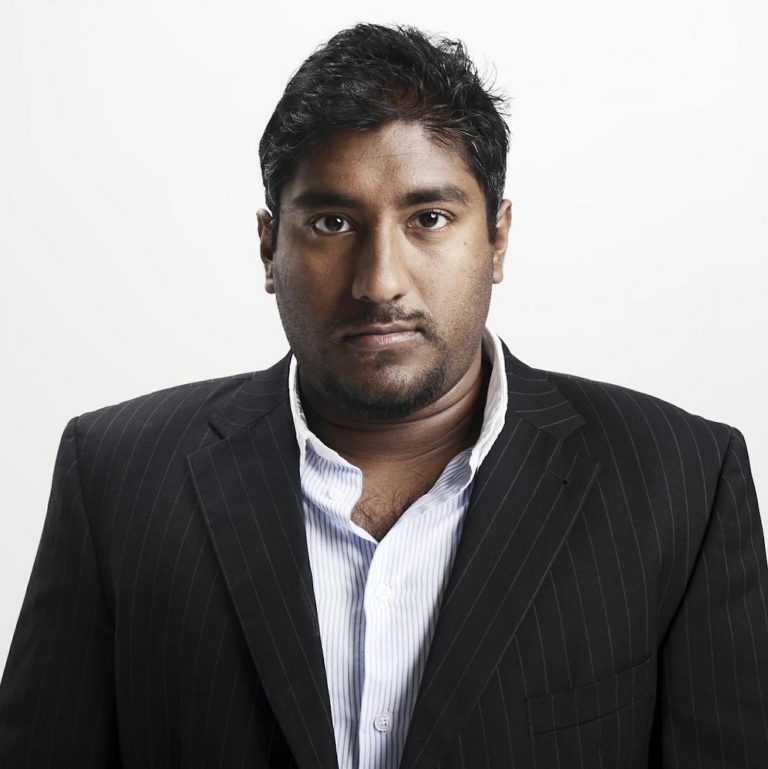
One of bitcoin’s leading luminaries, Vinny Lingham has an opinion on everything and an uncanny ability to sense market movements, earning him the moniker of bitcoin Oracle. News.bitcoin.com caught up with the serial entrepreneur to get his thoughts on bitcoin cash, Lightning Network, token models and more.
Also read:
Vinny Lingham on Regulation
 On April 20, over 1,000 delegates gathered at the Fairmont in Santa Monica for ICO Summit 2.0. The event began sharply at 8:30am, with Vinny Lingham the most recognizable figure on a panel titled The State of ICO Regulation. Afterwards, news.bitcoin.com sat down with the Civic founder for a chat about dual token models, blockchain scaling, and the acrimony that’s riven elements of the bitcoin community.
The overarching message to emerge from the summit was that most tokens are securities, and following the regulatory route – likely Reg A+ – is the only way to avoid SEC censure. “If the price of something is determined by its ability to deliver an investment return then it’s a security,” acknowledges Vinny. Belatedly accepting that many, if not most, ICO tokens may fall into that category, a number of projects have opted for a dual token model, one a utility, the other a dividend. Vinny Lingham is not a fan of this setup however, opining:
People will raise money by whatever way they possibly can [even] if it means bending the rules, changing the system, and unsuspecting people will wind up putting up the money to buy it. But just because you can raise money in a certain way doesn’t mean you should.
Like most of the delegates at the Start Engine conference, he’s convinced that the industry is headed towards securities, complete with the full regulatory compliance that brings, venturing: “I think security tokens will outpace utility tokens by a mile in the next three years”. A month previously, in a titled The Value Trap Dilemma, he wrote: “If you’re building a utility token, it has to have real utility — if you’re just using it to raise money, then it’s a security.”
Don’t Fear the SEC
On the same day that news.bitcoin.com spoke to Vinny Lingham, details were emerging of the SEC-led complaint against Centra, including allegations of the ICO’s founders and creating . When asked whether there’s likely to be further subpoenas in the token space, Vinny responds: “There will definitely be some. They’re going after the most egregious people.” He doesn’t believe that escalating SEC activity could impact on all U.S.-based token projects, though, including his own Civic, adding “I sleep very well at night, I don’t worry about the next day waking up and [receiving a subpoena]”.
Vinny was tight-lipped about future developments for other than to confirm there are “lots” on the way, some of which will emerge at the Consensus summit on May 14-16 in New York. He gives short shrift to the string of identity-based projects that have emerged since Civic, referencing a recent he composed on the topic, and proclaiming: “If you ask someone what are the top companies in the [identity] space, Civic will always come up number one. And there’ll always be a different number two.”


Vinny Isn’t Struck by Lightning
When conversation switched from the token economy to bitcoin, Vinny predictably had a lot to say about BTC, BCH, and the scaling methods attempted by both sides. There’s a tendency for proponents (or “maximalists” as the more devout are sometimes branded) to fall on one side of the divide rather than straddle the fence. Vinny Lingham is much more measured, seeing the merits in , whilst remaining broadly supportive of the approach taken by bitcoin Cash.
The South African entrepreneur isn’t a fan of the elements that are “too extreme” and encourages both camps, Cash and Core, to “exercise some restraint”, particularly when it comes to asserting which brand of bitcoin is the true bitcoin. A day after talking to news.bitcoin.com, he shared the following tweet:

When asked whether he believes a sizeable bitcoin Core contingent are pinning all their scaling hopes on Lightning Network (LN), Vinny agrees vigorously. “It is the panacea for them right now. Lightning is a big thought experiment which is in code right now and is not proven. How much money is in Lightning – less than $100k? There’s nothing there.” While acknowledging the effort that has gone into developing LN he says:
Lightning, maybe it works, maybe it doesn’t. The point is, you’re going from something that’s proven, that can scale [increasing the block size], at least to some degree, versus something which is unproven [LN] and it may not be able to scale, and we’re pinning our hopes on it. It’s very impractical.
 “I think Segwit’s got some flaws in it,” says Vinny at one stage, before asserting that in the short to medium-term it makes more sense to increase the block size, venturing that “There’s no real centralization risk with [increasing the BTC block size to] two megabytes. There’s no centralization there and anyone who thinks otherwise is stupid. Let’s say the number of nodes that could afford to run in the long-term dropped by around 2%, that’s not going to create centralization.”
Decentralization Isn’t Everything
On the topic of decentralization, and the sacrifices that must be made to increase the speed of new blockchains, Vinny predictably has a lot to say:
EOS is one where there is a trade-off, it’s more centralized, but it’s not very centralized. I think there’s a balance you can get. Like, how many nodes is enough [to ensure decentralization]? That’s the real question and no one can give me an answer…Is it a billion? Give me a number, any number.
He agrees that new blockchains are still years away from needing to fulfil the half a billion transactions a day they purport to offer, adding: “That’s exactly my point. We’re nowhere close to the usage of needing to worry about it. Instead of kicking the can down the road and worrying about it later, we’re trying to deal with this now and it’s not an issue right now.”
 The interview concludes with Vinny reflecting a sentiment that is expressed multiple times during the course of the by investors, lawyers, and entrepreneurs: that the token economy is “such a dynamic space you’re basically just guessing what [governments and regulators] are gonna do next.”
The bitcoin Oracle has been proven right about many things, but when it comes to figuring out regulators, even he’s in the dark.
Do you agree with Vinny Lingham that certain elements within the BCH and BTC communities are too ‘extreme’ in their views? Let us know in the comments section below.
Images courtesy of Shutterstock, Twitter, and Vinnylingham.com.
Need to calculate your bitcoin holdings? Check our section.
The post appeared first on .
Russian ICOs attracted a total of $300 million last year but half of the funds went to financial pyramids, according to the Russian Association of Cryptocurrencies and Blockchain. The organization that represents the crypto community in the country is now working on an ICO standard to help investors distinguish real projects from fraudulent schemes. Russian ICOs account for 10% of global volume.
Also read:
Russia Expects Up To $1.5 Billion from Coin Offerings
At least $150 million dollars raised by Russian ICOs in 2017 were collected by pyramids, RACIB revealed, while announcing a plan to fight financial fraud in token sales. The initial coin offerings with Russian participation account for 10% of the global market, as previously . The association expects Russian projects to attract $1-1.5 billion USD in 2018.
This is some serious money and the Russian crypto community believes the country should take advantage of it. Two major factors can influence negatively these investments and RACIB is actively working on both fronts. Excessive regulation may force Russian companies to seek jurisdictions with a more favorable climate for crypto business. The association already warned about that in a report addressed to President Putin. RACIB is also preparing an “ICO standard” to help investors distinguish real ICOs from fraudulent schemes.

A startup conducting a coin offering will be judged by several criteria, including the credibility of its team members, Izvestia reported. RACIB will verify if the company has a website with information about previous projects. The association will check for a white paper and a roadmap for the ICO. Startups will be expected to announce a minimum rate of return of the investments.
The ICO standard is part of efforts to introduce a level of self-regulation and will not be included in the upcoming legislation. Two bills regulating the crypto sector have been filed in the State Duma, the lower house of Russia’s parliament. The draft law “On digital financial assets” legalizes various crypto activities, including initial coin offerings. Another bill aims to amend the civil code in order to regulate the use of “digital money” in payments and protect investors’ rights and interests.
Authorities Agree, Some Self-Regulation Is Necessary
The chairman of the parliamentary Financial Market Committee, Anatoliy Aksakov, shares the view that the ICO sector should regulate itself to a certain extent. The proposed legislation covers token sales only in general terms, he noted. The details can be introduced through , the lawmaker added.
Some Russian experts believe that only “qualified investors” should have access to initial coin offerings. “Citizens can lose money not only because a project might be fraudulent, but also because they don’t understand cryptocurrencies very well,” says Teimuraz Vashakmadze from the Russian Presidential Academy of National Economy and Public Administration. Investments in tokens can be highly risky, he warns.
 Clear and transparent self-regulation by market participants will help minimize fraud in this sector thinks Igor Nikolaev, Director of the Institute of Strategic Analysis at FBK Grant Thornton. However, he is unsure if that will help the market at all. Nikolaev says that the potential of digital currencies is limited due to the reluctance of central banks to recognize them as means of payment.
The State Duma has already accepted the bill “On digital financial assets”, which was also by the Cabinet of Ministers. This draft, along with the amendments regulating the use of cryptocurrencies, should be adopted by early summer, probably in time for the football . Russia is expecting $2 billion dollars from fans visiting the country. Part of the money is likely to come in the form of .
Do you think self-regulation is an appropriate mechanism to fight financial fraud associated with ICOs? Tell us in the comments section below.
Images courtesy of Shutterstock.
Make sure you do not miss any important bitcoin-related news! Follow our news feed any which way you prefer; via Twitter, Facebook, Telegram, RSS or email (scroll down to the bottom of this page to subscribe). We’ve got daily, weekly and quarterly summaries in newsletter form. bitcoin never sleeps. Neither do we.
The post appeared first on .