January 26, 2026

Capitalizations Index – B ∞/21M

VeChainThor’s DDV Helps Users Control What Data they Sell to Companies

VeChainThor’s DDV Helps Users Control What Data they Sell to Companies

VeChainThor, a blockchain startup that aims to make identification of counterfeit products easier by an RFID technology, is yet again in the highlights with a fresh technical update. They are introducing the Distributed Data Vending (DDV), a compliant way to share sensitive data securely on the blockchain.

The VeChain Foundation announced on their Twitter on March 22:

Introducing Distributed Data Vending (DDV), the future of compliant data sharing exclusive to VeChainThor. Putting power back into the hands of enterprises, customers, and researchers to collaborate and revolutionize the way the world shares and advances!https://t.co/OwjKG0V87G

— VeChain Foundation (@vechainofficial) March 22, 2018

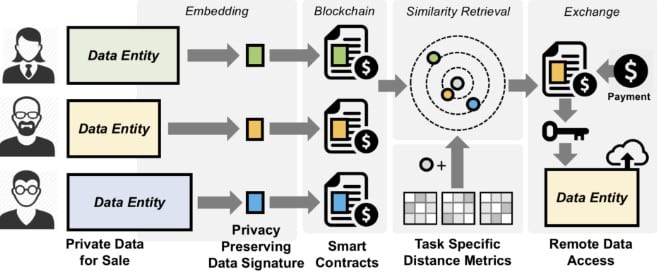
In an era of big data, where enormous information is used each day to enhance decision making for companies, the DDV allows individual data owners to directly benefit from sharing proprietary data. In the traditional markets, companies leverage data to generate revenue through developing customized recommender systems and targeted advertisements. This process results in enormous profits for the organizations, as they collect and aggregate data only to sell it to relevant companies later. However, an organization would categorize this collected data as their “private asset.”

On the other hand, the DDV model encourages tokenizing the sharing of data, thus, also making the individual or group from whom the data is collected a stakeholder in that particular info/data. And since they are the source of that information, they can then claim a share of dividends.

The system is already undergoing testing and development by the VeChain Foundation, and it would also be available to enterprises and upcoming dApps. The purpose of distributed data vending is to enable data providers to use existing blockchains as infrastructure for securely listing their compiled data and adhering to regulatory and compliance needs. The entire data exchange process is done without any third parties involved.

What DDV Means for VeChain’s Business?                                                                                                  

Use of distributed data vending in various domains could be useful since it encourages sharing and distribution of information. Sectors like healthcare, logistics, and engineering are likely to benefit the most.  Using distributed data vending, the adoption for VeChainThor across multiple markets shall be a real-world example of technology being implemented in everyday business.
Vechainthor’s ddv helps users control what data they sell to companies

Source: Distributed Data Vending on Blockchain

An extensive application toolkit has been developed by VeChain for developing solutions such as EdgeChain to power the advancements made by VeResearch.

For the common person, this would really address the issue when data is sold in between companies without the consent or knowledge of people that the data concerns.

The article was written concerning a VeChain funded research paper on DDV, accessible here.

The post VeChainThor’s DDV Helps Users Control What Data they Sell to Companies appeared first on BTCMANAGER.

Previous Article

Hi all the GLOBATALENT (GBT) and crypto bitcoin mania fans.

Next Article

Ripple Donates $29 Million in Crypto to Public Schools

You might be interested in …

bitcoin superstar erfahrungen review results

bitcoin superstar erfahrungen review results “bitcoin Superstar Erfahrungen” https://tinyurl.com/bitcoinsuperstars Klicken Sie links, um meine ausführliche Geschichte und schockierende Ergebnisse der Verwendung dieses geheimen the bitcoin superstar system jetzt zu lesen! Mein Kurz zum Punkt bitcoin […]

South Korea Moves to Regulate Domestic Bitcoin Trading, Exchanges

South Korea Moves to Regulate Domestic Bitcoin Trading, Exchanges

Since late November 2017, South Korea has looked to regulate cryptocurrency trading in domestic exchanges, including Bithumb, Coinone and Korbit,  The Korea Herald reports. Now, trying to tame the wave of wild cryptocurrency speculation in the country, South Korea is imposing trade bans for minors and looking for ways to impose taxes on investment returns.

South Korea is the world’s third largest market in bitcoin trading, after Japan and the U.S., and the largest exchange market for ether, accounting for more than 33 percent of its market share, according to a recent MIT Technology Review report. The country is also home to two of the top 15 global digital-currency exchanges (Bithumb and Coinone) and believed to have about one million registered daily traders in virtual currencies, which is equivalent to about one out of every 50 citizens.

This is worrying the South Korean government. In September 2017, the country’s Financial Services Commission (FSC) ordered a ban on Initial Coin Offerings (ICOs). In November 2017, the head of South Korea’s Financial Supervisory Service said that the agency was monitoring cryptocurrency trading inside the country, and the country’s National Tax Agency revealed that it was considering a value-added tax, a capital gains tax or both on cryptocurrency trades. If the plan is implemented, South Korea will become one of the few countries to tax cryptocurrency-to-cash exchanges.

The government’s concern is also motivated by the risk of cyberattacks from the country’s rogue neighbor, North Korea. According to South Korea’s National Police Agency, North Korean hackers could be targeting South Korean bitcoin exchanges.

With these newest measures, North Korean banks that offer accounts for cryptocurrency trading will have to verify the identification of new account holders and prohibit minors from opening accounts. Woori Bank and Korea Development Bank will shut down virtual accounts offered to cryptocurrency exchanges before year-end, according to the banks.

The regulators will also bar financial institutions from investing in or obtaining cryptocurrencies, and is considering ways to oblige cryptocurrency exchange operators to verify users’ real names, strengthen storage security of encryption keys, and disclose purchase price and order volumes. The authorities will also take strong-handed punitive actions against the perpetrators of cryptocurrency-related scams.

In a press release, the government said that the new regulations were necessary “to prevent a general public without expertise from suffering losses by participating in virtual currency investments that have massive fluctuations.”

These issues were discussed on Wednesday, December 13, 2017, in a meeting presided over by Hong Nam-ki, minister of the Office for Government Policy coordination, and attended by officials from the ministries of justice, finance, and science and ICT, as well as from the Financial Services Commission, the Korea Communications Commission, the Fair Trade Commission and the National Tax Service.

While some news headlines are presenting this as a catastrophic development that will shut down the cryptocurrency industry in South Korea, the initiative of the South Korean authorities is in line with current trends toward stronger cryptocurrency regulations in China, Europe and the U.S.

“A right set of regulations will rather nurture the (virtual currency) market, and we would welcome that,” Bithumb representatives told Reuters, adding that such a code of conduct could add legitimacy to the market.

The post South Korea Moves to Regulate Domestic Bitcoin Trading, Exchanges appeared first on Bitcoin Magazine.