January 28, 2026

Capitalizations Index – B ∞/21M

US Congressman Calls for Ban on Crypto Buying and Mining

Us congressman calls for ban on crypto buying and mining

US Congressman Calls for Ban on Crypto Buying and Mining

Us congressman calls for ban on crypto buying and mining

A U.S. lawmaker has called for a blanket ban on cryptocurrency buying.

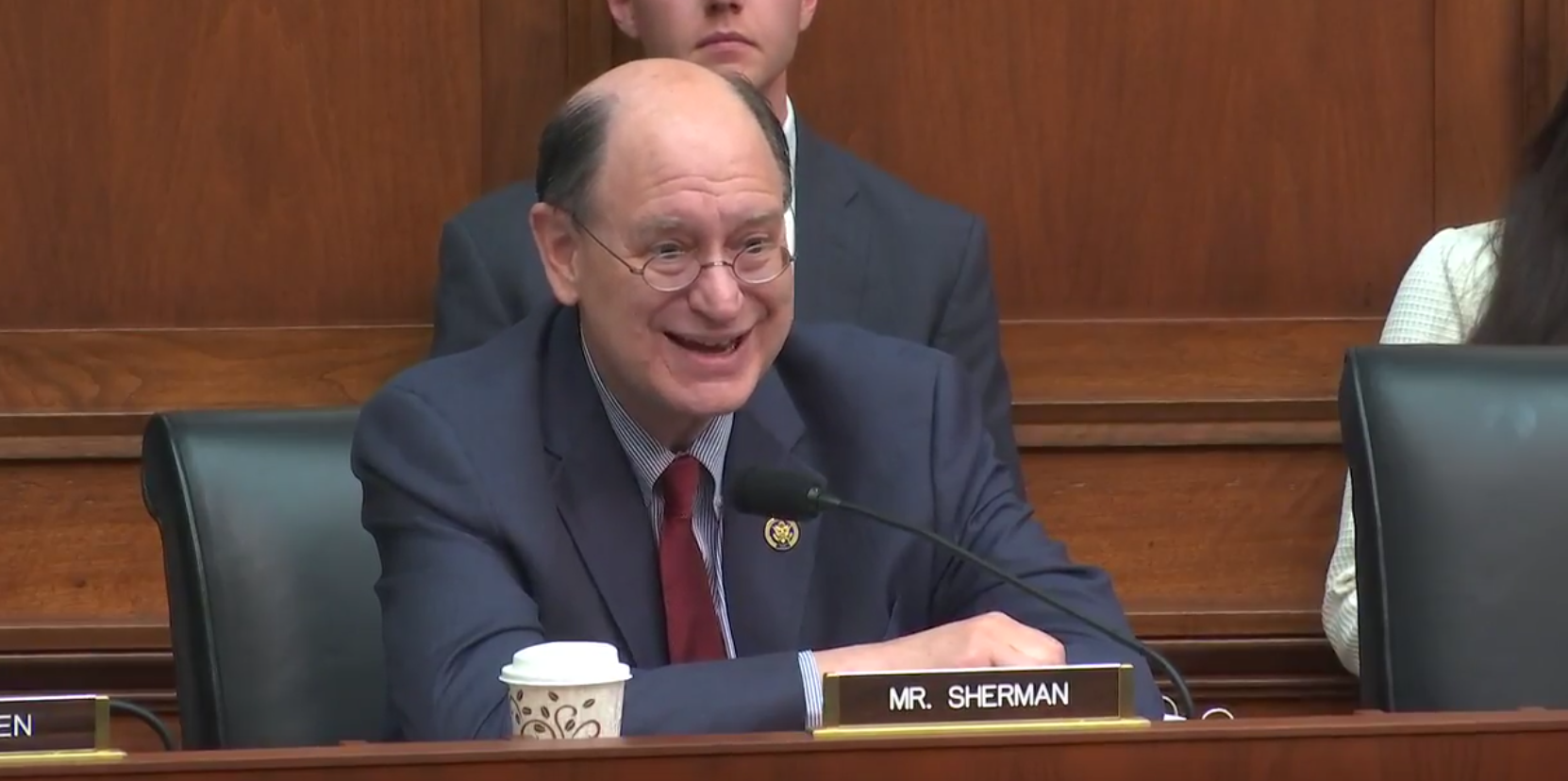
Congressman Brad Sherman is no stranger to controversial statements on the subject – back in March he called cryptocurrencies “a crock” – and during the Wednesday hearing of a subcommittee for the House of Representatives Financial Services Committee, he went so far as to advocate keeping Americans out of the market entirely.

“We should prohibit U.S. persons from buying or mining cryptocurrencies,” the California Democrat – whose largest donor is credit card processor Allied Wallet – declared. He added that, beyond cryptocurrencies being potentially used as a form of money in the future, it can currently be used by tax evaders and rogue states seeking to bypass U.S. sanctions.

One of the panelists, Norbert Michel, director for the Center for Data Analysis at the Heritage Foundation, pushed back against the idea that criminal use should define cryptocurrencies as a whole.

Michel told the subcommittee:

“Yes it is true that criminals have used bitcoin, but it’s also true that criminals have used airplanes, computers and automobiles. We shouldn’t criminalize any of those instruments simply because criminals used them.”

“Those components I believe are the main barriers to widespread adoption in the U.S,” he added.

No love for CBDCs

Though much of the hearing revolved around general monetary policy and history, the crypto-specific portions revealed a general opposition to the idea of a central bank digital currency (CBDC).

To quickly recap: a number of central banks around the world have been investigating the idea of using some of the technology concepts behind bitcoin and other cryptocurrencies as part of new, wholly digital money systems. The idea is that the tech can boost transparency and efficiency.

But some of those looking into the subject have warned that it could amplify the risk of bank runs, and several institutions have sworn off the idea entirely following their research.

Alex Pollock, a senior fellow at the R Street Institute, blasted the concept during Wednesday’s hearing, declaring it “a terrible idea – one of the worst financial ideas of recent times.”

Other committee members couldn’t help but agree that the idea, at the very least, raised more fundamental questions about how blockchain and cryptocurrencies actually work.

Congressman Bill Foster asked about blockchain immutability, saying “the promise of blockchain is a non-falsifiable ledger … [what] remains an unsolved problem in the digital world is how do you authenticate yourself?”

Payments boon

On a more positive note, Dr. Eswar Prasad, senior professor of Trade Policy at Cornell University, argued that the existence of cryptocurrencies had the potential to impact the financial services system, particularly the payments system, in positive ways.

According to Prasad, cryptocurrencies could “make transactions much easier … and bring down the cost,” but the benefits are limited at the moment.

Michel himself noted:

“It is certainly difficult to imagine a cryptocurrency replacing the U.S. dollar as long as the Federal Reserve acts as a moderately good steward of the national currency, but it is for this very reason that Congress should eliminate barriers that impede people from using their preferred medium of exchange.”

Ultimately, the hearing was cut short in order to make way for a House vote.

However, just prior to dispersing the attendees, chairman Andy Barr noted that cryptocurrencies will “continue to have a greater and greater impact on our financial system,” making it a topic the committee would likely have to “revisit” once again.

You can follow CoinDesk’s live coverage of the hearing on Twitter.

Editor’s note: This article has been updated. 

Image via House Financial Services Committee 

The leader in blockchain news, CoinDesk is a media outlet that strives for the highest journalistic standards and abides by a strict set of editorial policies. CoinDesk is an independent operating subsidiary of Digital Currency Group, which invests in cryptocurrencies and blockchain startups.

Published at Wed, 18 Jul 2018 21:35:39 +0000

Regulation[wpr5_ebay kw=”bitcoin” num=”1″ ebcat=”” cid=”5338043562″ lang=”en-US” country=”0″ sort=”bestmatch”]


Previous Article

Bitcoin Trading Volume Is Up 100% From Its Recent Low

Next Article

DJ King Crypto Banker

You might be interested in …

Ethereum Hard Fork Proposed in Response to New ASIC Miners

Ethereum World News Ethereum Hard Fork Proposed in Response to New ASIC Miners Ethereum’s pending major update Casper will already be part of a planned Ethereum hard fork titled Constantinople and is likely to occur […]

Cambridge University: Cryptocurrency Use Seeing ‘Significant Growth’

A report by Cambridge University’s CCAF reveals that the number of people using cryptocurrency today has seen significant growth and rivals the population of small countries.


Global Cryptocurrency Benchmarking Study

The Cambridge Centre for Alternative Finance (CCAF) has recently published a research paper called Global Cryptocurrency Benchmarking Study, which examines several sectors of the global cryptocurrency industry, including exchanges, wallets, payment providers, mining and more.

The study was led by Dr.Garrick Hileman, senior research associate at the CCAF and a researcher at the Centre for Macroeconomics. According to the CCAF, it’s the first global research of its kind to systematically investigate all key cryptocurrency industry sectors based on non-public “off-chain” data.

The paper makes several key findings that challenge some of the erroneous concepts that many have regarding the cryptocurrency space and shows that digital currencies are becoming an increasingly important part of our society. Dr.Garrick Hileman wrote:

Dr.Garrick Hileman

“The growing usage and range of capabilities we document in this study indicate that cryptocurrencies are taking on an ever more important role in the lives of a growing number of people (and machines” around the world. As we show in this study, the number of people using cryptocurrency today has seen significant growth and rivals the population of small countries.”

According to Dr. Hileman, a second paper by the CCAF focusing blockchain technology will also be launched in the following weeks. The paper is centered around the use of blockchain technology by more established industry players as well as at public sector institutions such as central banks.

What’s in it

The study collected data from nearly 150 cryptocurrency companies and individuals, covering 38 countries from five world regions, including names like Peter Smith from Blockchain.info, Roger Ver from bitcoin.com and companies like Coinbase, Bitmain, BTCC, Unocoin, and others.

The CCAF carried out four online surveys from September 2016 to January 2017 and communicated with the companies and individuals involved in order to collect this data. For companies that did not contribute to the study, the dataset was supplemented with additional research and web scraping using commonly applied methods.

The 114-page report counts with four sections, each covering one of the aforementioned industry sectors: exchanges, wallets, payments and mining. There are also three appendixes; the first one is an introduction to cryptocurrencies, the second offers a more detailed intro to the cryptocurrency industry and the third covers the geographical dispersion of cryptocurrency users.

Key Findings

The CCAF highlights the following findings as the key points of the paper:

  • The current number of unique active users of cryptocurrency wallets is estimated to be between 2.9 million and 5.8 million. (The majority of which are located in North America and Europe)

Cryptocurrency wallet users donut chart

  • The lines between the different cryptocurrency industry sectors are increasingly blurred: 31 percent of cryptocurrency companies surveyed are operating across two cryptocurrency industry sectors or more, giving rise to an increasing number of universal cryptocurrency companies.
  • At least 1,876 people are working full- time in the cryptocurrency industry and the actual total figure is likely well above two thousand when large mining organizations and other organizations that did not provide headcount figures are added.
  • Average security headcount and costs for payment companies and exchanges as a percentage of total headcount/operating expenses are similar but significantly higher for wallets.

Exchanges

  • The exchanges sector has the highest number of operating entities and employs more people than any other industry sector covered in the study; a significant geographical dispersion of exchanges is observed.
  • 52% of the small exchanges hold a formal government license compared to only 35% of large exchanges.
  • On average, security headcount corresponds to 13% of total employees and 17% of the budget is spend on security.

Cryptocurrency exchanges chart

Wallets

  • The lines between wallets and exchanges are increasingly blurred; 52% of wallets surveyed provide an integrated currency exchange features, of which 80% offer a national-to-cryptocurrency exchange service. In contrast with exchanges, the majority of wallets do not control access to user keys.

Payments

  • While 79% of payment companies have existing relationships with banking institutions and payment networks, the difficulty of obtaining and maintaining these relationships is cited as this sector’s biggest challenges.
  • On average, national-to-cryptocurrency payments constitute two-thirds of total payment company transaction volume, whereas national-to-national currency transfers and cryptocurrency-to-cryptocurrency payments account for 27% and 6% respectively.

National-to-cryptocurrency transactions vs other transactions

Mining

  • 70% of large miners rate their influence on protocol development as high or very high, compared to 51% of small miners.
  • The cryptocurrency mining map shows that publicly known mining facilities are dispersed, but a significant concentration can be observed in certain Chinese provinces.

Cryptocurrency mining by country

Do you think cryptocurrency use is growing? Have you seen indicators of increased mainstream adoption? Let us know in the comments below!


Images Courtesy of CCAF, AdobeStock

The post Cambridge University: Cryptocurrency Use Seeing ‘Significant Growth’ appeared first on Bitcoinist.com.