August 13, 2026

Capitalizations Index – B ∞/21M

Up 55%: NEM (XEM) Defies Crypto Snooze as Week’s Biggest Gainer

Up 55%: nem (xem) defies crypto snooze as week’s biggest gainer

Up 55%: NEM (XEM) Defies Crypto Snooze as Week’s Biggest Gainer

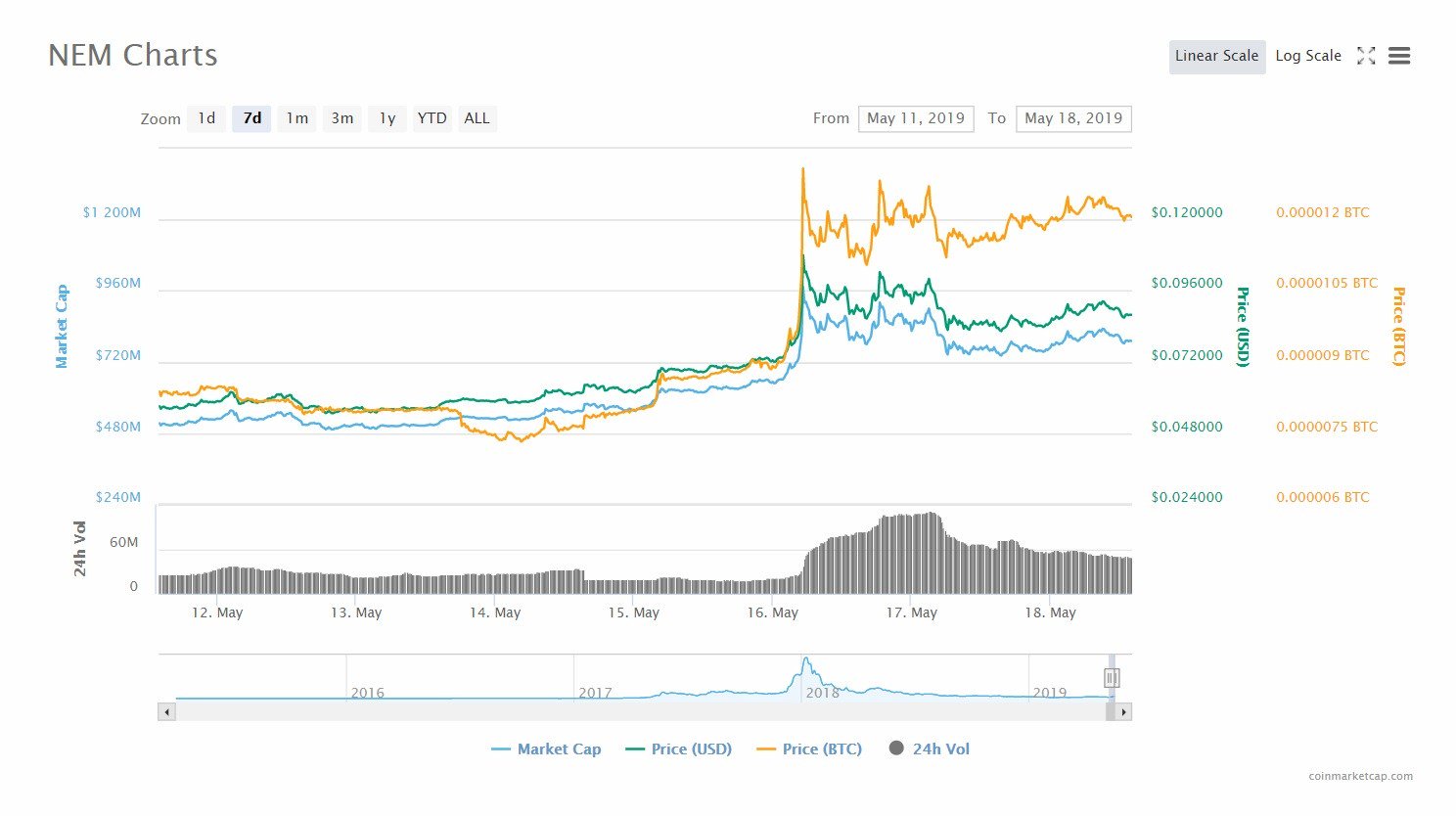
By CCN: The crypto market took a breather from its bull run this week, with bitcoin slightly departing from its recent year-to-date peak. However, NEM has been defying this mini-correction mood to gain over 55 percent since Monday, according to Coinmarketcap data.

Thus, NEM, whose coin is trading under the ticker XEM, has been the best performer of the week among the top 100 coins. On Thursday, it jumped about 50 percent in less than six hours, hitting a daily peak at $0.108, which is the highest level since November 2018.

The surge allowed it to enter the top 20 league and currently stop on the 19th position. NEM is now trading at $0.087 at a market cap of $791 million as at 11:00 AM UTC.
Up 55%: nem (xem) defies crypto snooze as week’s biggest gainer

NEM Holders to Spend XEM via Apple Pay and Samsung Pay

On Thursday, NEM caught investors’ attention with a tweet that announced the collaboration with Zeux.

The industry might be oversaturated with countless less relevant partnerships whose main purpose revolves around marketing. However, at this time, the news has some substance, as Zeux is a fintech firm that operates a digital payment wallet app that allows users to spend with merchants through Apple Pay and Samsung Pay.

The London-based company will fully integrate XEM on May 23.

NEM Foundation co-founder Jeff McDonald commented on the partnership, noting that the utilization of XEM as a payment option was a major step for the blockchain network.

However, this is not all, XEM price also benefits from the gradual launch of its version 2.0 blockchain engine, called Catapult, and the update of its website, which suggests a positive dynamic at NEM Foundation.

NEM’s Catapult Update is Catapulting XEM

NEM is making further steps towards adopting its blockchain engine update, referred to as Catapult. The new version will host several smart contract plugins and features that will eventually become an integral part of the NEM blockchain network. The new plugins touch upon bulletproof digital asset creation, advanced account systems, decentralized swaps, and business logic modeling.

At the end of March, the team presented the roadmap and vision for Catapult. According to the roadmap, the public release of the update will take place after the end of the third quarter.

NEM Foundation admitted that it struggled financially at the start of 2019, but managed to reorganize and target a new path, also thanks to the developers and community. Now the teams behind NEM are heavily relying on Catapult.

The update and recent partnerships have helped NEM to forget the Coincheck hack, in which $530 worth of XEM had been stolen from the Japanese exchange platform.

Will the Rally Continue?

Right now, NEM’s bullish movement finds support in the positive sentiment in the crypto community. While it’s challenging to estimate the next stop for XEM from this position, we can assume that everything will depend on the implementation of the Catapult update and whether the market will perceive it as a relevant innovation.

On Tuesday, NEM introduced catapult feature updates on namespaces and mosaics, which are said to make the blockchain network more convenient and intuitive.

Earlier on Saturday, NEM presented the Catapult mobile wallet development roadmap, which reveals that the mobile wallet will be ready in about 23 weeks from now.

To conclude, NEM price is currently tightly linked with how Catapult is adopted, with the community now trying to figure out whether NEM has the potential to become a major player again.


Published at Sat, 18 May 2019 12:00:51 +0000
Previous Article

3 Reasons The Current Bitcoin Price Rally is Fundamentally Different –

Next Article

NEM (XEM) Defies Crypto Snooze as Week’s Biggest Gainer

You might be interested in …

Our vision and mission behind starting changeangel. Io

Our Vision and Mission behind starting changeangel.io

Our Vision and Mission behind starting changeangel.io Changeangel.io, is a crypto to crypto, wallet to wallet, no-custody, swap exchange service. The first currencies to be listed for direct swapping were DGB, POT, GRS, DOGE, DCR, […]

Cfun is working with jd. Com-korean version

CFun is working with jd.com-Korean version

CFun is working with jd.com-Korean version March of 2017, CFun became the largest Nijigen content provider for JD,JD (NASDAQ:JD) which is the third largest ecommerce business enterprise in the world. CFun collaboration with JD, Providing […]

The Ethereum Killer Is Ethereum 2.0: Vitalik Buterin’s Roadmap

VitalikTalk.jpg

Speaking on November 25 at BeyondBlock Taipei 2017, Ethereum inventor and co-founder Vitalik Buterin outlined his vision for Ethereum 2.0. He described major changes in Ethereum’s architecture that are likely to be implemented over the next few years to improve Ethereum in terms of privacy, safety (consensus safety and smart contract safety) and, of course, scalability, which was the main focus of Buterin’s talk.

Buterin doesn’t seem worried about competitors. “The Ethereum killer is Ethereum, the Ethereum of China is Ethereum, the Ethereum of Taiwan is Ethereum… 2.0,” he said.

The fact that Ethereum is booming seems to confirm Buterin’s optimism. ETH’s price has been relentlessly climbing, recently reaching almost $500, and Ethereum is handling more transactions than all other major blockchains combined.

Decentralization, scalability and security are among the important properties that blockchain systems should have, but there are conflicts. Off-chain solutions are useful, but limited. According to Buterin, it’s very easy to have two of these properties but very hard to have all three. However, Ethereum’s ambitious goal should be that of achieving all three at the same time. “We want to scale to thousands of transactions per second, on chain, without any supernodes,” reads one of Buterin’s slides.

Sharding

Sharding — dividing a blockchain network into several smaller component networks (called shards) capable of processing transactions in parallel — is considered to be a promising way to achieve high throughputs comparable to the thousands of transactions per second of traditional payment networks such as Visa and MasterCard.

“You can think of [sharding] as, in a fairly simple version, creating a blockchain where you have, let’s say, a hundred different universes, and each of these universes is a different account space,” said Buterin. “So you can have an account in some universe or you can have a contract in some universe and you can send a transaction in some universe, and if you send a transaction in some universe it only affects stuff in some universe.

“But these kind of 100 universes are not just separate blockchains; they are systems that are also interconnected with each other,” continued Buterin. “Particularly, they share consensus. So in order to break even one of them, you have to break the whole thing.”

Buterin went on to describe relatively easy and more sophisticated ways to implement sharding in the Ethereum blockchain, outlining a sharding roadmap that foresees, at least initially, the creation of new “universes” that don’t impact the main chain while permitting iterative experimentation, such as introducing higher levels of scalability, starting with “quadratic scalability as nodes validate certain shards and act as light clients for other shards.”

Privacy

Buterin noted that zero-knowledge proof (zk-Snarks) privacy technology equivalent to Zcash has been implemented in the recent “Byzantium” Ethereum upgrade, offering application developers new ways to implement tighter privacy. These new privacy tools will permit showing transactions to specific parties while hiding them from public view. Buterin went as far as saying that the privacy problem is now three quarters of the way to being solved.

Proof of Work vs. Proof of Stake

A major upgrade to Ethereum will be the introduction of Proof of Stake (PoS) in Casper which, according to Buterin, might be ready by next summer. With the first release of Casper, Ethereum will transition from pure Proof of Work (PoW) to hybrid PoW/PoS. “In this scheme, all of the proof-of-work mechanics will continue to exist, but additional proof-of-stake mechanics will be added,” noted Buterin.

The main reason why PoS is seen as a necessary development is, of course, the need to reduce the energy requirements of PoW blockchains like the current versions of Ethereum and bitcoin. A recent report claims that bitcoin mining consumes as much power in a year as 159 countries, which is clearly far too much, and Buterin admitted that today’s Ethereum isn’t any better than bitcoin in that respect.

Smart Contract Security

Smart contracts implemented with Turing-complete programming languages are arguably the main innovation introduced by Ethereum. While smart contracts are finding countless applications and moving lots of money, the security and safety of Ethereum smart contracts have been questioned. Buterin confirmed that Ethereum will eventually introduce formal verification for smart contracts and that a new Python-like smart-contract programming language — dubbed “Viper” — is being implemented to enable the development of safer Ethereum applications.

While Buterin hasn’t said anything that he has not said in previous talks and papers, his BeyondBlock talk served as a useful confirmation and summary of the ambitious Ethereum development roadmap.

Besides Buterin’s talk, all the talks given at BeyondBlock Taipei 2017 are included in the full video recordings of the morning session and the afternoon session.

The post The Ethereum Killer Is Ethereum 2.0: Vitalik Buterin’s Roadmap appeared first on Bitcoin Magazine.