September 15, 2026

Capitalizations Index – B ∞/21M

Under Pressure: Bitcoin Price Could Defend $5.6K, Charts Say

Under pressure: bitcoin price could defend $5. 6k, charts say

Under Pressure: Bitcoin Price Could Defend $5.6K, Charts Say

Down two-thirds from its peak of $20,000, bitcoin (BTC) now risks printing fresh 2018 lows below $5,755.

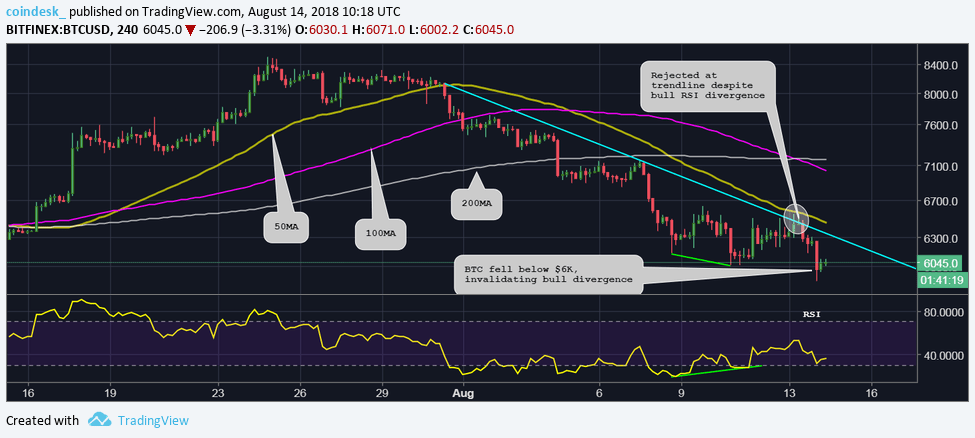
The corrective rally seen over the weekend failed to penetrate a key rising trendline hurdle of $6,480 on Monday, allowing the bears to make a strong comeback.

As a result, the leading cryptocurrency fell below $6,000 (February low) and extended the slide to $5,859 earlier today – the lowest level since June 29 – according to Bitfinex data.

As of writing, BTC is changing hands at $6,032 – down 6 percent in the last 24 hours. Despite sharp losses, bitcoin is the fourth best-performing cryptocurrency among the top 100 cryptocurrencies by market capitalization, according to CoinMarketCap.

Other cryptocurrencies are reporting bigger losses. For instance, 92 out of top 100 cryptocurrencies by market capitalization have suffered double-digit losses on a 24-hour basis.

Further, the bitcoin dominance rate, a measure of BTC’s market share, jumped to an eight-month high of 53.7 percent today.

Hence, it seems safe to say that the cryptocurrency markets have turned risk-averse, that is, investors are venturing out of the high-risk alternative cryptocurrencies and into well-established cryptocurrencies like BTC, and then possibly on to fiat currency.

Looking ahead, the risk aversion could worsen as the price chart analysis is calling a deeper sell-off in the world’s largest cryptocurrency by market capitalization.

4-hour chart
Under pressure: bitcoin price could defend $5. 6k, charts say

The bears could be feeling emboldened, having defended the descending trendline resistance, despite the bullish divergence of the relative strength index (RSI), as seen in the chart above.

More importantly, the bullish RSI divergence has been invalidated (prices dropped below $6,000) within three days of confirmation, which indicates the bearish sentiment is quite strong.

What’s more, the major moving averages (50-candle, 100-candle, and 200-candle) continue to trend south in favor of the bears.

Thus, BTC could hit fresh yearly lows below $5,755 (June low) this week.

Weekly chart
Under pressure: bitcoin price could defend $5. 6k, charts say

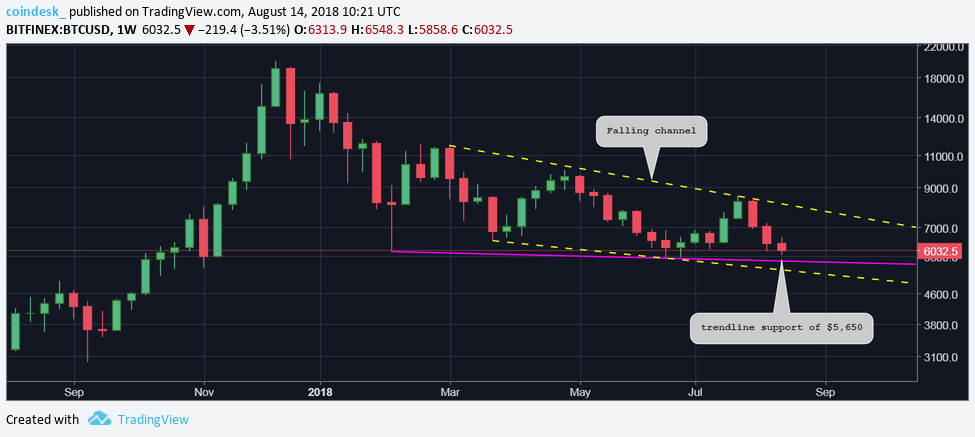
As the above chart shows, BTC could encounter support around $5,650 (trendline drawn from the Feb low of 6,000 and the June low of $5,755).

More importantly, the cryptocurrency could defend the support at $5,650 in the short-term as the cryptocurrency is looking oversold, having dropped more than 40 percent over the last three weeks.

However, if the support at $5,650 is breached, then the lower end of the falling channel, currently located at $5,340, could come into play.

View

  • BTC could drop below the June low of $5,755 this week, however, support at $5,650 (as per the weekly chart) could hold ground in the short-term, courtesy of the oversold conditions.
  • A high volume break above the falling trendline seen in the 4-hour chart would confirm a short-term bearish-to-bullish trend change and would allow a rally to $6,850–$7,000.
  • The outlook as per the weekly chart would turn bullish after prices break above the July high of $8,507.

Disclosure: The author holds no cryptocurrency assets at the time of writing.

Bitcoin image via Shutterstock; Charts by Trading View

Join 10,000+ traders who come to us to be their eyes on the charts, providing all that’s hot and not in the crypto markets.

The leader in blockchain news, CoinDesk is a media outlet that strives for the highest journalistic standards and abides by a strict set of editorial policies. CoinDesk is an independent operating subsidiary of Digital Currency Group, which invests in cryptocurrencies and blockchain startups.

Published at Tue, 14 Aug 2018 11:00:07 +0000

Markets

Previous Article

BREAKING NEWS! Funds are Safu? Binance Syscoin API HACK? 1 SYS = 96 BTC??

Next Article

Electra Elemental Shaman by Freshca – Hearthstone

You might be interested in …

Segwit Activated: How it Works & What’s Next for Bitcoin

Segregated Witness, or Segwit, has finally been activated by a super majority of the current hashpower on the bitcoin network. Segwit fixes many bugs currently in the protocol, and allows for some scaling using an effective blocksize increase.


Almost two years of debate

In December of 2015, the source code for Segregated Witness (Segwit) was released. It was meant as a fix for the ever-problematic transaction malleability bug, which allowed for someone to change one or two characters of a transaction’s ID before it was cemented into the blockchain. Along with that, it provided a method of scaling bitcoin. Doing away with the concept of a blocksize, a new metric was made called blockweight.

For years the software was not added to the bitcoin protocol as it never garnered the necessary 95% of the hashpower needed to activate. It was to be implemented though means of a softfork, which meant it would comply with all currently consensus rules and be backwards compatible with those running old software and did not wish to upgrade.

Whether you believe that Segwit was a direct result of the grassroot approach of BIP148 forced miners to finally activate it after all this time, or the New York Agreement was the reason everyone came together to signal for Segwit, it is finally here.

A second BIP was released weeks ago to lower the activation threshold to 80% of the hashpower, but even with the lowered bar Segwit still achieved around 97% signaling and locked in during the beginning of August.

After the official lock-in period, the network allowed for two weeks to provide grade period of sorts for people to upgrade their software to work with Segwit.

How Segwit Works

There has been a ton of misinformation about Segwit, so this article will hopefully clear some things up of how it actually works. As stated earlier the whole idea of a blocksize has been gotten rid of. Instead, the network will now use blockweight.

There’s two types of data that are contained in a transaction. Firstly, there is actual transaction data, such as the address the coins are being sent to. Then there is the witness data, which is all the information that is only needed when the transaction is confirmed, and then that data is essentially never used again.

Segwit provides a “discount” to the witness data, and once committed to the blockchain it gets pruned. These 1000 1KB transactions would obviously fill the current blocksize of 1MB, but remember blocksize isn’t even a metric any more. It’s been replaced by blockweight, the new limit of which will be set at 4,000,000 “units.”

The way the new unit system works is the number of units in a transaction is simply the number of bytes of transaction data multiplied by four. Witness data is, as said before, discounted. The bytes of the witness data are essentially a direct translation to units at a 1:1 rate.

So, for example, let’s say there’s 1000 transactions in the mempool, all at 1KB of data. Now let’s say in each of the transactions, 400 bytes is witness data and the other 600 bytes is transaction data. The 600 bytes for transaction data is now worth 2,400 units, while the witness data is now worth 400 units giving the whole transaction a weight of 2,800 units. All of these transactions together will only take up 2,800,000 of the 4,000,000 units, leaving room for more transactions.

Once the transaction is confirmed by the network, the not needed witness data will be pruned off the blockchain, to save storage space and decrease bandwidth use.

How Do I Actually Use SegWit?

For those of you expecting an immediate sign that Segwit is helping everything, I’m sorry to let you down. In reality, it could be weeks or even months before Segwit really starts to have widespread adoption.

Segwit transactions can only be sent from Segwit addresses. So, every single address that currently contains coins would have to send them to a Segwit address before we see the full effect of the upgrade. And even then, there could be a decent chunk of users who still don’t trust Segwit and don’t want to use it. Which is perfectly fine, that’s the point of a softfork. It doesn’t force users who don’t agree to it to upgrade to it.

For you to use segwit and send segwit transactions, you’ll need to send your coins to wallet that generates Segwit addresses. Otherwise, it will just be a normal transaction.

Moving forward, Segwit was an important setup to the upgrading and scaling of the bitcoin network, which has been woefully overloaded in the past several months. Segwit opens the door to better implementation of the lightning network, which can allow for transactions to be sent off chain for pennies.

Coming in November, the second half of the New York Agreement is set to take place calling for a doubling of the blockweight to even further scale the network though means of a hardfork.

Will you be using segwit from here on in? How do you think this will effect the network? Let us know in the comments below!


Images courtesy of Shutterstock, Segwit.co

The post Segwit Activated: How it Works & What’s Next for Bitcoin appeared first on Bitcoinist.com.