July 4, 2026

Capitalizations Index – B ∞/21M

UK’s Crypto-Accepting Mosque Raises more Cryptocurrency Donations than Cash

Uk’s crypto-accepting mosque raises more cryptocurrency donations than cash

UK’s Crypto-Accepting Mosque Raises more Cryptocurrency Donations than Cash


Shacklewell lane mosque cryptocurrency
Advertisement

Barely two months after announcing that it would start accepting donations in cryptocurrency, East London’s Shacklewell Lane Mosque has received more contributions in cryptocurrency compared to cash.

According to iNews, the Dalston, East London-based mosque collected donations amounting to approximately £13,983 in cryptocurrency. This was four times more than the value of contributions that were received in cash – £3,460. During the Muslim fasting period of Ramadhan, 24 cryptocurrency donations were received by the mosque. One individual gave as much as £5,200 in cryptocurrencies. Per the mosque’s website, the accepted cryptocurrencies are bitcoin and Ethereum.

Doubters Proved Wrong

The chairman of the mosque, Erkin Guney, expressed excitement at the initiative’s success despite the fact that there was a lot of skepticism initially.

“When the donations started to flow in, we were blown away. We received four times more in cryptocurrency donations than in cash from our local worshippers during Ramadan, and we are still receiving cryptocurrency Sadaqah [voluntary donations]. It is amazing!” Guney told iNews.

Shacklewell Lane Mosque first announced that they would be experimenting with cryptocurrency donations on May 21, a few days after the annual fasting period had started.

While Sadaqah is voluntary, Zakat is obligatory for all financially able Muslims with the qualifying members of the faith required to give 2.5% of their wealth annually to assist the less fortunate in the society.

Convenience and Wider Reach

According to Guney, the idea of accepting cryptocurrencies came about when Gurmit Singh, the founder of blockchain firm Combo Innovations, suggested that it would benefit the mosque to welcome such donations since a lot of Muslims were using crypto anyway.

And by allowing contributions to be made in cryptocurrencies it would be convenient for donors who already held digital assets since they wouldn’t have to go through the hassle of converting their holdings into U.S. dollars or Sterling pounds prior to giving. The mosque also saw an opportunity of being able to receive donations from across the globe.

At the time, the local financial institutions didn’t have cryptocurrency expertise and the responsibility fell on Singh to offer the necessary advice on receiving, storing and selling cryptocurrencies. As CCN has previously reported, the blockchain technology firm Combo Innovation undertook the implementation of Crypto Zakat and Crypto Sadaqah. The main Islamic advisor of Shacklewell Lane Mosque, Zayd al Khair, was also heavily involved.

The cryptocurrency donations that Shacklewell Lane Mosque has received will go towards feeding and sheltering the homeless in the local area as well as conducting needed mosque repairs.

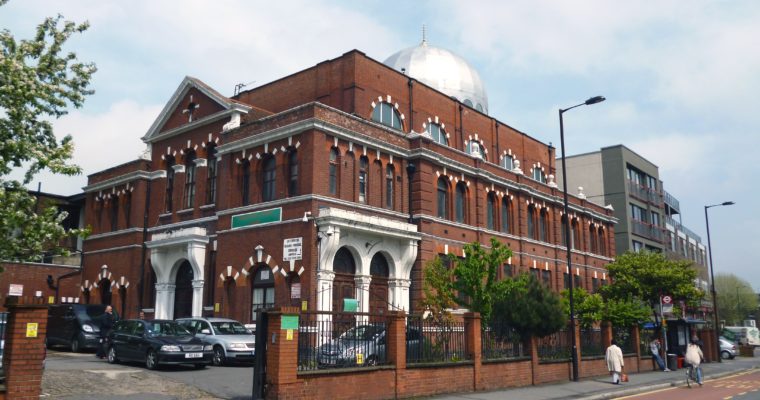
Featured image from Geograph/ Dr Neil Clifton.

Follow us on Telegram or subscribe to our newsletter here.
Join CCN’s crypto community for $9.99 per month, click here.
Want exclusive analysis and crypto insights from Hacked.com? Click here.
Open Positions at CCN: Full Time and Part Time Journalists Wanted.

Advertisement


Published at Tue, 17 Jul 2018 09:26:55 +0000

Accepts bitcoin
Previous Article

‘More Durable’: CFA Institute Bullish On Bitcoin As It Adds Crypto To 2019 Exams

Next Article

1 Kilo Koala Proof Coin, 2 oz Proof 12 coin collection

You might be interested in …

Interview: Cryptographer Silvio Micali on Bitcoin, Ethereum and Proof of Stake

Interview: Cryptographer Silvio Micali on Bitcoin, Ethereum and Proof of Stake

Silvio Micali is an MIT professor and Turing Award–winning cryptographer known for his work in technologies that form the bedrock of blockchains today: public-key cryptosystems, digital signatures, pseudorandomness and multiparty computations. He is also the co-inventor of the zero-knowledge proof.

In the ’90s, he worked on Byzantine agreement, a protocol for getting nodes in a distributed system to agree on a state change. And in 2012, he and long-time collaborator Shafi Goldwasser were co-recipients of the A.M. Turing Award, essentially, the “Nobel Prize in computing.”

Upon learning about bitcoin three years ago, Micali turned his attention from mechanism design, which had consumed him for the previous seven years, and dove headlong into creating a proof-of-stake algorithm. His project is called Algorand.

Put simply, Algorand relies on a novel form of Byzantine agreement with only nine expected steps. In each step, committee members, chosen at random in a private lottery, are replaced. The result is a high-security system with a negligible risk of forks.

According to Micali, recent tests show Algorand can process 2 MB blocks in 17 seconds, compared to bitcoin, which produces a 1 MB block every 10 minutes. (A paper on these results will be presented at SOSP, the biennial ACM Symposium on Operating Systems Principles, later this month.)

In an interview with bitcoin Magazine, Micali explained why he thinks proof of stake is superior to proof of work, the consensus algorithm that underlies most cryptocurrencies today, including bitcoin and Ethereum. Although Ethereum, more often viewed as a smart contract platform, aims to transition to proof of stake next year.

Unnecessary Evil

Micali thinks proof of work was a great idea when it first came out, but now that we have seen the consequences, he calls it an “unnecessary evil” for several reasons.

“The first time I heard about bitcoin, I saw all the difficulties. To me, the main difficulty is the waste of computational resources. That is really appalling,” he said. “It drives up prices and depletes the planet of resources.”

Second, he sees miners as “a new center of power” and an orthogonal force to the real users of the system: the coin holders.

“If five mining pools can control what goes in or does not go in a block, in what sense is the ledger decentralized? You don’t want miners having control over the ledger, particularly when they have low margins, are far away and accountable to no one. I think it is a recipe for disaster,” he said.

Finally, transaction ambiguity does not sit well with him. In bitcoin, occasionally two blocks are found at roughly the same time, creating a temporary fork in the chain. When that happens, the branch with the greater hash power is elongated, while the other and its blocks “disappear.” If your transactions happened to be in an orphaned block, it will eventually get picked up again in the main chain, but for Micali, the idea is unsettling.

“Every time I see my transaction is in a block, I worry the block may disappear. But never mind anxious people like me; banks may not be willing to take on the additional risk,” he said. “Can you imagine a financial world where wire transfers could be taken back?”  

Natural Democracy

Micali thinks proof of stake is a better option. In proof of stake, there are no miners, just the coin holders. Further, a coin holder’s ability to create or validate a block is based on how many coins in the system he or she owns.

“This is a natural interpretation of democracy,” Micali said. “Your influence in maintaining the integrity of the system is based on how much you are really invested in the system.”  

But there is a catch: creating a proof-of-stake algorithm is hard to do. While several projects claim to have come up with a secure protocol, Micali thinks some of those claims are questionable. “The fact is, people can claim anything they want,” he said.

One of the biggest challenges in proof of stake is the “nothing at stake” problem. If the chain forks, the optimal strategy for any coin holder is to extend both chains to earn additional block rewards or to double spend. That goes against the central design goal of all blockchains: getting users to converge on a single chain.

Some projects are looking at ways to sculpt their proof-of-stake protocols by adding perks or punishments to get coin holders to abide by the rules. As part of that, some proof-of-stake systems require users to put up a type of security deposit or bond.

Micali feels a well-designed proof-of-stake cryptocurrency should stand on its own, however, without extra measures. He thinks bonding opens doors to bad actors.

“Let me ask you, what fraction of your disposable income can you put on the table and not touch?” he said and suggested that honest people will put up only a small amount, ceding control to bad actors with big pockets.

“The danger is that only bad people will give up control over a large amount of money to manipulate the system. And if they earn much more money by misbehaving, they will be happy to lose what they put on the table,” he said.

He also disagrees with the idea of using punishment to get users to fall in line.

“A weak state rules through threats and fear,” he said, comparing the practice to barbaric punishments used by some nations to fight crime. Why do they do it? Because criminals are so rarely caught, he said. “So once they catch one, they disembowel the poor guy.”

He continued, “Do you want to oust somebody who misbehaves? Of course. But a well organized system is one in which you don’t need to punish people.”

bitcoin and Ethereum

Most people view bitcoin solely as a cryptocurrency, but Micali thinks the greatest value of bitcoin and Ethereum are as enablers of smart contracts, in which users can stipulate if-then conditions around payments.  

“At the end of the day, doing only payments is easy,” he said, adding that he did not want to trivialize the problem. “Of course, decentralized payments are better than centralized payments, but what really differentiates a cryptocurrency from any other form of money is that you can actually do a smart contract.”

Based on that, he thinks that both bitcoin and Ethereum would benefit from implementing the best consensus algorithm available. Currently, both systems are “huffing and puffing,” he said. bitcoin is constrained to 7 transactions per second, while Ethereum can process only 15 per second, compared to Visa’s 2,000 per second.

“If the blockchain scales, isn’t it better for bitcoin and Ethereum? If the blockchain has a [mathematical] proof of security, isn’t it better for its users?” he said. “If the blockchain cannot be hijacked by miners who are accountable to nobody and live in some faraway jurisdiction, isn’t that a plus for all users?” Micali thinks so.

The post Interview: Cryptographer Silvio Micali on Bitcoin, Ethereum and Proof of Stake appeared first on Bitcoin Magazine.