Revolut, London-based fintech startup that created the first app allowing customers to invest in bitcoin, is adding bitcoin Cash and Ripple to its cryptocurrency feature.
is the UK-based payments company which uses investments to further expand its operations and allow users to purchase and sell digital currency. Founded in 2015 by former institutional trader Nikolay Storonsky, it is a digital banking alternative that includes a pre-paid debit card, currency exchange, cryptocurrency exchange and peer-to-peer payments.
Last December, Revolut to let customers invest in bitcoin. Now Revolut will offer them the chance to buy Ripple and bitcoin Cash as well.
🤩 The wait is over. You can now buy, hold and sell and instantly with Revolut. 
— Revolut (@RevolutApp)
Ripple and bitcoin Cash are the third and fourth most popular cryptocurrencies by market value. Among cryptocurrencies that have already been made available for clients to trade within the app are bitcoin, litecoin and ethereum.
“We’ve been asking the Revolut community which cryptocurrencies they would like to see next, and the demand for both XRP and bitcoin Cash has been absolutely overwhelming,” said Vlad Yatsenko, Revolut chief technology officer.
According to the company, the decision to include bitcoin Cash and XRP was made because “other major cryptocurrency exchanges are yet to support these digital currencies”.
“After months of negotiation and development work, we’re incredibly excited to offer exposure to these two digital currencies to the UK market,” Vlad Yatsenko said.
A fee for cryptocurrency transactions makes up 1.5%. In comparison with a traditional cryptocurrency exchange, you can’t send or receive cryptocurrencies from your Revolut account. All you can do is buy tokens in the app. If you want to transfer those tokens somewhere else, you’ll have to sell them for USD, GBP, etc. and then buy cryptocurrencies on a traditional exchange using your fiat money.
Revolut conducts over 100,000 cryptocurrency transactions per day. Recently, the startup added a new feature called Vaults. With the feature, Revolut users can set up a vault to save money over time. You can round up your spare change every time you make a transaction. You can also set up recurring payments to set aside a bit of money daily, weekly or monthly. Moreover, you get to choose the currency of your vault, which is a good way to hedge against the volatility of cryptocurrencies.
More than 50,000 of Revolut’s customers signed up to the feature. However, they don’t earn interests on vaults. This feature is just a way to set some money aside that doesn’t appear in your main Revolut account.
Revolut has extensive plans for growth. The company wants to bulk up its engineering and design staff in order to expand into the United States, Canada, Singapore, Hong Kong, Australia and New Zealand this year.
“By expanding overseas, we will be empowering millions of people to take control over their financial lives, and in the process, we will be reducing the cost of international transfers by partnering with the best players in the financial world,” Revolut said.
The post appeared first on .
GMO Internet Group, a Tokyo-based IT giant is making every possible effort in order to establish itself as a leader in the cryptocurrency mining business. Almost a year back in September 2017, the company announced its plans to bring to the market a based on 7nm chips and the company now looks all set for its launch.
On Wednesday, May 23, the GMO Group announced that the company is all set to launch its own high-performance computer for mining – GMO miner B2 – in the market next month on June 6, 2018. In its , the company said:
We will mass-produce the world’s first mining machine equipped with a cutting-edge 7 nm* process based semiconductor chip (7 nm mining chip; “GMO 72b”), which will be shipped at the end of October 2018
Last year in September 2017, the company had pumped nearly $320 million in the research and development of the new ASIC processor. In less than a year’s time, the company is out with its product and this reflects towards the commitment of GMO in order to grow its crypto mining business.
On the launch day itself, the company will be having an information session for potential customers willing to purchase the B2 miner. At the launch, the company will be unveiling further details of performance and pricing of the miner. The GMO miner B2 is expected to deliver high-levels of hashing power with lower electricity demands.
Last year in December 2017, the GMO Group announced the expansion plans for its by developing new facilities in Northern Europe. At that time, the company said: “The cryptocurrency mining business will use existing technology to mine from facilities (mining centers) in Northern Europe. GMO Internet will increase the size of the operation in phases, expanding the business.”
During the same time, the company had also that it will be paying all of its employee’s salary in bitcoin. The company said: “GMO Internet Group has decided to introduce a system that allows part of the salary’s payment to be received by bitcoin in order to promote ownership of the employees’ virtual currency.”
A fresh report released earlier this month showed that the firm has already mined 906 bitcoin and 537 bitcoin cash by April 2018. Note that GMO is not the lone player in the race of the producing advanced mining chips for the bitcoin mining industry. Earlier this year in February, a report arrived which said that Korean tech giant Samsung is also starting the “risk production” of 7nm chips in 2018.
The post appeared first on .

Back in the day, before cryptocurrency was worth anything, an email address and a password was all you needed to login to an exchange. Then came 2FA, using email verification or Google Authenticator. Then came the third generation of secure sign-in methods, and that’s when things started getting weird.
Also read:
From Fit the Puzzle to Make the Gesture
 As attackers have gotten more sophisticated, so have the measures cryptocurrency exchanges have taken to keep them at bay. These are designed to fulfill a range of objectives, including spam and bot deterrence, as well as to perform increased due diligence for legal reasons.
Binance with its “Fit the puzzle piece carefully” which has spawned numerous memes, and kept its customer support busy attending to users who can’t fit the puzzle. Kucoin, meanwhile, began asking odd questions of its customers a few weeks ago, and then repeating those questions every time they went to login, much to their annoyance.
 Kucoin asks the important questions
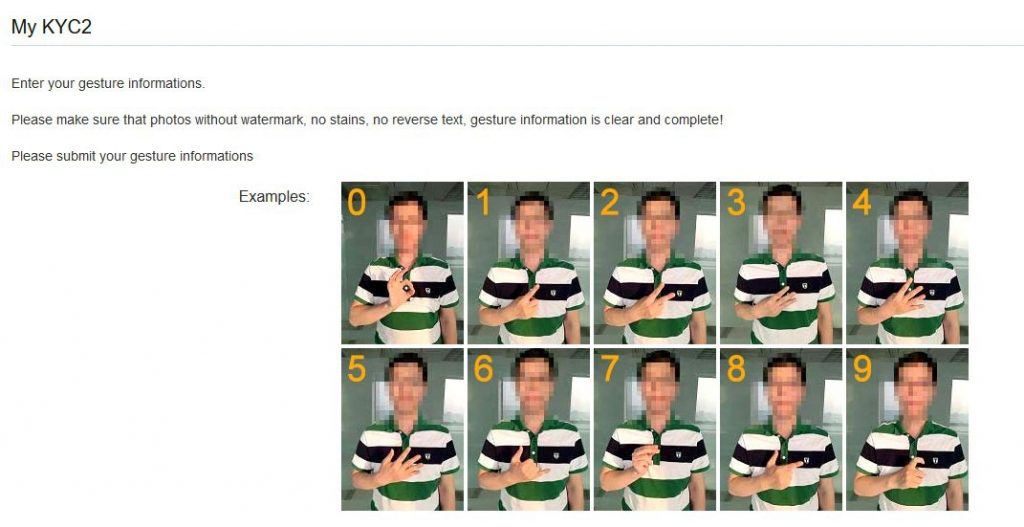
Bittrex will force you to log in twice after clicking a link in your email, stating that it doesn’t recognize your IP – even when you’re signing in from your usual location on your usual device. The quirks of logging into major exchanges have been assimilated into cryptocurrency culture, and while users may grumble, they accept that these measures are in place for their own benefit. Gate.io’s latest verification trick, though, has gotten traders talking:
 Gate.io’s new KYC
Prove You’re Human
Completing KYC for Gate.io in a public place is no longer viable, but perhaps that’s part of the plan: to embarrass users into upping their opsec by logging in at home. As part of the verification process, users are required to recreate four out of a possible nine gestures before their webcam. From a security perspective, it’s certainly effective: bots have yet to master human gestures while pulling gang signs.
In no other industry would the public tolerate such bizarre security measures. Cryptocurrency is different though. Undergoing unorthodox procedures is the price that must be paid for trading on an exchange. Traders can complain, but if they want to withdraw their funds, they have no option other than to comply.
Do you think enhanced verification measures heighten exchange security, or do they simply inconvenience users? Let us know in the comments section below.
Images courtesy of Shutterstock, Binance, Gate.io, and Kucoin.
Need to calculate your bitcoin holdings? Check our section.
The post appeared first on .
