February 25, 2026

Capitalizations Index – B ∞/21M

UK Bank NatWest Debuts Credit Cards with Built-In Fingerprint Reader

Uk bank natwest debuts credit cards with built-in fingerprint reader

UK Bank NatWest Debuts Credit Cards with Built-In Fingerprint Reader

Uk bank natwest debuts credit cards with built-in fingerprint reader

Photo: NatWest

Forms of payment have rapidly revolutionized with the introduction of various technologies into the financial industry. For instance, contactless payments have existed for many years. One of the most common revolutionary forms of payment is mobile payments that involve smartphones. On the other hand, actual debit or credit card payments keep improving as financial institutions strive to enhance their efficiency.

However, users still need to authenticate payments exceeding certain amounts when using their cards. The only available method currently to verify these payments is with the use of a PIN code. Nonetheless, several banks are ready to try a new debit card that has a fingerprint sensor built into it.

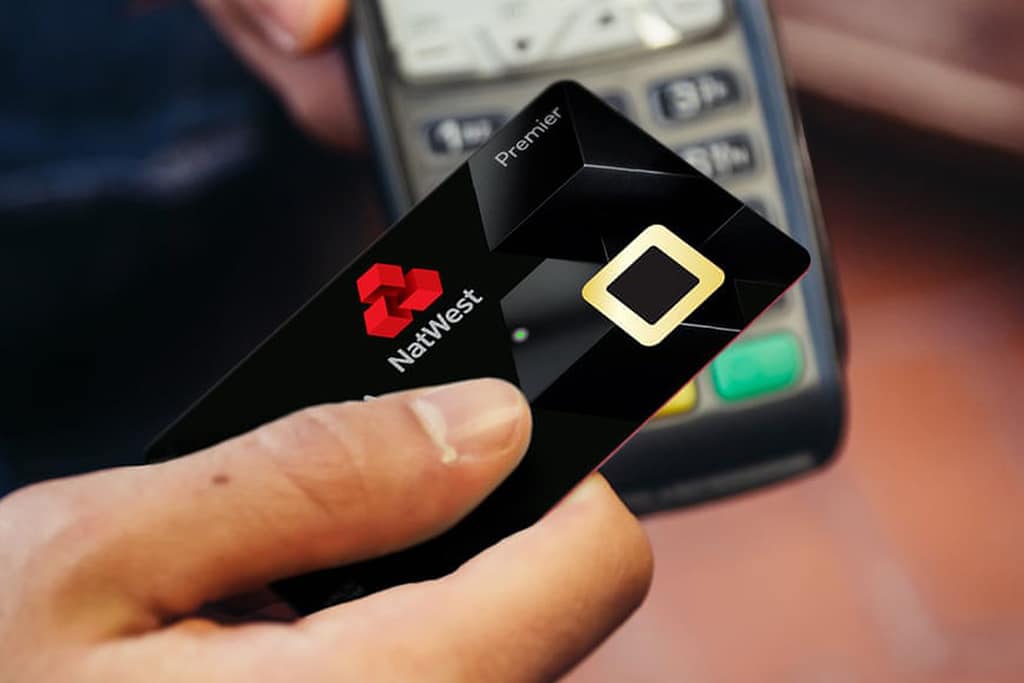
NatWest, a British bank, is testing the use a new NFC payment card that comprises of a built-in fingerprint scanner. The trial is set to take place in mid-April featuring 200 customers. The participants will have capabilities to make NFC payments known as “contactless” in the UK. They will not need to input any form of a PIN or provide a signature.

The standard £30 limit set for contactless payments will not apply whenever the participants use their fingerprints. All cardholders in the UK can currently make contactless payments by tapping their cards on the terminal. The £30 limit is applied to these payments as a security measure. For any expensive purchases, users must place their cards into a reader and enter their PIN.

Even though the existing mobile payments need authentication, users can only transact within the same £30 limit.

How it Works

Fundamentally, the new NFC cards have a fingerprint scanner. The scanner stores the fingerprint data locally on the customer’s card which reduces the risk of theft considerably. The new security measure is, however, not proven fully effective since in theory a thief can spoof a fingerprint and gain access to the money.

The scheduled trial seems to prove that NatWest thinks the contactless system is the future of card payments. David Crawford of NatWest added that:

“We are using the very latest technology across our business to make banking easier for our customers and biometric fingerprint cards are one of the many technologies we are exploring further. This is the biggest development in card technology in recent years and we are excited to trial the service.”

The participants will need to visit a bank branch to register their fingerprint. However, Gemalto hopes that all interested users can use their phones to register in the future. MasterCard tested this technology back in South Africa in 2017 but it never thrived.

Previous Tests

An increasing number of fraudster cases prompted financial institutions to strive to come up with enhanced security measures. Biometric authentication has grown into a standard component of NFC mobile payments. However, despite the credit card trials having appeared since 2015, they have failed to get any traditional bank card hosts.

Gemalto ran several trials in South Africa in 2017. It followed it up with a pilot project in conjunction with Italian bank Intesa Sanpaolo in 2018. The contactless cards have some way to go before they gain mass adoption.

However, the introduction of digital currencies into the global financial network can offer several solutions. It can bring about the security required by most institutions, individuals, and governments while transacting their money.

Published at Tue, 12 Mar 2019 11:06:57 +0000

Previous Article

88% of Crypto Volume Could Be False: Is Bitcoin Price Drop Inevitable?

Next Article

This Cryptocurrency Surged 200% after a Good Old Pump from Mastercard

You might be interested in …

GoldMint and the Future of Gold Ownership

GoldMint Header

Reflecting gold’s historical repute as a scarce and valued
resource, bitcoin has become known in many investment circles as “digital
gold.” With its unprecedented rise, bitcoin’s worth is now estimated to be
about twice that of an ounce of physical gold.

On August 7, 2017, the startup GoldMint was launched with the intent of ushering
in a new digital era of gold as a store of value. This project aims to provide
a unique set of gold ownership solutions for cryptocurrency investors and
enthusiasts worldwide. It is
holding an initial coin offering (ICO) that starts in less than
12 hours. 

The GoldMint
project reaffirms the notion that physical gold is a respected method of
payment and wealth preservation, all tied to its value and scarcity. Gold
ownership, however, requires expensive security, safekeeping and insurance.
GoldMint’s innovative approach seeks to address these inherent issues.

GoldMint
purchases, sells and repurchases their native digital asset called

“GOLD,” which is
100 percent backed by physical gold. It features an Exchange Traded Fund (ETF)
which can be utilized as a payment and investment tool for both companies and
individuals in hedging risk.

Capitalizing off
of the inherent advantages of its physical counterpart,

GOLD tokens offer
a stable, transparent, non-volatile means of buffering one’s crypto portfolio
from wild market swings. Here, GoldMint is committed to ensuring that GOLD
delivers consistent value through paper assets like ETFs and futures as well as
through physical assets. Moreover, GOLD owners will be able to use their tokens
to secure guarantees, loans and escrow services, all at a modest 5 percent
purchase and 3 percent sale fee.

GoldMint will
also deliver a utility token known as “MNT” to facilitate operations, implement
smart contracts and incentivize block creation and transaction confirmation.

During the early
stages of this project, MNT will be sold and distributed on the Ethereum
blockchain. After the MNT distribution has taken place, Goldmint will launch
its own Graphene -based Proof-of-Stake (PoS) blockchain that offers a safer,
more productive and faster experience.

Minting the Blockchain

GoldMint utilizes
a blockchain ledger to execute trades, loans and investments for profit. The
following are what make the GOLD crypto asset unique:

  • 100 percent
    information transparency relative to all GoldMint GOLD. The company discloses
    its gold reserves, fostering the opportunity to buy back GOLD at its current
    trading price.
  • GoldMint utilizes
    the decentralized blockchain for smart contracts and for its crypto assets.
  • ETFs are used for
    liquidity and elasticity facilitating gold trades which are far faster than
    those of physical gold.
  • Secured loans can
    be leveraged with GOLD, like jewelry or coins. GoldMint assists in the storage
    of this collateral through its unique Custody Bot, a blockchain-connected robot
    used for inspection, temporary and long-term storage and the transfer of
    physical gold, jewelry, coins or gold bullion.
  • Members have the
    ability to earn passive income as the market price of GOLD rises.
  • An option which
    allows for the buyback of GOLD for fiat according to the current price of GOLD.
  • A fast and
    efficient user registration and identification system.

To support merchants and developers,
GoldMint is in the process of releasing an application programming interface
(API) for the development of third-party apps and other interfaces. Use of this
API will allow online stores to accept GOLD as a payment method, enable loans
to be secured by banks and provide access to services such as escrow accounts
and financial guarantees.

The Goldmint Team

Goldmint is led by CEO Dmitry
Plutschevsky, who co-founded Lot-Zoloto — a gold trading company based in
Russia with trading transactions totaling $100 million in 2017 — with
former banker Konstantin Romanov. Serg Umansky, head of portfolio management at
Whiteridge Investment Funds, Alex Butmanov, managing partner at DTI and Julian
Zegelman, managing partner at Velton Zegelman, are among the advisors of the
company

GoldMint founders predict that its unique
value proposition will disrupt the billion-dollar gold market, allowing
GoldMint to establish itself as a market leader in the coming cryptocurrency
revolution.

To learn more about GoldMint and
participate in its token sale, visit its website,
read the white
paper
and follow the company’s social media channels on Facebook and Twitter.

The post GoldMint and the Future of Gold Ownership appeared first on Bitcoin Magazine.

Signrequest introduces blockchain-backed electronic signatures with lto network

Signrequest Introduces Blockchain-Backed Electronic Signatures with LTO Network

Signrequest Introduces Blockchain-Backed Electronic Signatures with LTO Network Signrequest Introduces Blockchain-Backed Electronic Signatures with LTO Network ⋆ Crypto New Media Home 2019 April 23 News Signrequest Introduces Blockchain-Backed Electronic Signatures with LTO Network Published at […]

Iota foundation bezieht stellung zum 10-millionen-us-dollar-hack

IOTA Foundation bezieht Stellung zum 10-Millionen-US-Dollar-Hack

IOTA Foundation bezieht Stellung zum 10-Millionen-US-Dollar-Hack Es ist ein Vorzeigebeispiel für die Zusammenarbeit einer gemeinnützigen Stiftung mit internationalen Behörden und gut organisierten End-Usern. Vor mehr als einem Jahr sind Unregelmäßigkeiten in den IOTA-Wallets vieler Nutzer […]