News Release: UHIVE future generation social networking application introduces a crossbreed concept as well as launches token generation event (TGE). LONDON, UK, April 11th, 2018: A novel social media sites network introducing its cutting-edge hybrid centralized/decentralized idea is poised to inaugurate the new digital life period. UHIVE, the project that is being developed by UHIVE Ltd., is […] The blog post UHIVE The Next-Gen Social Networking Application Announces Token Occasion appeared
As it has become known, the, Britain’s Central Bank, in cooperation with Blockchain startup Chain has released a which analyzes the opportunities to ensure a safe and secure network for users where they will be able to share data.
With a view to examine this issue and to find out how distributed ledgers could be adopted to provide privacy in data sharing across a network, the bank entered into partnership with Chain, the startup that works on developing of infrastructure protocols.
Though the Proof-of-Concept wasn’t implemented into practice, it itself is aimed at providing academic understanding and overview, and is now viewed as a practical solution. But in the framework of their cooperation, both sides were preoccupied with the questions related to the development of a distributed network system.
In the paper we can find an ideal scenario in which the DLT system includes such essential participants as a central authority (a central bank can be a good example), a regulator, and several parties dealing with transfer of some asset.
The central authority needs to obtain the power to issue and retire new units of assets and provide all participants with access permissions. While oversight of all assets in the system should be the task of the regulatory authority. The regulator is the only party that would be granted with an opportunity to see the details about the transaction in which it doesn’t participate. As for hacker attack, with a view to decrypt data, intruders would need to find the private keys for each transaction, which is quite a challenging task.
Before conducting this research work, the bank has set such key goals as, for example, to explore whether there is a possibility to configure DLT based systems in a way that only the regulator would have an access to details about transaction and participants in consensus process would have a limited visibility of transactions details. Another goal of the bank was to find out how privacy settings could affect the working process of the system and what challenges and risks they could bring.
The Bank of England named this scenario an ideal case for enhancing data sharing privacy among users and highlighted that though such a scenario is theoretically possible, it’s still far from being implemented right now. The trade-offs still need to be explored further with a special focus on such aspects as speed of transaction processing, scalability and risks related to the applied cryptographic techniques.
The paper has been released just after the Bank of England announced its plans to take a DLT solution as the basis for the next version of its gross settlement system. Nevertheless, according to the bank, currently, DLT tech is still not mature enough to be implemented but it has a great potential to become a priority technology in the future.
The post appeared first on .
Urdubit, a leading Pakistani bitcoin exchange, has closed down permanently. The news came after the central bank of Pakistan announced a ban on dealings with cryptocurrencies. The trading platform urged customers to withdraw their funds “as fast as possible”. Its team confirmed on social media its operations had been suspended due to the prohibition of crypto transactions. Other exchanges have followed suit.
Also read:
Urdubit Cancels All bitcoin Orders
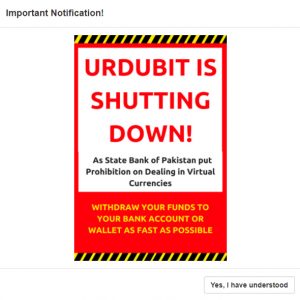 Pakistan’s “first bitcoin exchange” announced its decision to shut down after the State Bank of Pakistan barred all financial institutions from processing crypto-related transactions. Urdubit warned its clients to withdraw both their fiat and crypto funds immediately. Through its accounts on and , and on its , the platform said it was terminating services due to the central bank’s ban.
On April 6, SBP issued a on the “prohibition of dealing in virtual currencies”, effectively banning crypto transactions in Pakistan. The move came after a similar ban introduced by the central bank in neighboring India. SBP advised commercial banks and payment providers to refrain from using, trading, holding, and transferring digital coins. The document, signed by the State Bank’s director Muhammad Javed, stated that banks and businesses should not facilitate crypto transactions of their customers and account holders.
According to Pakistani media, the Karachi-based Urdubit is the country’s first bitcoin exchange. Launched in 2014, the platform gained popularity along with the world’s leading cryptocurrency. On Saturday its team said in a Facebook post:
Due to the current stance on virtual currencies by the SBP, we are closing Urdubit. Withdraw your funds as soon as possible! Please, buy BTC instantly, as we are canceling orders on, or withdraw your PKR [Pakistani Rupee] immediately.
Its website tells visitors: “Urdubit is shutting down! Withdraw your funds to your bank account or wallet!” The closure was confirmed via Twitter with a message published on Sunday: “Urdubit is closed. All bitcoin withdrawals will be closed today at midnight. Please, withdraw your funds.” The platform’s trading volume increased over the weekend following its decision to close down. According to Bitcoincharts, it traded 26 BTC on April 6 and 6 BTC on the next day.
The Future of Crypto Trade in Pakistan Is Unclear
The prohibition was imposed without an official government mandate and despite the lack of dedicated legislation on cryptocurrencies. Nevertheless, SBP asked Pakistani banks to “immediately” report any crypto transactions to the Financial Monitoring Unit (FMU). Furthermore, the central bank warned citizens against using cryptocurrencies to transfer money abroad. SBP also made it clear that virtual currencies like bitcoin are not considered legal tender in the country.
It remains unclear how many of Urdubit’s customers have managed to get their funds back. Small amounts of bitcoin have been traded after the closure on April 8. One of the warnings states that the exchange should not be held liable if clients failed to withdraw their money. There is no indication as to whether Urdubit intends to reopen again, in case the regulatory situation improves.
According to a company working with Urdubit, the exchange is trying to reimburse its customers. “Governments and banks are going to fight bitcoin because investing in it means a bank run on the central bank,” co-founder of Blinktrade Rodrigo Souza told the local online edition Propakistani. His company has been maintaining the open-source software used by Urdubit.

Other Pakistani exchanges have also decided to stay away from trouble with the SBP. A message on BTCPK’s states that the price quotes are for informative purpose only. “BTCPK follows prohibition rules as set by the State Bank of Pakistan via of 2018,” the trading platform tells its customers. The exchange claims to be “the largest crypto market in Pakistan.”
Authorities in Islamabad have already demonstrated negative attitude towards cryptocurrencies in the past. Crypto traders have been targeted recently by the Federal Investigation Agency of Pakistan. SBP’s ban, however, is the largest clampdown on local cryptocurrency exchanges so far.
Do you think Pakistani exchanges will find alternative ways to provide services to the crypto community in the country? Share your thoughts on the ban in the comments section below.
Images courtesy of Shutterstock.
bitcoin News is growing fast. To reach our global audience, send us a news tip or submit a press release. Let’s work together to help inform the citizens of Earth (and beyond) about this new, important and amazing information network that is bitcoin.
The post appeared first on .