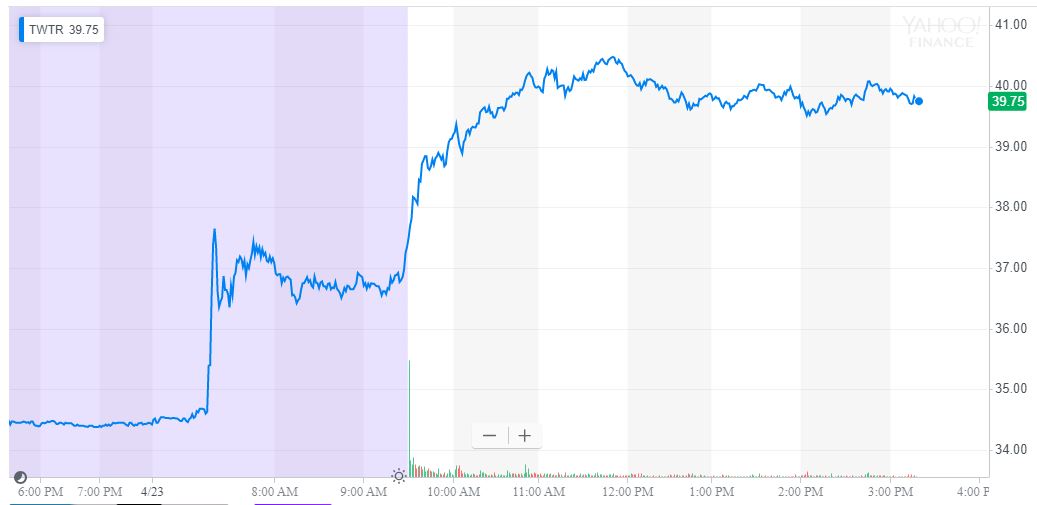
By : Twitter stock (TWTR) surged 16% Tuesday on mammoth first-quarter earnings and massive user growth. The company posted $191 million in net income or 25 cents a share. That’s a 213% increase from the $61 million in net income the company achieved in Q1 2018.
The platform also saw a tsunami of new monthly active users (MAUs) since January. With 9 million new users over the period, Twitter destroyed expectations of a 4 million MAU decline.
Twitter stock jumped nearly 16% after it smashed earnings expectations. | Source: Yahoo Finance
This is the last time will be reporting its monthly active user base for the quarter. From now on, the social media company will only report “daily active users.” The goal is to give investors a better sense of Twitter’s monetizable monthly user base.
A Good Time To Sell Twitter Stock
Twitter’s first-quarter earnings and user growth were wildly unexpected. These numbers represent a surprise aberration from Twitter’s own expected future growth.
Its long-term revenue outlook remains as weak this Spring. Any user growth at all, much less robust user growth as unsustainable as last quarter, is not in the cards. And Twitter expects its operating costs to rise by 20% in 2019.
Value investors looking to buy and hold equities as part of a long term savings portfolio, but who like to do some managing that falls short of day , may do well to cash in on this week’s by letting go some of their Twitter stock.
Day traders who make a profit from the daily rise and fall of various securities might take this opportunity to unload Twitter for some cash and buy it back when the market cools down.
Where Is Twitter Stock Headed Next?
Although it is unlikely to repeat its quarter one performance any time soon, Twitter is a powerful global brand and highly utilized platform with a reliable team at the helm.
Its long-term prospects are as great as or better than the rest of the U.S. equities market as a whole. (Though all of it is in this year’s feverish stock market.)
Twitter will focus its future efforts on of the conversation on its platform. That’s a cause very near and dear to the heart of Twitter’s founder and CEO , but overbearing censorship could also trigger a punishing user exodus.
Remember, it wasn’t that long ago that TWTR shareholders dumped the stock on absolutely abysmal user stats.
Published at Tue, 23 Apr 2019 19:42:16 +0000
![Ethereum [eth]: ‘vitalik boterin,’ an ai-powered bot catches co-founder’s attention](https://ohiobitcoin.com/storage/2019/05/GVD7GK.jpg "Ethereum [eth]: ‘vitalik boterin,’ an ai-powered bot catches co-founder’s attention")