
April 22, 2026

Capitalizations Index – B ∞/21M

Turks Own More Cryptocurrency Than Any Other European Nation

Turks own more cryptocurrency than any other european nation

Turks Own More Cryptocurrency Than Any Other European Nation

A couple of surprises to come out of Meltem Demirors’ Twitter account in the last few hours. Firstly, that the CoinShares Chief Strategy Officer and Blockchain Council member speaks Turkish (who knew?). And secondly, that the Turks own more cryptocurrency than any other European nation. (If you consider Turkey a European nation, of course).


Turks Own More Cryptocurrency at 18% of the Country

From what the author could gather from Google Translate, Demirors declares that she is proud to be Turkish, based on the ING findings that 18% of Turks own cryptocurrency. This is much higher than the overall 9% average.

She also pays tribute to the great success of startups and investors in the country. However, there may be a few more reasons why Turkish people are holding onto digital assets.
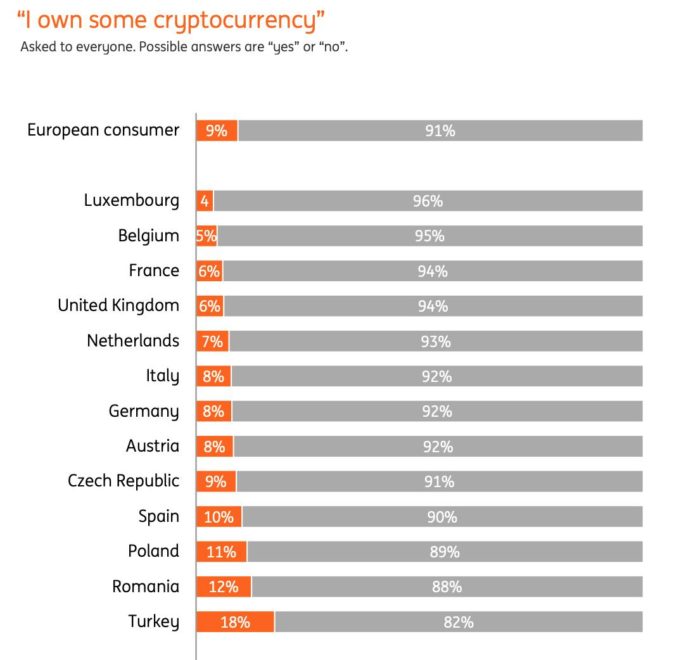
Turks own more cryptocurrency than any other european nation

For one thing, bitcoin may be volatile, but so is the country’s currency, the lira. In fact, even as bitcoin racked up record losses last November, trading volume on Turkish exchanges shot up by 37 percent.

The Turkish lira crisis involving dollar-denominated debt that took place last summer greatly devalued many Turkish families’ life savings. They also saw their pensions and investments significantly affected.

We may not be talking about the likes of Venezuela, but the lira did lose 20% of its value from one day to the next on August 10. Erdogan’s Turkey may be creating the perfect storm for cryptocurrencies.

With a dwindling economy and devalued national currency, it’s hardly surprising that Turkey takes the lead in cryptocurrency ownership. In fact, the anonymous co-owner of bitcoin.org tweeted about the huge surge in traffic from Turkish investors in August, saying this is how bitcoin takes over the world:

Turkey Is Ripe For bitcoin Adoption

Besides the crumbling economy and fluctuating lira, according to computer science professor at Cornell University Emin Gün Sirer, culture plays a large role in the Turkish appetite for bitcoin.
42% traffic increase to bitcoin. Org amidst lira's hurtling price

Not only does the country have a much younger population than the rest of Europe, but they are particularly open to new technology. Moreover, he says that financial schemes with high-profit margins are naturally attractive to Turks. This means the Turks own more cryptocurrency not only as a means of payment but also as a speculative asset.

As for Erdogan, he has not made cryptocurrency illegal in the country. However, he has tried to persuade citizens to convert their dollars into lira, rather than bitcoin. The state religious authority Diyanet also decreed that Muslims should not trade in cryptos.

When Turcoin turned out to be a Ponzi scheme, this gave more fodder for both their arguments. But while the Turkish people are not oblivious to cryptocurrency scams, neither are they blind to the erratic behavior of their government, nor the volatility of their national currency.

So, while Demirors may be right about cryptocurrency startups, it seems there are plenty of other factors steering the Turks towards investing in bitcoin.

Will Turkey become a hotbed for cryptocurrency adoption? Share your thoughts below!


Images courtesy of Shutterstock

Published at Fri, 01 Mar 2019 00:00:43 +0000

Previous Article

bearish until proven otherwise/theory of the descending triangle

Next Article

Warren Buffett, Ray Dalio Or Peter Lynch Investing Styles

You might be interested in …

Bitcoin - bearish symmetrical triangle

Bitcoin – Bearish Symmetrical triangle

bitcoin – Bearish Symmetrical triangle EN English (UK) EN English (IN) DE Deutsch FR Français ES Español IT Italiano PL Polski SV Svenska TR Türkçe RU Русский PT Português ID Bahasa Indonesia MS Bahasa Melayu […]

SALT Enables Traditional Lending Secured by Cryptocurrency

SALT Enables Traditional Lending Secured by Cryptocurrency

A new startup in Denver, Colorado has set out to take on the blockchain-based lending market. Secured Automated Lending Technology, or SALT for short, is a membership-based financial enterprise with its eyes set on being recognized as the first lending platform to facilitate loans collateralized by bitcoin and other cryptocurrencies.

Touted as “traditional lending secured by cryptocurrency,” SALT will allow members to leverage assets like bitcoin and ether for loan collateral. This new platform, which will be tethered to Ethereum ERC20 smart contracts, will enable borrowers to tap into “capital on demand” via its ecosystem of lenders. The major value proposition is that it provides a mechanism for supporting the value of investor holdings, while simplifying all aspects of the loan process and leveraging the power of a blockchain-centric lending market.

The following scenario illustrates a typical use case for SALT: imagine if you sold out your entire bitcoin holdings in 2016 for a luxury purchase, only to see the price shoot to the moon in 2017, resulting in a loss of all that you might have gained over the course of that period had you held on to your bitcoins.

With SALT, an investor who has collateral they wish to retain can leverage their crypto-assets for a loan. This allows them to maintain a long position with their assets while creating a greater set of options with their taxes.

The SALT loan process consists of four primary steps:

  1. Loan Creation: a borrower sets up a membership account and then forwards their collateral to the SALT Oracle Wallet. This is a multi-signature blockchain wallet that functions as a repository for collateral while automatically managing the lending terms.

  2. The loan funds, once approved, are transferred to the borrower’s bank account.

  3. Loan Repayment: a borrower makes timely, periodic payments to the lender.

  4. Loan Completion: upon repayment of the loan, the borrower will have their collateral returned.

SALT doesn’t perform credit checks on borrowers but does conduct full Anti-money Laundering (AML) and Know Your Customer (KYC) verification checks. Loans made via the platform are denominated in and repaid with traditional currencies.

Cryptocurrency assets are used only by the recipient as collateral for the loans. Borrowers can choose to pay off their loans early without being subjected to a prepayment penalty.

SALT members are not required to possess blockchain assets in order to lend on the platform. Lenders must be accredited investors in accordance with federal regulations and guidelines established by the U.S. Securities and Exchange Commission. They must also pass SALT’s Lending Suitability Test.

At the time of the company’s soft launch, Shawn Owen, CEO of SALT, told bitcoin Magazine, “Currently, if you are a holder of blockchain assets, a large chunk of your financial wealth is not being recognized by lenders. With SALT, we see a future where virtually all of the world’s value is on blockchains, with lending reflective of our globally connected, digitized lives.”

Owen says he left his full-time job in 2016, intrigued by the idea of a lending platform that could leverage billions of dollars of untapped cryptocurrencies. “I saw this trend where the vast majority of Bitcoiners just wanted to hold on to their assets. With this realization, the light bulbs all went off, which prompted me to go full blast with SALT. I haven’t really looked back since.”  

When asked about how he came up with name SALT, Owen has this to say: “We liked the name because ‘salt’ was historically the first well-known commodity-based money. Our version of SALT is a way to articulate what we do: taking blockchain technology and smart contracts and building lending terms and everything revolving around credit products and putting them into smart contracts in a more automatic and secure way.”

Owen says many in the bitcoin community have at one point or another experienced a situation where they have sold because they felt that they had a good gain, only to look back and realize that they had missed a massive opportunity. And in that sale, notes Owen, they most likely had to worry about capital gains tax counting and were now wishing they could go back in time six months and have all that ether or bitcoin back.

In terms of emerging trends in the blockchain lending space, Owen points to the massive growth in the number of cryptocurrencies coming online and the innovation associated with them. He says that although it will be a bumpy ride, he believes we’ll continue to see more and more of the world’s value accounted for on distributed ledgers and on blockchains.

“I see a world where large portfolios will be made up of digital assets and they will be much more granular abilities to lend against these portfolios in a much higher liquid form than what we have today. This, I am certain, will solve a lot of the liquidity inefficiencies in the market.”  

Though SALT is currently operating only in the U.S., Owen anticipates making a quick move into Ireland, followed most likely by Canada. “The big picture we are striving for is to create the mechanisms with which lending terms of any type, between any person or individual, whether it be business or not, can interact in a peer-to-peer way with contracts that are enforceable without counterparty risk.”

Erik Voorhees, founder and CEO of ShapeShift and a member of SALT’s board of directors, commented, “SALT’s disruptive innovation is an important project for broadening the usefulness and global reach of blockchain technology.”

The post SALT Enables Traditional Lending Secured by Cryptocurrency appeared first on Bitcoin Magazine.