August 16, 2026

Capitalizations Index – B ∞/21M

Turkish Police Detain 11 Suspects in Bitcoin Theft Case

bitcoin News
Turkish Police Detain 11 Suspects in bitcoin Theft Case
Turkish police detain 11 suspects in bitcoin theft case

The cybercrime unit of the Turkish police has detained 11 people suspected of hacking into emails, user accounts and cryptocurrency wallets. The operation was launched after law enforcement received a number of complaints from victims who lost digital cash.  

Also read: Church Mining Cryptocurrency to Pay Higher Electricity Rates              

Hackers Steal $80,000 Worth of Cryptocurrency

According to Turkish media, 14 people have informed authorities about their compromised cryptocurrency wallets. The coins have been transferred to other wallets and subsequently sold for fiat. Investigators discovered the hackers had stolen “bitcoins worth 437,000 Turkish lira” (over $80,000), the Daily Sabah reported.

The cybercrime combatting division identified some of the suspects by tracking a new phone number they used to register on the trading platforms where they exchanged the cryptocurrency. The thieves moved the money through numerous accounts to cover their tracks, the Hürriyet newspaper detailed.
Turkish police detain 11 suspects in bitcoin theft case

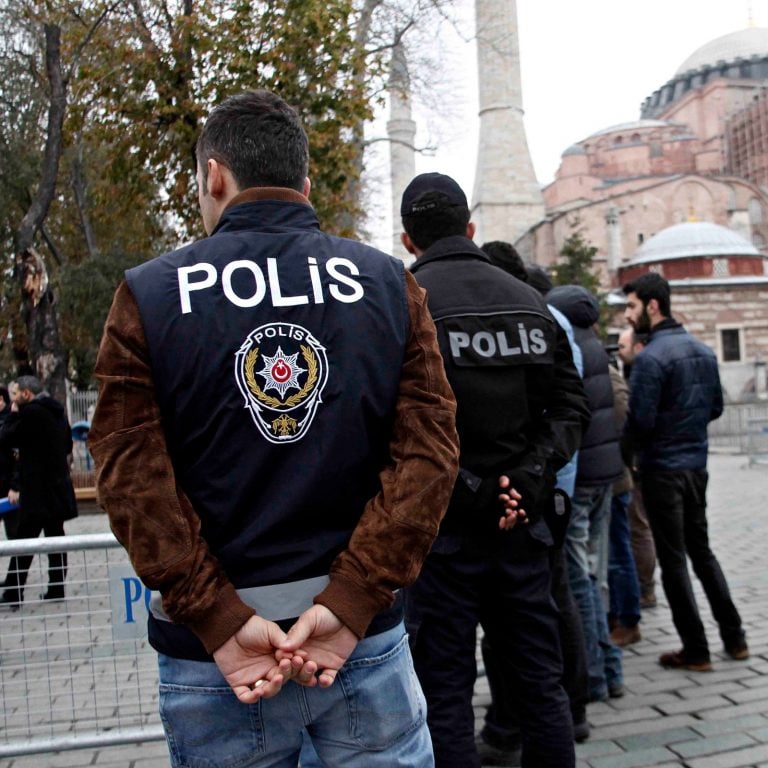
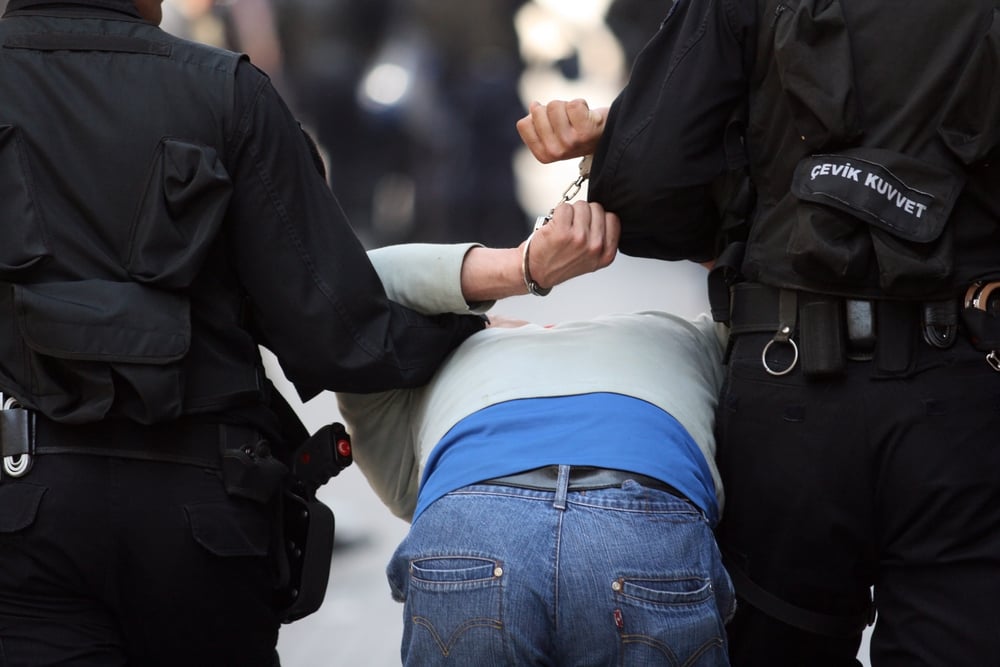
On Oct. 26, agents from the unit detained 11 people at different addresses in Istanbul during joint raids with Polis Özel Harekat, the special operations department of the Turkish police. Currently, 10 of the accused remain in custody. Policemen also seized 18 mobile phones and SIM cards, 22 memory sticks, six laptops, three hard disks, a tablet, two driver’s licenses, and a fake identity card.

During the investigation, police officers tracked the suspects who tried to withdraw the fiat money from various banks and ATMs. Their attempts have been recorded by multiple security cameras. Investigators are also looking for more victims of the hackers.

In Turbulent Times, Turks Turn to bitcoin

Turkey, a country of around 80 million people and a regional powerhouse, has been through some rough times recently, in both economic and political terms. The country’s fiat currency, the lira, has been hit by hyperinflation and lost ground against the U.S. dollar ­– its value dropped by over 45 percent in the first seven months of this year.

These developments convinced many Turks to seek refuge in cryptocurrencies from the lira, but also from the dollar. In August, BTC trading volumes on Turkish exchanges and peer-to-peer platforms like Localbitcoins spiked following rumors that banks in the country may discontinue support for USD accounts and calls from the government to get out of foreign currencies, especially the U.S. dollar.
Turkish police detain 11 suspects in bitcoin theft case

The growing popularity of cryptocurrencies, however, has also given rise to numerous scams. Many Turks invested in Turcoin, the so-called “national alternative digital currency” which was advertised as a “rival to the global virtual currency bitcoin.” This past summer, Turcoin was exposed as a Ponzi scheme after the Istanbul-based company that launched it stopped distributing dividends in June and its founders reportedly fled the country with millions of dollars collected from defrauded investors.

Earlier this year, Turkish media reported about a number of fake websites of popular hotels in Bodrum, Antalya and other resorts. Fraudsters blackmailed their owners demanding ransom in cryptocurrency to close down dozens of domains resembling the brand names of the hotels.

Do you think the Turkish police will be able to secure a prosecution in the bitcoin theft case? Let us know in the comments section below.

Images courtesy of Shutterstock.

Make sure you do not miss any important bitcoin-related news! Follow our news feed any which way you prefer; via Twitter, Facebook, Telegram, RSS or email (scroll down to the bottom of this page to subscribe). We’ve got daily, weekly and quarterly summaries in newsletter form. bitcoin never sleeps. Neither do we.

The post Turkish Police Detain 11 Suspects in Bitcoin Theft Case appeared first on Bitcoin News.

Previous Article

The Bitcoin Game #60: Dr. Adam Back Part 2 – Liquid

Next Article

17 Reasons Why NOW Is The Time To Buy CryptoCurrency!

You might be interested in …

Bitcoin Gold Is About to Trial an ASIC-Resistant Bitcoin Fork

Bitcoin Gold Is About to Trial an ASIC-Resistant Bitcoin Fork

It’s forking season.

After bitcoin Cash (Bcash) forked from the bitcoin blockchain to create a new cryptocurrency (BCH), and ahead of the SegWit2X fork that may do the same thing, a third bitcoin fork is in the making: bitcoin Gold (Bgold; BTG). But where Bcash and SegWit2X are scaling-related forks — both mainly increase bitcoin’s block size limit — Bgold wants to re-decentralize mining by implementing a new proof-of-work algorithm.

“What was born as decentralized is now centralized,” bitcoin Gold contributor J. Alejandro Regojo told bitcoin Magazine, referring to the current state of bitcoin mining. “With this fork, we want to show how bitcoin can be as ‘Satoshi’ as possible, as social as possible, and as decentralized as possible.”

Mining Centralization

bitcoin Gold was initiated by Jack Liao, CEO of Hong Kong–based mining hardware producer LightningASIC, and was first announced in late August. The open project has been gaining traction and support in the wider cryptocurrency space since, with a dedicated Slack as a main hub for discussion and organization. Bgold is currently being developed by the pseudonymous developer “h4x3rotab” along with a small group of volunteers contributing to the project in other ways.

The attention Bgold has attracted is probably in part because anyone who owns bitcoin (BTC) on October 25th will receive the equivalent amount of BTG. While this model has been criticized, particularly because it presents a burden on service providers and users, it has also proven successful. With the launch of bitcoin Cash in particular, users eagerly accepted their batch of “free money,” while exchanges, wallets and other service providers proved relatively willing to integrate the new coin.

Further, the Bgold team believes that this distribution method should also benefit bitcoin over altcoins as it provides an extra incentive to hold BTC on particular dates.

“But the key goal that we are trying to achieve with this fork is to build a perpetually ASIC-resistant version of bitcoin,” said Robert Kuhne, another bitcoin Gold contributor, in explaining the purpose of the project to bitcoin Magazine.

Bgold contributors like Regojo and Kuhne think that bitcoin’s proof-of-work hashing algorithm was essentially broken by the introduction of specialized ASIC (application-specific integrated circuit) mining hardware. In the early years of bitcoin’s existence, individual users were often also miners; this has since become concentrated into relatively centralized data centers operated by professionals.

“And we’re now in a situation where 65 percent of hash power comes from a country that doesn’t like bitcoin,” Regojo noted, referring to China’s recent clamp down on cryptocurrencies.

An Uneven Playing Field

And while mining is centralized, ASIC production is even more centralized, the Bgold contributors pointed out. Only a handful of companies currently produce such specialized chips.

This means that anyone who wants to be a miner in any meaningful way is beholden to these companies, Kuhne argued.

“The way the monopoly manufacturer currently operates is abusive to its customers — individual miners — and the industry at large,” he said, referring to major Chinese ASIC producer Bitmain. “Manufacturers can produce ASICs at a tiny cost, but miners have to buy at a high price. This violates the one-CPU-one-vote ethos as described in the bitcoin white paper, because while everyone can buy CPU at the same price, the same is not true for ASIC hardware.”

Regojo and Kuhne see this as a fundamental problem — not something that free market dynamics can realistically resolve. They suggest that the barrier of entry to the ASIC market to compete with existing manufacturers is fundamentally too high to allow for open competition.

“You can’t build a factory without approval from the government and banking system. So there are really only a handful of entities in the world that have total authority over who can and can’t manufacture ASIC machines. And all this could potentially get much worse if and when those institution really start feeling the disruption from bitcoin, which hasn’t begun in earnest yet,” Kuhne said.

bitcoin Gold

As opposed to the bitcoin Cash and (especially) the upcoming SegWit2X forks, bitcoin Gold very specifically does not make a claim to be the “real” bitcoin. Instead, the Bgold project hopes it can prove a valuable exercise for bitcoin; a sort of test case for a hard fork that bitcoin itself may one day require.

Concretely, bitcoin Gold is now implementing the Equihash proof-of-work algorithm. This is already used by Zcash and is relatively ASIC-resistant.

Full ASIC-resistance, however, is thought to be impossible: Any mining algorithm could be subject to specialized chips. Like Vertcoin, the Bgold community therefore plans to re-deploy a new proof-of-work algorithm hard fork if it is found out that ASIC-chips for Equihash are being produced. (This plan alone, of course, could be a deterrent for any potential ASIC-producer.)

For security, the project plans to implement strong replay protection to avoid loss of funds for unsuspecting or non-technical users. It will also adopt a new difficulty re-target algorithm to prevent the blockchain from stalling: Difficulty is re-adjusted at every block instead of once every two weeks.

While the coin is set to launch two weeks from now, the Bgold codebase is not yet fully developed and ready to be deployed. Implementation of the new proof-of-work algorithm and replay protection, as well as the new difficulty re-adjustment scheme, are yet to be finished.

Nor are all the details for the project even ironed out.

Early announcements indicated that bitcoin Gold would have a closed launch and a presale of coins. A new batch of BTG was to be mined in the first week after the fork and subsequently distributed to designated investors, not unlike an ICO. Proceeds of this “ICO” were then to be used for development and other Bgold-related purposes.

However, as interest in the project grew, this idea became more controversial. Not everyone involved with bitcoin Gold likes the idea of an additional founders reward — something Bcash, for example, did not have.

Kuhne addressed the issue by stating: “We have heard a lot of feedback from the community, so this proposal will be replaced with an updated and improved plan. But we will not completely rule out the possibility of a modest pre-mine to provide a basic level of funding for the project.”

Disclaimer: The author of this article holds BTC and will therefore also own BTG at launch.


The post Bitcoin Gold Is About to Trial an ASIC-Resistant Bitcoin Fork appeared first on Bitcoin Magazine.