
Tron sustained its climb after completing a quick retest of its broken triangle resistance as . Price is now setting its sights on the top of its long-term range, possibly even on the 0.0600 mark.
The moving averages are still oscillating as these indicators have yet to catch up to the sharp bullish move. Note that the earlier triangle spanned 0.0280 to 0.0480 so the resulting rally could be of the same size. The 100 SMA is attempting an upward crossover and this could draw more buyers in.
However, stochastic is indicating overbought conditions and looks ready to turn south once more, possibly leading to yet another correction. Similarly, RSI is dipping into overbought territory to reflect some exhaustion among buyers and potential profit-taking.
In that case, a short-term correction could find support at the 0.0450 area of interest or until the moving averages’ dynamic inflection points.
Tron just introduced a concept known as , which is open to every token holder on the network. This allows for even the smallest coin holder on the TRX network, to have a voice in the project.
The criteria for being a Super Representative is that the delegate should:
Have an official website
Have team information ready: location of the team, arranged location of server and server type
2018 expenditure budget and technical plan by June 26th
2018 hardware capacity upgrade plan after June 26th
2018 community support plan
List of key staff and their photos
Background qualifications of key staff
Testable nodes for community members
A certain amount of social media influence: Twitter or local equivalent of 500+ followers; or Telegram group or local equivalent with 500+ members; or a Reddit page or a local forum homepage with 500+ subscribers; 500+ followers on other social media platforms
This could strengthen the network and its security as Tron eliminates its dependence on the Ethereum blockchain.
The post appeared first on .

The persistent rise of cryptocurrency is changing the internet in a variety of ways, and although it’s relatively early days there’s already been some high profile cryptocurrency fraud incidents. As soon as a new technology hits the www, scammers move in to grab what they can, and crypto is no different.
Over the last 12 months or so, there has been a growing number of crypto scams appearing on Twitter. They’re a sneaky twist on the old ‘Nigerian Letter’ hoax; scammers tweet something like ‘bitcoin giveaway’ or ‘free crypto’ and promise that if you send them a small fraction of a coin to verify your account, they will send back 10 times as much.
You might think that nobody would be silly enough to fall for an old gag like that, but the really devious part of this scam is that the crooks behind it are impersonating the Twitter accounts of high profile cryptocurrency influencers to gain people’s trust. Crypto is still a small world, and there are some well-known investors and founders who have a lot of sway in the online community.
Free crypto?
Recently, a scammer using the Twitter handle @lisa_jones4810 set up a hoax account mimicking Litecoin luminary and started offering free coins. If you’re in the crypto-sphere, this is like someone impersonating Elon Musk and promising to send you a free Tesla if you put $50 in his bank account. It’s the same kind of psychological trickery that scammers use when they send out invoices; big names inspire trust.
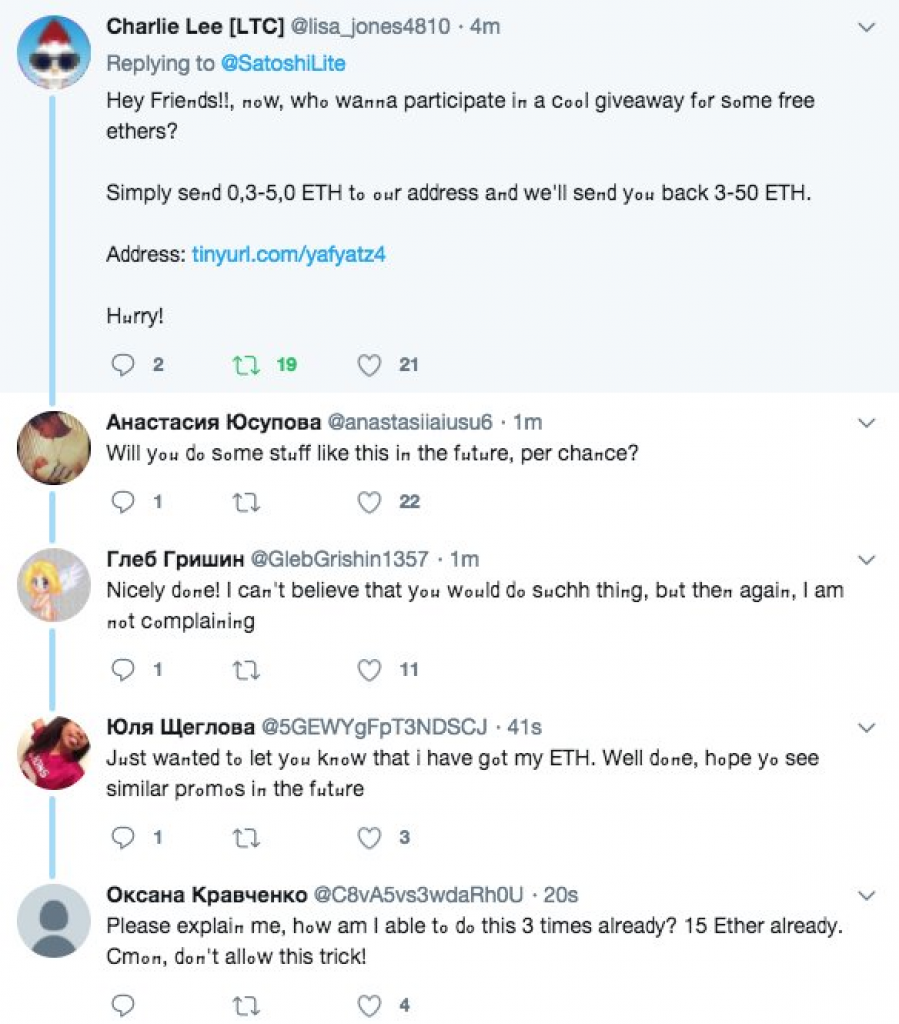
(Image: in a reboot of the old ‘Nigerian Letter’ scam format, social media fraudsters pose as crypto influencers to extort cryptocurrency from victims.)
The proliferation of cryptocurrency scams on social media is a reminder that we always have to be careful when we’re doing business online, whether it’s through email, cryptocurrency exchanges or social channels. Technology keeps changing but some things always stay the same; there will always be crooks trying to make a quick buck, ripping off unwary people.
Fighting back
A savvy self-styled ‘crypto hygienist’ going by has made an which is now automatically replying to ‘free crypto’ tweets with a huge banner proclaiming ‘that tweet is a scam!’.
New technology creates opportunities for criminals but fortunately, there are also cybercrime-fighters looking out for scams and striking back.
 Crypto crime
bitcoin and cryptocurrency, in general, have become an attractive target for cybercriminals, because of their soaring value and the ease with which they can be laundered and sold. Recent conducted by Reuters found that approximately 980,000 bitcoin have been stolen from exchanges since 2011. At current valuation, that’s nearly US$11 billion worth.
The frustrating aspect of cryptocurrency theft, from my cybersecurity POV, is that the underlying Blockchain technology that crypto is built on is actually designed to promote accountability and transparency. Blockchain is a mechanism for making permanent records, so in theory, it should be possible to trace stolen cryptocurrency wherever it goes but ss with every new technology, it takes time to identify the weaknesses in the system and realise its full potential.
A secure Blockchain future
Blockchain is a technology in its infancy, but it’s advancing rapidly and we’re only just beginning to see what it can really do. It’s starting to be used to create platforms that transcend mere wealth exchange programs and can help to build communities for exchanging knowledge and developing ideas. Blockchain is a very versatile mechanism that will, in time, play a pivotal role in making the online space more transparent and secure.
There are bound to be more ups and downs in the crypto story, but I’m looking forward to a time when Blockchain technology is synonymous not only with online currencies but also with tools for making the internet more stable and resistant to fraudulent behaviour.
My brand-new venture, GlobalGuard, is designed to be part of that more secure online future.

is a Blockchain technology that’s going to leverage the past seventeen years of threat data, in combination with an artificially intelligent neural network that’s trained to detect cybersecurity threats. It will be a mechanism for real-time collaboration to correct the imbalance of cybercrime vs cybersecurity.
Going forward, I want to be working with the smartest minds around the planet to optimise our defence against cyber-attacks. I’ve in collaboration with and and we’re actively seeking new partnerships, so check out and get involved with this innovative Blockchain project.
> Join the conversation: follow me on or to stay informed about cybersecurity issues and news.
Originally published at .

The biggest challenge in cybersecurity is keeping up with the new attacks that criminals are always coming up with. They’re always looking for new tools and strategies to defraud companies, so we have to be forward-looking in our approach to defence as well.
MailGuard has built its success on being able to respond to new threats ahead of the market and it’s always been our mission to devise better strategies to combat cyber-attacks in real time.
A while ago, an idea started to take shape in MailGuard meetings; a concept of a massive neural network, enhanced by cutting-edge AI, that could use all the most up-to-the-minute intel on cyber-attacks from across the globe. That was the origin of our new cybersecurity project:
Blockchain cybersecurity
GlobalGuard will be a mechanism for real-time collaboration to correct the imbalance of cybercrime prevention; it’s going to leverage the past seventeen years of MailGuard threat data and IP, in combination with an artificially intelligent neural network that’s trained to detect cybersecurity threats. It’s a global ecosystem of cybercrime fighters using the power of next-generation AI and Blockchain technology to defend businesses from criminal intent. It unites end-users, technology partners, cybercrime experts and vendors, on a living neural network, to identify and stop emerging threats immediately. will protect businesses worldwide from high-value cybersecurity damage and criminal threats including email malware, phishing and social engineering attacks.
Phishing is the big threat and makes up about 50% of all cybercrime. One email is all it takes for cybercriminals to break into a computer system, so with the growth in online fraud at an all-time high, it’s never been more important to take proactive steps against cyber-attack.
MailGuard + DigitalX
MailGuard is partnering with to launch the Blockchain cybersecurity ecosystem that will power GlobalGuard.
I want to share this quote with you from DigitalX CEO Leigh Travers who I’ve been working with very closely:
“GlobalGuard will unite end-users, technology partners, cybercrime experts and vendors throughout the world on a living neural network, to identify and stop threats immediately. It is the next generation of cybersecurity and threat detection. Blockchain technology and AI is the new frontier in the fight against cybercrime. GlobalGuard will connect a network of collaborators to identify and thwart cyber threats instantaneously.”
– Leigh Travers, CEO DigitalX
Today (March 14) our partners DigitalX announced GlobalGuard to the ASX.
Read the announcement doc,
 Me and Leigh Travers at the MailGuard HQ.The new venture
GlobalGuard’s algorithm was originally developed by MailGuard, in collaboration with We are also working with , DigitalX and others to bring the GlobalGuard neural network to life.
Although GlobalGuard is a new venture for me, in a very real way the MailGuard team has been working on this project for years now. It’s long been our view that cybersecurity needs to constantly evolve to remain effective. Cybercriminals are always looking for new tools and strategies to scam companies, so we have to be forward-looking in our approach to defence as well.
GlobalGuard will be a mechanism for real-time collaboration to correct the imbalance of cybercrime prevention; it’s going to leverage the past seventeen years of MailGuard threat data and IP, in combination with an artificially intelligent neural network that’s trained to detect cybersecurity threats.
Everyone working on this project is holding a piece of the puzzle. GlobalGuard puts all the pieces together to solve it. On an ongoing basis, we want to be working with the most advanced technology and the smartest minds to optimise our defence against cyber-attacks.
The strength and calibre of our partnership network shows that this is a global problem that needs a united solution. We are pleased to be working with universities, large corporations and tech experts from around the world to make the GlobalGuard platform the smartest it can be.
We’re actively seeking new partnerships and I’m encouraging businesses to find us on
GlobalGuard: collaborative security
We want to make sure people and businesses are safe when they connect, interact or do business online.
60% of small to medium businesses that suffer a cyber-attack are out of business within 6 months. The economy here in Australia is made up of small businesses, so what impact is that going to have on the rest of us if their doors shut? What effect on the economy is that going to have?
Even the world’s largest companies and governments can’t win the war on cybercrime by acting alone.
A collaborative approach to having conversations with peers, applying knowledge to our customer base, our downstream, our collaborators is essential; we’ve all got to participate in stopping these threats from occurring.
The power of Blockchain is to facilitate collaboration and incentivise people to work together, but of course, the weakness of any currency system is its vulnerability to attack and theft. For us, a cybersecurity company, entering the Blockchain space is a win-win. This is an opportunity to leverage massive scale collaboration; to build an unprecedented community of cybercrime-fighters and at the same time offer new and better tools to stop criminals attacking Blockchain infrastructure.
Get involved
GlobalGuard will be launching later in 2018, so stay tuned. To keep up with all the news, check out and follow me on
Learn more
If you would like to learn more about the complex cybersecurity challenges facing business today, you can download the e-book version of for free.

“Cybercrime is a serious and growing business risk. Building an effective cybersecurity culture within an organisation requires directors and executives to lead by example. Surviving the Rise of Cybercrime is a must-read for directors and executives across business and in government and provides strong foundations for leaders determined to address cyber risk.”
– Rob Sloan, Cybersecurity Research Director, Wall Street Journal
Download your copy of Surviving the Rise of Cybercrime for free,
About Craig McDonald is a veteran cybersecurity entrepreneur, founder and CEO of and author of Surviving the Rise of Cybercrime — a plain English handbook explaining the most common cyber-threats and providing essential guidance on managing business risk.
Originally published at .

Is it possible to repair a negative image when it comes to ICOs?
Originally published at .
was originally published in on Medium, where people are continuing the conversation by highlighting and responding to this story.

