
Over the years there have been many news.bitcoin.com tutorials about the very basics of trading, market indicators, and the multitude of websites that collect vast amounts of data. Some of these resources give traders a step towards making their first trades. Now after a few losses and some lucky gains these individuals are interested in how to read the market.
Also Read:
Confidence is Silent
 Head n Shoulders pattern.
Learning to trade can be difficult but there are so many experts in the field and online resources that can teach anyone to trade cryptocurrencies. The first thing to realize is that bitcoin markets or any cryptocurrency markets are very different than your average stock or FX trading arenas. In fact, many people will tell you that traditional will never be accurate when it comes to digital currency markets. However, there are those that use TA regularly to day trade, make a living, and predict the short-term price swings we all know and love.
The first thing a trader should get to know is the most common financial chart used in the cryptocurrency industry which is the . The size of each candlestick represents a certain time interval, and individuals who study TA look for patterns in the market. This is when you will hear about certain like the ‘Head n Shoulders, the Cup n Handle, Triple Top & Triple Bottom,” and many more funky phrases. However, these pattern help traders predict cryptocurrency price movements in the short and long term. They say after memorizing enough patterns individuals can see them subconsciously while day trading.
 Studying Japanese candlestick charts can produce patterns that may be helpful towards predicting short and long-term price movements.
Cryptocurrency traders then take things to the next level by using a wide variety of tools that are also known to help forecast price movements in markets. One of the biggest indicators in the market many traders utilize is . For instance, a Simple Moving Average (SMA) is used by calculating the average of a digital assets closing value over a set interval. An Exponential Moving Average (EMA) and Displaced Moving Average (DMA) are more complex than the SMA. An EMA responds in a swifter manner to price fluctuations while the DMA is moved in set periods of time so a trader can predict market trends.
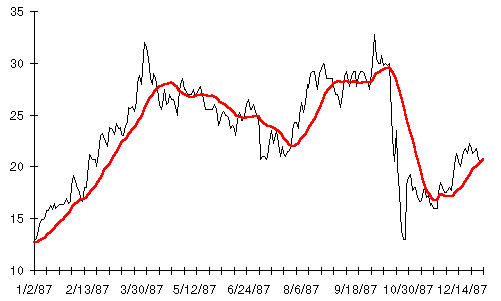 Moving averages are common trendlines followed by traders.
Another helpful tool used in trading digital assets is the (RSI). The oscillator basically determines the price momentum whether it climbs or falls. The measurement of speed is recorded between 0-100 and it’s one of the most popular trading indicators in many markets. The squiggly line typically meanders about sideways, or up or down, and if the line dips below 30 the market is oversold. When the RSI starts climbing past 70 then the analyst will say the price is overbought.
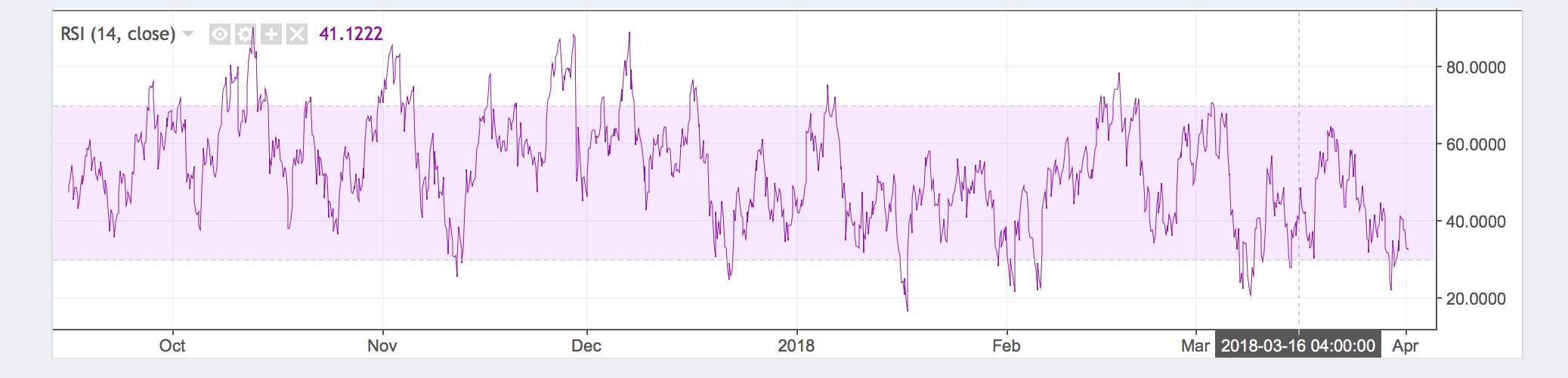
 The RSI and MACd are just a couple of different indicators that help traders forecast price movements.
Moving averages and the RSI is just the tip of the iceberg when it comes to cryptocurrency trading tools. Traders use other tools such as Bollinger Bands, Moving Average Convergence/Divergence (), Stochastic, the Detrended oscillator, and so much more. All of these tools and more are combined with plotting chart patterns used by traders flipping cryptocurrencies on the side or for a living. They are also incorporating other methods like and the tenets of the so they can forecast the infamous bitcoin ups and downs in value.
 The basic five wave sequence found in common Elliot Wave patterns.
Now good traders can study all of this stuff and figure out how to use these types of indicators. However, smart traders are also of crypto, so to speak, as many cryptocurrency enthusiasts have realized that news and community emotions can move the price of bitcoin. For instance, if there is a large exchange hack or some government ruling in the short term you can probably guess bitcoin’s price will go down a touch. If there is positive news like CME and Cboe opening some people bet the price would go up. Most traders are listening very closely to all that happens in bitcoin because they have a lot of skin in the game.
 Trading crypto is not easy and it takes time and patience. Even if you think you know all the chart patterns, indicators, and cryptocurrency street knowledge you can still lose everything.
Lastly even an individual who is very knowledgeable about technical analysis, and they also follow the street very closely, might make some very wrong predictions. Cryptocurrencies like bitcoin can often trick traders, and all that street knowledge and TA goes out the window. Traders with extremely crafted TA skills can lose their shirt in a matter of minutes in bitcoin-land. So, make sure you know for certain that’s a legitimate head n shoulder or bull flag.
Do you trade cryptocurrencies? Let us know your techniques in the comments below.
Images via Shutterstock, Stock charts, Pixabay, Wiki Commons, and Paramount Pictures.
Do you agree with us that bitcoin is the best invention since sliced bread? Thought so. That’s why we are building this online universe revolving around anything and everything bitcoin. We have a. And a. And a, a and real-time.
The post appeared first on .

![Re: [ann] arabianchain - dubaicoin (dbix) - smart contracts from dubai to the world](https://ohiobitcoin.com/storage/2017/03/KCFFFC.jpg "Re: [ann] arabianchain - dubaicoin (dbix) - smart contracts from dubai to the world")
