April 17, 2026

Capitalizations Index – B ∞/21M

Top 10 Cryptocurrency Projects by Git Metrics

BTCMANAGER
Top 10 Cryptocurrency Projects by Git Metrics

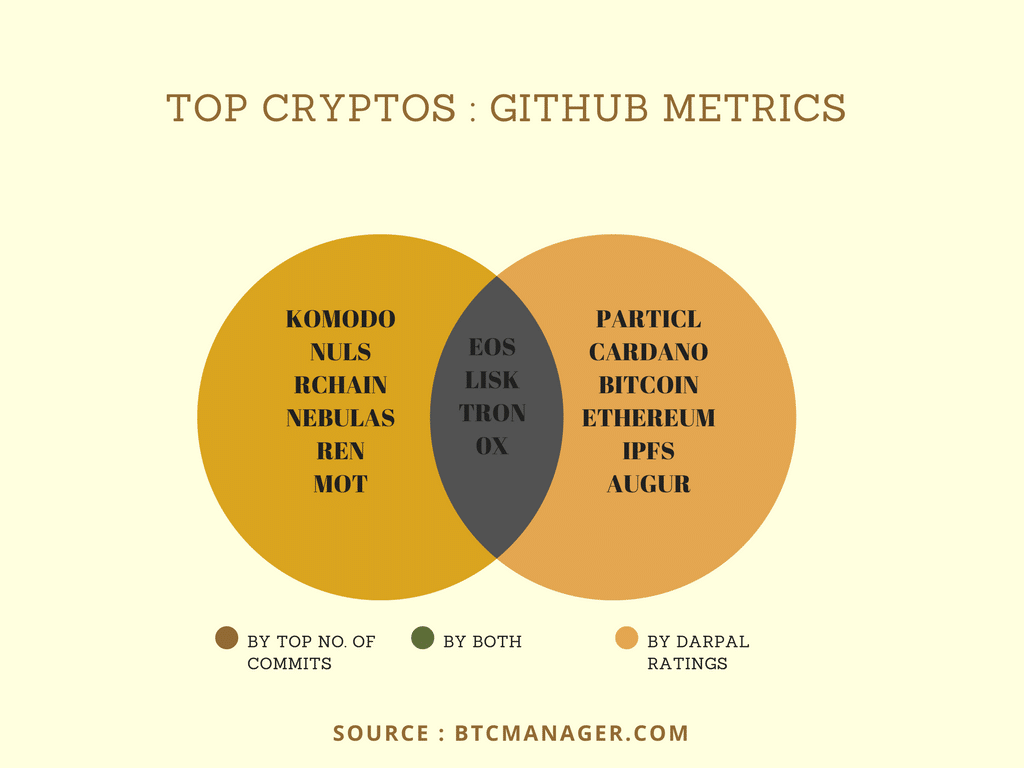
We explore top cryptocurrency projects by git metrics using the number of git commits and through the Darpal ratings, which is a more comprehensive git metrics analysis.

According to GitHub a commit:

Stores the current contents of the index in a new commit along with a log message from the user describing the changes.

CryptoMiso is a web platform that ranks cryptocurrencies in terms of their number of “commits” on GitHub. Commits help the track the level of developer activity on GitHub. This can be used as a metric for valuing cryptocurrencies.
Top 10 cryptocurrency projects by git metrics

Below are the top ten cryptocurrencies based on their number of commits for the last six months.

1. Komodo (KMD): 3,314 commits

Market Capitalization: $438 million; 24-hour volume: $4.11 million

Komodo is a second-generation bitcoin-based blockchain. It is a fork of the Zcash blockchain which in turn was a bitcoin fork. KMD is the native token of the Komodo blockchain with a total supply of 200 million tokens. Komodo implements zero-knowledge proofs (zkSNARK) anonymity protocols.

2. Lisk (LSK): 2,640 commits

Market Capitalization: $1.35 billion; 24-hour volume: $60.14 million

Lisk is a fork of the Crypti blockchain. It is an open source blockchain platform that will enable developers to write DApps in JavaScript programming language. Lisk plans to implement a sidechain for each DApp to ensure scalability. The platform is powered by the LSK tokens.

3. EOS (EOS): 2,543 commits

Market Capitalization: $17 billion; 24-hour volume: $3.62 billion

EOS is a blockchain that is designed to provide a platform for businesses to build large-scale commercial DApps. EOS uses asynchronous communication and parallel processing protocols to ensure scalability. The platform’s project includes an all-star cast of notable blockchain VIPs including Dan Larimer.

4. Nuls (NULS): 2,305 commits

Market Capitalization: $162 million; 24-hour volume: $17.7 million

Nuls is a blockchain platform that is focused on private blockchains. Nuls is developing a modular structure that will allow private blockchains have easy access to public blockchains.

5. TRON (TRX): 2,237 commits

Market Capitalization: $5.97 billion; 24-hour volume: $1.37 billion

Tron is a decentralized protocol that enables content creators to take complete control of the creative work. It features an incentivized platform where content creators can list their works, making it available for purchase. The native currency of the blockchain is called Tronix (TRX). The project looks to solve the problem of censorship and high channel fees in the content industry.

6. 0x (ZRX): 2,102 commits

Market Capitalization: $653 million; 24-hour volume: $10 million

0x is a decentralized exchange (DEX) platform. It allows the trading of ERC20 tokens on the Ethereum blockchain. The project aims to improve the functionality of decentralized exchanges by using off-chain orders in tandem with on-chain settlements. This approach aims to significantly reduce transaction fees associated with cryptocurrency trading on the DEX.

7. RChain (RHOC): 1,531 commits

Market Capitalization: $617 million; 24-hour volume: $1.05 million

Rchain is designed to be a scalable blockchain platform. Up to 40,000 transactions can be carried out on the Rchain network per second. It uses game theory and Mobile Process Calculi to deliver an efficient decentralized network.

8. Nebulas (NAS): 1,423 commits

Market Capitalization: $353 million; 24-hour volume: $38.67 million

Nebulas is a search engine for blockchains. It is an incentive-based, self-evolving platform with smart contract capabilities. The project aims to enable users to privatize their data thereby stopping large internet companies from profiting off users’ data.

9. Republic Protocol (REN): 1,402 commits

Market Capitalization: $41 million; 24-hour volume: $3.62 million

Republic protocol is an atomic swap, darkpool trading platform. It enables private large-scale cryptocurrency trading transactions. The platform uses a zero-knowledge proof that only verifies the logic aspect of a trade without investigating any specific details.

10. Olympus Labs (MOT): 1,341 commits

Market Capitalization: $18 million; 24-hour volume: $1.49 million

Olympus labs is an ambitious process that aims to create a robust blockchain-based decentralized financial ecosystem. The platform combines a DEX with smart contract implementation and cross-chain exchanges.

DarpalRating

DarpalRating is another service that tracks GitHub developer activities on cryptocurrency and blockchain projects. The platform uses four parameters to rank crypto projects. These are:

The popularity of the library,
Number of contributors,
Release frequency,
Type and number of commits.

The top ten projects (as per data of March 2018) in the DarpalRating ranking are; EOS, Lisk, Particl, Cardano, bitcoin, Ethereum, IPFS, TRON, 0x, Augur.

The post Top 10 Cryptocurrency Projects by Git Metrics appeared first on BTCMANAGER.

Previous Article

Coinbase Soon to Offer Block Trading Facility For Institutional Investors

Next Article

Бобби Ли и Саймон Кокинг выступят на NEXT BLOCK Conference в Киеве

You might be interested in …

Martexcoin(mxt) + conclusão aeon wallet + news poswallet. Com

MarteXcoin(MXT) + Conclusão AEON Wallet + News PoSWallet.com

MarteXcoin(MXT) + Conclusão AEON Wallet + News PoSWallet.com MarteXcoin é uma Criptomoeda brasileira, possui mineração híbrida, PoS e PoW, foi a primeira Altcoin de algoritmo X13 à adotar esta técnica de mineração. Também neste vídeo, […]

Bitcoin Gold Is About to Trial an ASIC-Resistant Bitcoin Fork

Bitcoin Gold Is About to Trial an ASIC-Resistant Bitcoin Fork

It’s forking season.

After bitcoin Cash (Bcash) forked from the bitcoin blockchain to create a new cryptocurrency (BCH), and ahead of the SegWit2X fork that may do the same thing, a third bitcoin fork is in the making: bitcoin Gold (Bgold; BTG). But where Bcash and SegWit2X are scaling-related forks — both mainly increase bitcoin’s block size limit — Bgold wants to re-decentralize mining by implementing a new proof-of-work algorithm.

“What was born as decentralized is now centralized,” bitcoin Gold contributor J. Alejandro Regojo told bitcoin Magazine, referring to the current state of bitcoin mining. “With this fork, we want to show how bitcoin can be as ‘Satoshi’ as possible, as social as possible, and as decentralized as possible.”

Mining Centralization

bitcoin Gold was initiated by Jack Liao, CEO of Hong Kong–based mining hardware producer LightningASIC, and was first announced in late August. The open project has been gaining traction and support in the wider cryptocurrency space since, with a dedicated Slack as a main hub for discussion and organization. Bgold is currently being developed by the pseudonymous developer “h4x3rotab” along with a small group of volunteers contributing to the project in other ways.

The attention Bgold has attracted is probably in part because anyone who owns bitcoin (BTC) on October 25th will receive the equivalent amount of BTG. While this model has been criticized, particularly because it presents a burden on service providers and users, it has also proven successful. With the launch of bitcoin Cash in particular, users eagerly accepted their batch of “free money,” while exchanges, wallets and other service providers proved relatively willing to integrate the new coin.

Further, the Bgold team believes that this distribution method should also benefit bitcoin over altcoins as it provides an extra incentive to hold BTC on particular dates.

“But the key goal that we are trying to achieve with this fork is to build a perpetually ASIC-resistant version of bitcoin,” said Robert Kuhne, another bitcoin Gold contributor, in explaining the purpose of the project to bitcoin Magazine.

Bgold contributors like Regojo and Kuhne think that bitcoin’s proof-of-work hashing algorithm was essentially broken by the introduction of specialized ASIC (application-specific integrated circuit) mining hardware. In the early years of bitcoin’s existence, individual users were often also miners; this has since become concentrated into relatively centralized data centers operated by professionals.

“And we’re now in a situation where 65 percent of hash power comes from a country that doesn’t like bitcoin,” Regojo noted, referring to China’s recent clamp down on cryptocurrencies.

An Uneven Playing Field

And while mining is centralized, ASIC production is even more centralized, the Bgold contributors pointed out. Only a handful of companies currently produce such specialized chips.

This means that anyone who wants to be a miner in any meaningful way is beholden to these companies, Kuhne argued.

“The way the monopoly manufacturer currently operates is abusive to its customers — individual miners — and the industry at large,” he said, referring to major Chinese ASIC producer Bitmain. “Manufacturers can produce ASICs at a tiny cost, but miners have to buy at a high price. This violates the one-CPU-one-vote ethos as described in the bitcoin white paper, because while everyone can buy CPU at the same price, the same is not true for ASIC hardware.”

Regojo and Kuhne see this as a fundamental problem — not something that free market dynamics can realistically resolve. They suggest that the barrier of entry to the ASIC market to compete with existing manufacturers is fundamentally too high to allow for open competition.

“You can’t build a factory without approval from the government and banking system. So there are really only a handful of entities in the world that have total authority over who can and can’t manufacture ASIC machines. And all this could potentially get much worse if and when those institution really start feeling the disruption from bitcoin, which hasn’t begun in earnest yet,” Kuhne said.

bitcoin Gold

As opposed to the bitcoin Cash and (especially) the upcoming SegWit2X forks, bitcoin Gold very specifically does not make a claim to be the “real” bitcoin. Instead, the Bgold project hopes it can prove a valuable exercise for bitcoin; a sort of test case for a hard fork that bitcoin itself may one day require.

Concretely, bitcoin Gold is now implementing the Equihash proof-of-work algorithm. This is already used by Zcash and is relatively ASIC-resistant.

Full ASIC-resistance, however, is thought to be impossible: Any mining algorithm could be subject to specialized chips. Like Vertcoin, the Bgold community therefore plans to re-deploy a new proof-of-work algorithm hard fork if it is found out that ASIC-chips for Equihash are being produced. (This plan alone, of course, could be a deterrent for any potential ASIC-producer.)

For security, the project plans to implement strong replay protection to avoid loss of funds for unsuspecting or non-technical users. It will also adopt a new difficulty re-target algorithm to prevent the blockchain from stalling: Difficulty is re-adjusted at every block instead of once every two weeks.

While the coin is set to launch two weeks from now, the Bgold codebase is not yet fully developed and ready to be deployed. Implementation of the new proof-of-work algorithm and replay protection, as well as the new difficulty re-adjustment scheme, are yet to be finished.

Nor are all the details for the project even ironed out.

Early announcements indicated that bitcoin Gold would have a closed launch and a presale of coins. A new batch of BTG was to be mined in the first week after the fork and subsequently distributed to designated investors, not unlike an ICO. Proceeds of this “ICO” were then to be used for development and other Bgold-related purposes.

However, as interest in the project grew, this idea became more controversial. Not everyone involved with bitcoin Gold likes the idea of an additional founders reward — something Bcash, for example, did not have.

Kuhne addressed the issue by stating: “We have heard a lot of feedback from the community, so this proposal will be replaced with an updated and improved plan. But we will not completely rule out the possibility of a modest pre-mine to provide a basic level of funding for the project.”

Disclaimer: The author of this article holds BTC and will therefore also own BTG at launch.


The post Bitcoin Gold Is About to Trial an ASIC-Resistant Bitcoin Fork appeared first on Bitcoin Magazine.