A Little Bit Higher Now
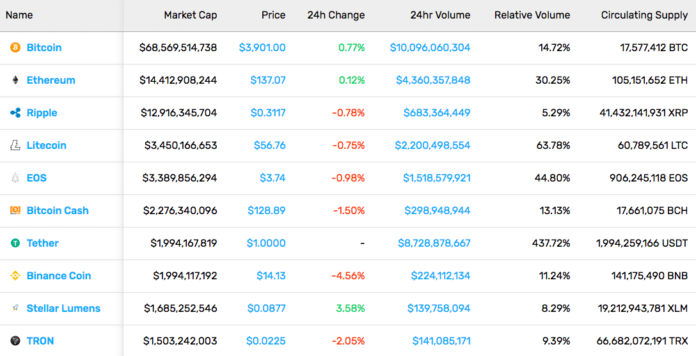
A little bit higher now. And a little bit higher now. The crypto market continued to show consistent growth this week, gaining over $2.5B in the overall market cap. Led by Litecoin (18.63%), Binance Coin (27.50%), and BAT (18.03%), the market grew a healthy two percent over the week. As for the top three coins:
Cryptocurrency Market Stats (3/8/19)
bitcoin won the week with a 1.43% price increase. It continues to creep closer to the $4,000 mark.
Ethereum hardly moved, growing only 0.36%. The price remains just shy of $140.
XRP experienced a slight pullback of 2.57% inching toward $0.30.

: Last week, Kroger, a prominent U.S. grocery store chain announced a store-wide ban on Visa payments starting in April. The move comes in response to Visa’s exorbitant processing fees, which are apparently making it difficult for the chain to maintain low prices for customers.
bitcoin advocates were, of course, quick to swoop in. Anthony “Virus is spreading”Pompliano put in a request on Twitter for any followers to put him in contact with the Kroger executive team. And, Satoshi be damned, it actually worked. Pompliano followed up this week, informing the Twitter masses that he spoke with the Kroger digital team, and things look to be progressing. bitcoin Lightning Network payments could be coming to a grocery store near you.
Grocery store is stopping acceptance of in over 250 stores because of network fees.
Who knows someone on the leadership team there?
The Morgan Creek Digital team will fly to meet them and get them hooked up with the Lightning Network nationwide. 🔥🙏🏽
— Pomp 🌪 (@APompliano)
The mile-high municipal is planning to pilot a mobile voting app for its election in May. They’re making the blockchain-based app available to active-duty military and their eligible dependents as well as any overseas voters. Moving the absentee voting process to a mobile app improves on the tedious process of having to print out and scan all the required documentation. And overall, it should help to increase voter turnout.
The progressive voting effort is in partnership with Tusk Philanthropies, an organization on a mission to “advance mobile voting and anti-hunger programs around the country.”
People Saying Things
bitcoin fanboy and Twitter/Square CEO Jack Dorsey is ensuring he’s on the right side of history when bitcoin becomes mainstream. This week, on the Tales from the Crypt podcast, Dorsey revealed that recently he’s been gobbling up $10,000 worth of crypto each week, the maximum amount via Cash App.

We spoke with the team making sure your smart fridge won’t extort you for bitcoin someday.
You could either place cause on the hemispheres or the questionable banking sector, but the Argentinean crypto winter is hot.
Because you should obviously trust your financial livelihood to the company that’s soo ethical with personal data.
Whales in 60 Days: Nom, nom, nom. Looks like the whales are finally starting to eat their lunch.
Isn’t Dying, It’s Just Hibernating: “bitcoin is dead!” We’ve heard a million times. Here’s why that’s clearly not the case.
We break down how this blockchain platform is making digital art provably rare and absolutely tradeable.

Nothing, apparently. Bloomberg reports that five of the six cold wallet addresses that Canadian exchange QuadrigaCX claims to have held the majority of users’ funds have been empty since April last year. To recap, Quadriga’s CEO, Gerald Cotton, died abruptly this year, allegedly taking the passwords to the majority of the exchange’s cold wallets with him.
Now, Ernst and Young is auditing the exchange in an attempt to find the hundreds of millions of dollars of user funds. So far, they haven’t had any luck. Their next line of attack is through Amazon Web Services (AWS). They’re looking for the court grant to order Amazon to give over details of the platform’s data. Because the account is in Cotton’s name, Amazon is unable (or unwilling) to hand it over without a court’s direction.
The verdict’s out. Colleges campuses are officially the second coolest place to mine cryptocurrency, according to a recent Cisco study. The birthplace of beer pong and keg stands came in second only to energy/utility plants. Twenty-two percent of all cryptocurrency mining activities occur on university grounds, likely due to the free electricity provided by the school.

Top Crypto Mining Verticals (Source: Cisco)
Other than students, though, Cisco threat researcher Austin McBribe believes that hackers have also been infecting campus computers with mining malware, AKA cryptojacking. He notes, “If you don’t have to pay for those costs, then you are in a really good spot for making money on the university’s dime.”
The post appeared first on .

is author of this content, TheBitcoinNews.com is is not responsible for the content of external sites.
source:
TheBitcoinNews.com is here for you 24/7 to keep you informed on everything crypto. Like what we do? Tip us some Satoshi with the exciting new Lightning Network Tippin.me tool!
Published at Fri, 08 Mar 2019 15:18:40 +0000