January 20, 2026

Capitalizations Index – B ∞/21M

This Japanese Cryptocurrency is Getting Dumped after Spiking 70% in a Week

This japanese cryptocurrency is getting dumped after spiking 70% in a week

This Japanese Cryptocurrency is Getting Dumped after Spiking 70% in a Week

This japanese cryptocurrency is getting dumped after spiking 70% in a week

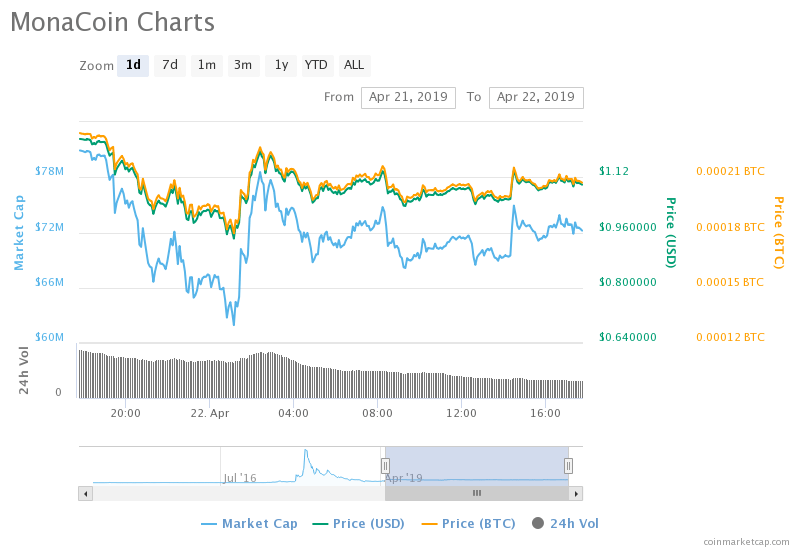
Monacoin traded lower on Monday after ending last week on a 50-percent gain.

The MONA-to-dollar exchange rate fell as much as 30-percent to $0.94 from its Sunday peak. As of 1344 UTC, the pair had recovered towards $1.10 with the coin’s market capitalization at $72.3 million. However, based on a 24-hour adjusted timeframe, both the price and valuation was still down by circa 10-percent against the dollar and 10.5-percent against bitcoin.

Monacoin undergoes a dump after raising over 50% the previous week.|  SOURCE: COINMARKETCAP.COM

The past 24 hours saw exchanges trading around $15.75 million worth of MONA-enabled pairs. Japan-based Bitbank hosted more than 90-percent of the total MONA trading volume against the Japanese Yen. At the same time, the exchange noted $367K worth of bitcoin-enabled trades in the MONA market. Bitbank is a regulated trading platform, which means that the probability of price manipulation by the exchange was the least in its case.

Mysterious Buyer

Monacoin is neither a Tezos featured in a high-profile staking service nor a Tron backed by a persistent marketer. The blockchain asset is merely a digital token which took its cues from a more established project like Litecoin and launched itself as a Japanese-version of Dogecoin in 2013. The project has been there for far too long which should keep the “scam accusations” away. But that still does not explain the fundamentals around the mysterious MONA pump.

Twitterati Bobcat Crypto reported a “medium strength buy signal” on Bittrex, a US-based cryptocurrency exchange that raised the buy volume by circa 276-percent. It appears the mysterious buyer(s) exhausted its buying frenzy at a certain level, followed by an exit. That is the only explanation which could explain Monacoin’s intraday performance on Saturday throughout Sunday, followed by a sharp correction Monday.

Opportunities

Entering new long positions in the MONA market looks risky since the potential of an extended downside correction is high. Meanwhile, a Short target towards the intraday support level at $0.94 could yield a decent interim profit. A stop loss order maintained a few points above the entry position would minimize losses in the event of the asset rebounding ahead of testing the Short target.

Published at Mon, 22 Apr 2019 15:41:26 +0000

Previous Article

South Koreans Invest an Average $6,000 in Cryptocurrency, Says New Survey

Next Article

Bitcoin Already Outperforming NASDAQ, S&P 500 and Gold in 2019

You might be interested in …

Bread part 1 | basics with babish

Bread Part 1 | Basics with Babish

Bread Part 1 | Basics with Babish Enter offer code “Babish” at Squarespace.com for 10% off your first purchase, or visit: http://smarturl.it/BWBsquarespace This week on Basics, I’m teaching you how to make bread. This process […]

Private Capital Market Ecosystems Meet the Blockchain

Private Capital Market Ecosystems Meet the Blockchain

In a move signaling blockchain technology’s continued advancement in the financial world, Hong Kong–based PrivateMarket.io and NY-based Symbiont announced an agreement to build an alternative investment marketplace for closed-end funds utilizing Symbiont’s SmartSecuritiesTM software. The parties anticipate that the marketplace will go live in late 2017.

PrivateMarket’s strategic intent is to ensure that a new generation of wealth managers are able to access, analyze and seamlessly execute primary and secondary market transactions online. Through technology, they deliver concrete solutions that foster a more transparent and efficient private capital market ecosystem.

In a statement, Loïc Engelhard, founder and CEO of PrivateMarket.io, said he welcomed the partnership, noting that the security and privacy elements being delivered by Symbiont are of paramount importance for his company’s success. In particular, he touted the ease of integration and fit of Symbiont with their own internal processes at PrivateMarket.  

Symbiont is largely known for a smart-contracts platform that tethers to institutional applications of distributed ledger technology. Its growing number of disclosed users include 19 financial institutions for Smart Loans™, arranged by Credit Suisse and executed via Synaps; its syndicated-loans joint venture with Ipreo; the State of Delaware for Smart Records™; a major European insurance company for Smart Swaps™ in the catastrophe insurance market; and Orebits, a provider of asset digitization services. The company’s technology has also been used in markets for syndicated loans and digitized gold claims.

Symbiont was started in early 2015 by Mark Smith, Adam Krellenstein, Evan Wagner and Robby Dermody — all of whom have extensive track records in the bitcoin/blockchain space as well as in fintech. Prior to Symbiont, the trio of Krellenstein, Wagner and Dermody founded Counterparty, the “bitcoin 2.0” open-source project targeting digital representation of non-bitcoin assets on the bitcoin blockchain.

In August of 2016, Caitlin Long, a Wall Street veteran of over 22 years, joined Symbiont as chairman of the board and president, assuming responsibility for Symbiont’s commercialization, business strategy and client relationship efforts.

In an interview with bitcoin Magazine, Long discussed how Symbiont’s new partnership with PrivateMarket is designed to provide an enhanced and efficient approach to private capital markets, with private equity and real assets as a main focus.

“The implementation of our blockchain and Smart Contracts solution will increase efficiency, transparency and the speed of the transactions in the antiquated over-the-counter market. It will also improve greatly the security of the private equity market by simplifying complex and highly manual bilateral contracts.”

She also noted that unlike the current state in private equity, where unlisted (investment) vehicles exist, Symbiont’s solution will greatly improve the liquidity of asset classes through the implementation of its SmartSecurities solution.

“We see blockchain technology having a significant positive impact on the investment world, and it starts with the fact that the foundational document for any investment — the registration of a company — will likely soon be possible to do on a blockchain in Delaware.”

Long says that when securities are issued natively on a blockchain, not only can they be administered via smart contracts, but issuers and investors will be able to communicate directly. In addition, she says, payment of dividends can be handled directly, proxy voting will be clear and accurate, share repurchases and tender/exchange offers for bonds will be easy to execute, and the roster of security owners will always be accurate and up to date.  

Long says that amid these advancements, there are also significant opportunities for improvement of business processes in the fund administration business — whether it be mutual funds or private asset funds.  

“At the end of the day, all of these benefits will accrue to end investors, who we’ve always said should be the biggest beneficiaries of blockchain technology in the financial sector.”

The post Private Capital Market Ecosystems Meet the Blockchain appeared first on Bitcoin Magazine.