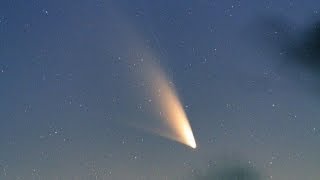
 The Top Ten Comets of All Time…….. Original Music (C) 2010
A Great Comet is comet that becomes exceptionally bright. no official definition; often the term is attached to comets such as Halley’s Comet, which are bright enough to be noticed by casual observers who are not actively looking for them, and become well known outside the astronomical community. Great Comets are rare; on average, only one will appear in a decade. While comets are officially named after their discoverers, Great Comets are sometimes also referred to by the year in which they appeared great, using the formulation “The Great Comet of …”, followed by the year.
Size and activity of the nucleus
Close perihelion approach
Close approach to the Earth
List of Great Comets
Comet of 1680
The vast majority of comets are never bright enough to be seen by the naked eye, and generally pass through the inner Solar System unseen by anyone except astronomers. However, occasionally a comet may brighten to naked eye visibility, and even more rarely it may become as bright as or brighter than the brightest stars. The requirements for this to occur are: a large and active nucleus, a close approach to the Sun, and a close approach to the Earth. A comet fulfilling all three of these criteria will certainly be spectacular. Sometimes, a comet failing on one criterion will still be extremely impressive. For example, Comet Hale–Bopp had an exceptionally large and active nucleus, but did not approach the Sun very closely at all, yet it still became an extremely famous and well observed comet. Equally, Comet Hyakutake rather small comet, but appeared bright because it passed extremely close to the Earth.
Size and activity of the nucleus
Cometary nuclei vary in size from a few hundreds of metres across or less to many kilometres across. When they approach the Sun, large amounts of gas and dust are ejected by cometary nuclei, due to solar heating. A crucial factor in how bright a comet is how large and how active its nucleus. After returns to the inner Solar System, cometary nuclei become depleted in volatile materials and thus are much less bright than comets which are making their first passage through the Solar System.
The sudden brightening of comet 17P/Holmes in 2007 showed importance of the activity of the nucleus in comet’s brightness. Between October 23–24, 2007 the comet suffered a sudden outburst which caused it brighten by factor about half million. It unexpectedly brightened from an apparent magnitude of about 17 to about 2.8 in a period of only 42 hours, making visible to naked eye. All these temporarily made comet 17P the largest (by radius) object in the Solar System although its nucleus is estimated to be only about 3.4 km in diameter.
Close perihelion approach
The brightness of a simple reflective body varies with inverse square of its distance from the Sun. That is, if an object’s distance from the Sun is halved, its brightness is quadrupled. However, comets behave differently, due to their ejection of large amounts of volatile gas which then also reflect sunlight and also fluoresce. Their brightness varies roughly as the inverse cube of their distance from the Sun, meaning that if a comet’s distance from the Sun is halved, it will become eight times as bright.
This means that the peak brightness of a comet depends significantly on its distance from the Sun. For most comets, the perihelion of their orbit lies outside the Earth’s orbit. Any comet approaching the Sun to within 0.5 AU or less may have a chance of becoming a Great Comet.
Close approach to the Earth
Halley’s Comet 1986 apparition was quite modest compared to some of the brightest
For a comet become spectacular, also needs to pass close to the Earth. Halley’s Comet, for example, is usually very bright when it passes through the inner Solar System every seventy-six years, but during its 1986 apparition, closest approach to Earth was almost the most distant possible. The comet became visible to the naked eye, but definitely unspectacular. On the other hand, intrinsically small faint Comet Hyakutake (C/1996 B2) appeared very bright and spectacular due to very close approach to Earth at its nearest during March 1996. Its passage near the Earth was one of closest cometary approaches on record.
List Great Comets
Great Comets of the past two millennia include the following:
Halley’s Comet — 87 BC[2]
Caesar’s Comet — 44 BC[3]
Halley’s Comet — 12 BC[2]
Halley’s Comet — 1066
Great Comet of 1264[4]
Great Comet of 1402
Great Comet of 1556[5]
Great Comet of 1618
Great Comet of 1680
Great Comet of 1744
Great Comet of 1811
Great Comet of 1843
Donati’s Comet — 1858
Great Comet of 1861
Great Comet of 1882
Great Daylight Comet of 1910
Halley’s Comet — 1910
Comet Skjellerup–Maristany — 1927
Comet Arend–Roland — 1957
Comet Seki-Lines — 1962
Comet Ikeya–Seki — 1965
Comet West — 1976
Comet Hyakutake — 1996
Comet Hale–Bopp — 1997
Comet McNaught — 2007
Comet Lovejoy — 2011