Recently I visited India representing the DFINITY Foundation. The trip was supported by upstart venture production and consulting group, Dunya Labs, and advocacy group, InCrypt. Those ten days altered my understanding of the way technology manifests products and the driving role the needs of high growth nations will have in defining the digital landscape of tomorrow.
In this episode, I’m joined by co-founder of Dunya Labs, Cathy Guo, and co-founders of InCrypt, Nitin Sharma & Sumukh Shetty. We examine the Indian startup, business and regulatory environments. We also look at the growth of telecommunications infrastructure alongside macro demographic trends and the unique business conditions they create.
IncryptInvestment, community building, and policy research and advocacy Has produced study and guidance on regulation
Dunya LabsResearch ArmProduct specific researchInfrastructure team connecting applications to protocolsCommunity and incubation
Cathy’s BookEntrepreneurial philosophyCorporate responsibilityEmerging tech landscape in IndiaEmerging startup ecosystemThe way that Indian startups create social and economic value
How do you see blockchain technology being deployed in India?Low trust, high administrative friction in IndiaMiddlemen are a big problemDesire for transparency and automationMore data is moved through Indian infrastructure than the USBeginning with banks and private ledgersSupply chain, etc. basic pilots that we are used to seeing in the first phase of blockchain experimentationNext step is public blockchainThis is limited by the regulatory environmentLook at India for talent, users & capital
The 4g RolloutIndia is experiencing a leapfrog effect for technology rollout
Tech companiesIndian tech companies are moving from a service based model through a period of optimizing external business models for the Indian market to a native innovation model where they will begin exporting technologyThere are 18 tech companies valued at over USD1b It is important not to overestimate the Indian consumer baseThere is limited local market protectionismThere may be 1.3 billion people but the number of consumers of tech products may be 30-50 millionUsers can’t pay the way that they can in China or the USCompanies survive by being very leanTalent is cheaper, this makes it a good place to launchDeep tech is still limitedNeed funding and educational supportIf we compare the Indian market to where it was 10 years ago you see 10 – 100x growth but it is still an order of magnitude lower than China/USThere is a huge impact in reducing fees on increasing addressable marketAlmost 50% of Indians are under 30Little legacy infrastructure but high web and mobile penetration3 million software developers in India with a 50-70% increase in graduates yoy
LegacyPrimacy of agricultureFear of automation (computers)This has changed
What are the business models that will drive the next generation of Indian unicornsMany current unicorns are already expanding overseasEnterprised focussed, or SaaS companies can be based in india and address markets abroad – Zoho, FreshworksA new crop of SaaS companies are emerging with that modelThis allows the targeting of specific niches because of the lower cost of talentMany blockchain projects fit this model
Engineering EducationTheoreticalLack of innovation focusDesiged to pass you on to a services companyMOOCs and open source are enabling autodidacts and hackers to innovate Tertiary education is of variable quality Brain drain is a major problem
RegulationIndian government is pro-business and pro-innovationHas supported identity and digital payment work State and national government are experimenting with private blockchainPonzi schemes have damaged the support for public blockchainFear of capital flight
Bit Connect took USD3b equiv from India

Surfacing in early 2017, Nimiq is the first browser-based blockchain and aims to be the most accessible, high performance, decentralized payment system. The Nimiq mainnet and its native NIM token have been operational since successful launch on April 14, 2018. Holders of the existing Ethereum-based (ERC20) NET token, used for project fundraising, have long been asked to claim their corresponding NIM tokens through the NIM Activation process. This process is coming to an end and with it the NET token smart contract will be terminated (End-of-life of the NET token).
Following three deadlines and more than seven months of time to activate, the Nimiq team recently extended the NIM Activation grace period and now are giving NET holders a final chance to make use of their NET and claim corresponding NIM tokens. As of publication, around ~1’600 NET addresses had a balance of 10 NET or more with a total of ~20% of the original NET token supply outstanding for NIM Activation.
The last and final opportunity to complete NIM Activation ends by Friday November 30, 2018 (3:00 PM GMT). As the NET tokens’ sole purpose is to use them to activate corresponding amounts in NIM tokens, the NET token smart contract will be stopped in conjunction and all blockchain movement of NET tokens immutably ends. NET holders should also expect delisting and ceasing of exchange trading any time prior to that deadline.
NIM Activation is done at a ratio of 100 NIM token per 1 NET token and takes respective NET out of circulation. NET holders should be aware that they must pass a KYC process to activate their NIM.
Details about end-of-life of NET token and instructions on this last chance to put your NET token to use and activate NIM are published on Nimiq’s official blog:
The Nimiq team has also expressed concerns over bad actors taking advantage of the activation period. They have warned users that actors could impersonate the project. The only trusted information sources are the official , the project’s and the official .

Starting today, Coinbase supports the (BAT) at Coinbase.com and in the Coinbase Android and iOS apps. Coinbase customers can now buy, sell, send, receive, or store BAT, along with bitcoin, bitcoin Cash, Ethereum, Ethereum Classic, Litecoin, ZRX and USDC.
BAT will be available for customers in most jurisdictions, but will not initially be available for residents of the state of New York.
One of the most common requests we hear from customers is to be able to buy more assets on Coinbase. In September we announced a , designed in part to accelerate asset addition. We are also investing in new tools to help people understand and explore cryptocurrencies. We launched informational asset pages (), as well as a to answer common questions about crypto.
You can to buy and sell BAT today.
was originally published in on Medium, where people are continuing the conversation by highlighting and responding to this story.

The Korean Bar Association, whose membership is mandatory for all lawyers in the country, has campaigned publicly for the government to pass a number of cryptocurrency-related laws. The group specifically proposes regulation for crypto exchanges, initial coin offerings, domestic and foreign crypto transactions, and cryptocurrency funds.
Also read:
Lawyers Press Government for Crypto Laws
 The Korean Bar Association on Thursday lobbied the government “to quickly establish a legal framework to help develop the blockchain-based virtual currency industry and protect investors,” Reuters reported.
“It is rare for the Korean Bar Association, membership of which is mandatory for all local lawyers, to campaign publicly for specific technological or business interest groups,” the news outlet noted.
At a press conference held at the National Assembly on Thursday, the president of the association, Kim Hyun, was quoted as saying:
We urge the government to break away from negative perceptions and hesitation, and draw up bills to help develop the blockchain industry and prevent side effects involving cryptocurrencies.
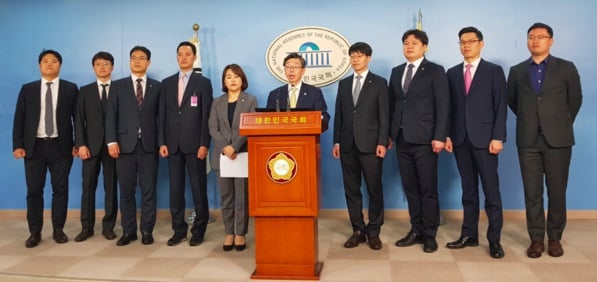 Representatives of the Korean Bar Association at the press conference on Thursday.
Crypto-Related Proposals
The Korean government is currently working on the legal framework for initial coin offerings (ICOs) which it banned in September last year “without disclosing legal grounds,” News1 wrote, elaborating:
The Korean Bar Association specifically proposed the direction of regulating cryptocurrency trading sites, ICOs, domestic and foreign cryptocurrency transactions, and cryptocurrency fund products.
The group urges the government to adopt clear legal legislation related to crypto exchanges to prevent activities such as wash trading, insider trading, and money laundering, Chosun explained.
 The association also presses for regulations in accordance with the Foreign Exchange Transactions Act for domestic and foreign crypto transactions.
Furthermore, instead of prohibiting investments in cryptocurrencies, the group proposes permitting certain types of organizations with expertise and qualifications to trade them.
The association asserted:
Even in the United States, where regulations on securities are strict, the law permits fund operations using cryptocurrencies as an underlying asset and futures trading.
Security ICOs
 For ICOs specifically, the association proposes applying the existing securities laws such as the Capital Markets Act or Financial Investment Business Act to security tokens, covering both domestic and foreign ICOs entering the Korean market, News1 detailed.
In addition, the group says the country’s Financial Services Commission (FSC) should “specify in advance the obligation to submit related documents such as a whitepaper” for ICOs of foreign companies entering the domestic market.
Meanwhile, FSC Vice Chairman Kim Yong-beom said on Wednesday that “The financial authorities will release the results of the actual initial coin offering situation this month.” The government is evaluating the outcome of its ICO survey conducted in September.
What do you think of the Korean Bar Association urging the government to pass these cryptocurrency-related laws? Let us know in the comments section below.
Images courtesy of Shutterstock, the Korean Bar Association, and Chosun.
Need to calculate your bitcoin holdings? Check our section.
The post appeared first on .

