January 26, 2026

Capitalizations Index – B ∞/21M

The Rise of Economic Development Zones:  A Way To Mitigate Crypto Taxation?

The rise of economic development zones:  a way to mitigate crypto taxation?

The Rise of Economic Development Zones:  A Way To Mitigate Crypto Taxation?

Taxation frustrates many in the cryptocurrency community. Investor capital gains along with Coinbase’s well-documented jockeying with the IRS, taxes continue to be an ongoing concern.

There is some good news however on the U.S. tax front with respect to these cryptocurrency valuations gains.


Embedded in the highly debated $1.5 trillion dollar tax cut signed by President Trump into the law in late 2017 is an esoteric section addressing the tax treatment of real estate and other tax assets. Known as the Investing in Opportunity Act and Opportunity Zone Investment program, it offers savvy investors the opportunity to defer and eliminate future capital gains through Qualified Opportunity Zones and Qualified Opportunity Funds.

So what are Opportunity Zones? In short, they are land parcels in low-income, geographic census tracts that have been designated for investment opportunities and favorable capital gains treatment.

The Qualified Opportunity Funds provide an investment vehicle for these zones. To obtain the maximum tax benefit, investors must hold monies in an Opportunity Zone Fund or property for 10 years

The Cryptotization of Opportunity Zones

Longtime bitcoin advocate Charlie Shrem recently opined on Twitter about the possibilities tied to bitcoin and Qualified Opportunity Zones.
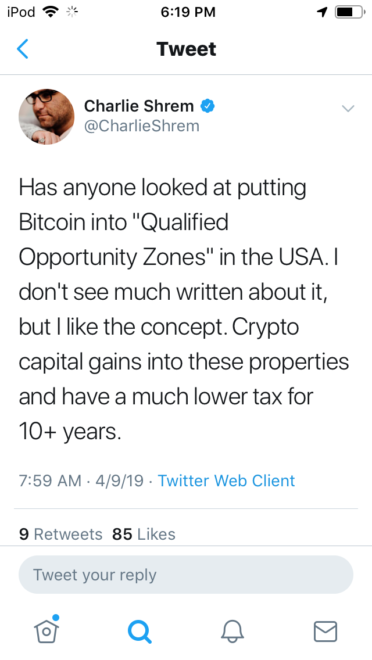
The rise of economic development zones:  a way to mitigate crypto taxation?

San Francisco blockchain innovator Jomari Peterson is a strong advocate of this notion. He, in fact, is birthing a new project known as Gama Ventures, a blockchain centric Qualified Opportunity Zone fund seeking to invest in the growth and development of distressed communities.

The goal?  To facilitate revenue sharing and micro-equity investments opportunities fueling commercial development, housing, health/wellness initiatives, and free localized WiFi for targeted, economically distressed areas. Asked about the potential benefits to investors, Peterson rattled them off in rapid-fire succession.

Defer capital gains

Reduce capital gains

Eliminate capital gains in future gains

Attracting Cryptocurrency Holders and Investors

He believes that these Opportunity Zone investment opportunities hold particular appeal for high net-worth crypto holders who remain under the edicts of U.S. tax law.

Says Peterson:

The repatriation of crypto funds from overseas offers a unique investment strategy for those looking to mitigate their tax liability while developing and maintain their long term wealth. They can make a meaningful impact by putting their money to work in a productive way in communities of need.

Through the use of blockchain, Gama Ventures is erecting an ecosystem of smart contracts and automated systems to foster transparency, access, and flexibility for its stakeholders. The goal, says Peterson,

is to coalesce a community of partners around an operational model that fosters multi-stakeholder participation in opportunity fund management.

The rise of economic development zones:  a way to mitigate crypto taxation?

Policymakers, too, are hopeful that these zones will create a much-needed flow of investment monies toward low-income communities throughout the nation, including in the unincorporated U.S. territory of Puerto Rico where large swaths of opportunity zones currently exist.

Peterson says that his extensive work in aligning economic development and cryptocurrency for the benefit of marginalized communities and populations gives him an uncommon lens for extolling the benefits of Qualified Opportunity Zones.

I am a huge advocate of operating within the regulatory framework, particularly when it involves not only tax advantages to crypto investors, but significant benefits to low-income communities here in the U.S. I see this as a unique win-win scenario.

The content published on Bitcoinist is intended for educational purposes only and should not be taken as investment advice. We strongly advise our readers to “do your own research” before investing in any type of program or project, particularly those that guarantee profits.


Images via Shutterstock, Pixabay

The Rundown

Published at Wed, 01 May 2019 13:00:02 +0000

Previous Article

Bitcoin Usage Spikes as BTC Price Surges 43% YTD; Bullish Indicator?

Next Article

Howard Marks On Market’s Record Highs, Potential Risks

You might be interested in …

Totle’s Price Savings – Totle –

Totle’s Price Savings – Totle – TotleBlockedUnblocktoken=”true” data-redirect=”https://medium.com/_/subscribe/user/4e44d8f68c31″ data-action-source=”post_header_lockup-4e44d8f68c31————————-follow_byline”>FollowFollowing Apr 30 Totle’s API is built around three core properties: Security, Accessibility, and Price. Traders and builders of decentralized finance apps are naturally drawn to the […]

Litecoin Price Tops $11 Amid SegWit Euphoria, Coinbase Support

With Litecoin’s price rallying and SegWit activation around the corner, bitcoin’s baby brother may soon be added to Coinbase.


Litecoin on Coinbase

Litecoin is the currently on the center stage of the blockchain sphere as the activation of SegWit becomes imminent and the price rallies to heights not seen since 2014. Now, it seems like Litecoin may become the second alternative cryptocurrency to be added to Coinbase, following Ethereum.

A recent Twitter conversation between Charlie Lee, founder of Litecoin and Brian Armstrong, co-founder and CEO of Coinbase, reveals that both want to see Litecoin added to Coinbase so that users can easily buy the altcoin with national currencies.

//platform.twitter.com/widgets.js

Although Litecoin trades on the GDAX exchange which belongs to Coinbase, adding it to the main Coinbase platform is a much more relevant step for LTC given that Coinbase is meant for the mainstream audience that is now entering the cryptocurrency scene, while GDAX is a platform for experienced traders. The addition of Litecoin to Coinbase will, as so, make it much easier for users to acquire it with fiat currencies.

Earlier this month, Coinbase received an approval by the Securities and Exchange Commission (SEC) to offer its customers the option of trading both Litecoin and Ether, making it the first NY-based exchange to offer both Litecoin and Ethereum markets.

SegWit may be coming for Litecoin

The argument used by Charlie Lee to get Litecoin into Coinbase is that Litecoin’s trading volume in GDAX was above $10M for the day, which was caused by the rally experienced yesterday in which Litecoin gained over 20% in value, going as high as $12.70.

CryptoCompare Index: Litecoin (LTC)

The reason for the surge in value is connected to the imminent activation of SegWit. Miner approval went as high as 65% yesterday (on the last 576 blocks at the time) and it’s currently sitting at 68%.

Once (if) the 75% mining approval threshold for SegWit activation is reached, miner approval will need to stay above this figure for two weeks (8064 blocks) in order to be activated. If SegWit is in fact activated in Litecoin, the following days/weeks could prove crucial for bitcoin’s future, as Litecoin leads the way as a scalability testbed for bitcoin. If the price increases tremendously, miners may be tempted to support SegWit with an increase in the mining revenue in mind.

SegWit support poll

Who is and Isn’t Signaling SegWit?

While some of the biggest Litecoin mining pools are signaling their support for SegWit, like F2Pool (34%), Batpool (11.6%), HappyChina (9.8%) and others, some refuse to change their position. Most notably, LTC1BTC which is the second biggest Litecoin mining pool in the market.

Litecoin mining pool market share

Jiang Zhuoer, founder of LTC1BTC said in an interview that LTC1BTC would not signal SegWit approval and he added that no other primary Litecoin pool would, which turned out to be incorrect.

Currently, only LTC1BTC (11.8%),BW (11%), Antpool (2.6%), LTC.top (2.4%) and Prohashing (1.4%) are not signaling for SegWit. It seems unlikely that Antpool and Prohashing will change to support SegWit, given their opposition to SegWit and support for bitcoin Unlimited.

Now, it all comes down to BW. Although it’s unclear what BW’s position on the matter is, we can expect an update to be released according to a recent tweet by the pool:

//platform.twitter.com/widgets.js

With BW’s 11% share of the Litecoin mining network, SegWit will most likely be activated. 

Will BW move to activate SegWit, allowing Litecoin to be the first SegWit-enabled cryptocurrency? Would this help bitcoin’s case for SegWit? Let us know what you think in the comment section.


Images courtesy of CryptoCompare, Segwit.co, Litecoinpool, Shutterstock

The post Litecoin Price Tops $11 Amid SegWit Euphoria, Coinbase Support appeared first on Bitcoinist.com.