By Paul Worrall, Co-Founder of Zonafide
In recent years, one of the growing threats to society has been cybercrime.
In 2015-16, the ONS recorded six million cases of fraud and cybercrime in England and Wales – which cost the UK £11 billion.
In addition, high profile cases such as the Equifax data breach, which saw the personal information of 143 million Americans and 400,000 Britons stolen in the summer of 2017, have emphasized the scale of the problem.
While blockchain is well-known as the network that powers crypto assets such as bitcoin, few realize that it’s the perfect solution to the growing threat of cybercrime.
Traditionally, organisations store data and information on centralized systems and pass it between each other in their processes. These computers can be hacked individually using automated processes over an extended period of time. The hackers will attack every surface, identifying and eventually exploiting weakness in the software and its configuration to steal data or compromise processes.
However, blockchain technology can make it much harder for hackers because it can remove the information they seek and attempting to compromise it is too expensive in terms of both time and money.
Established mathematical techniques, such as Public Key Cryptography and Zero Knowledge Proofs, on which blockchain technology is based, make it impossible to change data and enable it to be represented without being present. So hackers can’t subvert a process or find information to sell or exploit.
Blockchain networks also remove the dependencies on centralized systems that have become honeypots for hackers. The protocols on the network are based make them universally accessible. Whether it is a public blockchain, like bitcoin and Ethereum, or one where access is controlled, they provide a single coherent way of securing collaboration between all participants.
Public blockchain networks, in particular, make it very costly to hack. Every request to change data requires a fee. Exemplified by bitcoin and Ethereum, a crypto currency is required to pay the network for applying and securing any data changes. This has been so effective a whole new financial asset class has been created.
Counter intuitively, all the data on these blockchains is made public to make it safe. To ensure this is the case, a relatively new field of computer science, known as consensus algorithms or protocols, incentivizes the computers in the network to protect the integrity of the data. Now a hacker is not just attacking a passive centralized computer, but a whole network intent on thwarting their attempts.
Hackers have traditionally been incentivized by the potential to gain unique data or information which they could later sell on places like the dark web. However, the combination of the lack of data available, the difficulty, the cost and the incentives to behave in a more positive way for the blockchain means that cybercrime simply won’t pay.
At Zonafide, we used these tenets of the blockchain network to develop a Digital Wallet that helps users secure Activities and prevent the theft of their personal information. An Activity is something important you’re doing, such as changing credit limits with your bank, and takes the form of an Ethereum-based smart contract. The benefit of using an Ethereum-based smart contact is that it does not need to store information, but can still attest to its existence.
By using the blockchain, we change the relationship of trust. It allows people to control the means to identify themselves to organizations – it’s called being self-sovereign.
It removes the need for organisations to store personal information and challenge people to prove they know the information stored, before acting on their instructions. In tandem, it also completely removes the threat of individuals becoming victims of a large scale hack.
To most people, the idea of moving to a simple system that everyone can access and use to protect your personal information is terrifying.
But the blockchain network has properties that can completely eradicate cybercrime, if it’s adopted on a large scale.
Embattled Chinese smartphone maker, Huawei, is rumored to be in serious talks with Sirin Labs to bring its handset into the cryptoverse, possibly incorporating the Swiss company’s cold storage wallet along with its system to instantly convert fiat to crypto. This comes at a time when, in the US, at least one regulator is insisting carriers drop Huawei out of security concerns.
Also read:
Huawei Said to be in Talks with Sirin Labs, Maker of The Finney
What if the world’s third largest smartphone company distinguished its product by teaming with a crypto-savvy phone operating system, allowing it to provide cold storage and a way to instantly convert fiat to crypto? That’s the tantalizing rumor out of Bloomberg this week.
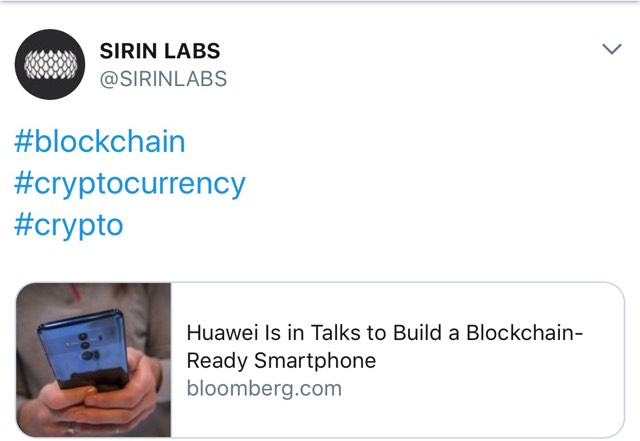
China’s “is considering developing a mobile phone that will be able to run blockchain-based applications, according to two people familiar with the plans,” the story ran. Applications by way of Sirin Labs’ SIRIN OS would parallel the set’s existing Android software. And though neither company has confirmed negotiations proper, Sirin took to and forwarded Bloomberg’s story.
is most famous for 2016’s Solarin smartphone, retailing for $16,000, and, more recently, its (ICO) last year in preparation to launch The Finney (named after Hal Finney), a smartphone claimed to include an embedded cold storage function and a way to automatically convert fiat to crypto. According to Sirin, preorders for the phone are already more than 25,000.
US Carriers Urged to Dump Huawei
“The plans would mark the first foray of a major smartphone maker into blockchain, the decentralized ledger used to record cryptocurrency transactions, potentially bringing the technology closer to the mass market,” the stated. Sirin Labs’ Telegram revealed back in February, “Amazing meeting just concluded between Sirin Labs and Huawei. Among other things discussed was the possibility of cooperating together to bring blockchain technology to the masses in a secure way.”
 Meanwhile, Huawei is coming under attack from US regulators such as the Federal Communication Commission (FCC) who believe the company to be a security, espionage threat. In fact, FCC chairman Ajit Pai released a proposing a freeze on funds to providers who use Chinese companies like Huawei.
Mr. Pai urges barring “the use of money from the FCC’s Universal Service Fund to purchase equipment or services from companies that pose a national security threat to United States communications networks or the communications supply chain.” This follows his earlier statement to congress where he insisted lawmakers consider the “security threat that Huawei and other Chinese technology companies pose to our communications networks.”
Assuming the smartphone, cold storage wallet collaboration goes forward, chances are it will never see the US market as a result.
Do you think such a phone will materialize, or is it just hype? Let us know in the comments!
Images via Pixabay, Huawei, Twitter.
At we do not censor any comment content based on politics or personal opinions. So, please be patient. Your comment will be published.
The post appeared first on .