
Being one of the highest-volume altcoins in the cryptocurrency market, you’ve probably heard of TRON, or its symbol, TRX. In this article we’re going to discuss what the market maker is, and how it might be suppressing the price of TRON.
Before we get started, what is TRON?
A brief summary can be found on their :
“TRON is an ambitious project dedicated to building the infrastructure for a truly decentralized Internet. The Tron Protocol, one of the largest blockchain based operating systems in the world, offers scalable, high-availability and high-throughput support that underlies all the decentralized applications in the TRON ecosystem.”
What does this mean?
TRON is building a platform for DApps, or decentralized applications. Think of it like an app store for apps being built on the blockchain. This makes TRON one of Ethereum’s biggest competitors. Some of TRON’s partners will be the first apps on their platform when their “main net” launches May 31st, .
After launching the official “test net” in their yesterday, they revealed their road map for 2018:
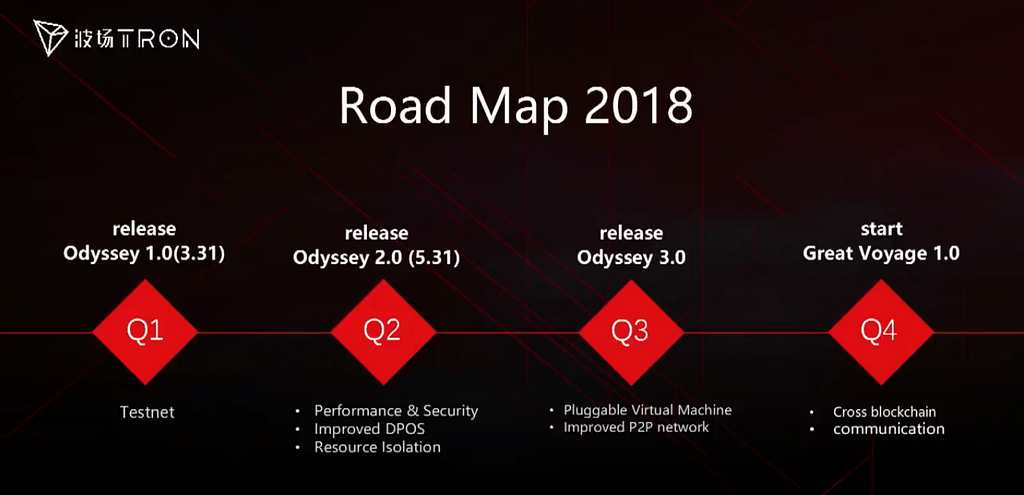 via Periscope
TRON’s coin burn was also mentioned, explaining that for every token created on the TRON Protocol (similar to a token created on the Ethereum Network) a fee of 1024 TRX will be paid, and burned permanently.
Following the livestream, TRON saw a in the past 24 hours. So with all this good news, why is TRON’s price not rising?
 via CoinMarketCap
Aside from the FUD and obvious conditions of the current market, there may be another player responsible for keeping a price rise at bay.
The Market Maker
Dun dun dun…
No, not really. A market maker is not a bad guy or a whale attempting to drop the price to accumulate more coins. In fact, market makers can be a necessity in such a volatile market.
To learn about what a market maker does, read this passage from Investopedia:
For example, let’s say that a market maker has entered a sell order for Microsoft (MSFT) and the is $65.25/$65.30. The market maker can try to sell shares of MSFT at $65.30. If this is what the market maker chooses to do, he or she can then turn around and enter a bid order to buy shares in MSFT. The market maker can bid higher or lower than the current bid of $65.25. If he or she enters a bid at $65.26 then a new market is created (referred to as ) because that bid price is now the best bid. If the market maker attracts a seller at the new bid price of $65.26 then he or she has successfully “made the spread.” The market maker sold 1,000 shares at $65.30 and bought these shares back at $65.26. As a result, the market maker made $40 (1,000 shares x $0.04) on the difference between the two transactions. This might not seem like much, but doing this repeatedly with larger order sizes can provide lucrative profits. All day long market makers do this, providing liquidity to individual and institutional investors. The major risk for the market maker is the time lapse between the two transactions; the faster he or she can make the spread the more money the market maker has the potential to make.
So why, and how, is this happening to TRON?
As for why, there’s no clear answer right now. We could come up with a million different theories. The important thing to look at is how it’s happening, and when it’s going to stop. To do this, we can simply look at the market maker’s address on Etherscan:
To sum it up, they’re selling. A lot. In March alone, .
The bright side? They’re almost out of tokens to sell. Starting as one of the largest TRON holders, they now only hold of the total supply. Their selling power will decrease, and at this rate, their supply will be depleted early April.
The following pie charts show the total supply breakdown of TRON from about two months ago, and today. You can find the market maker’s account outlined in red.
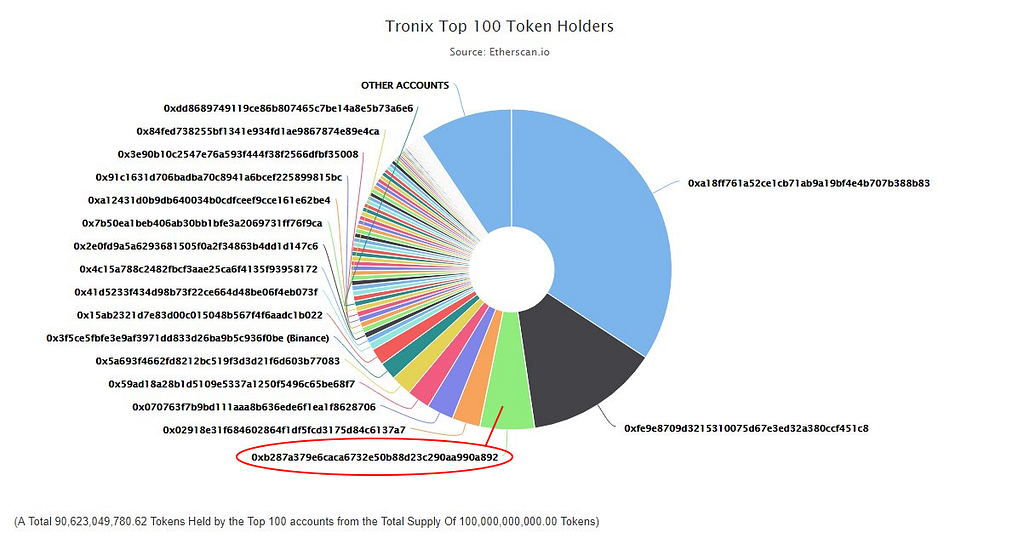
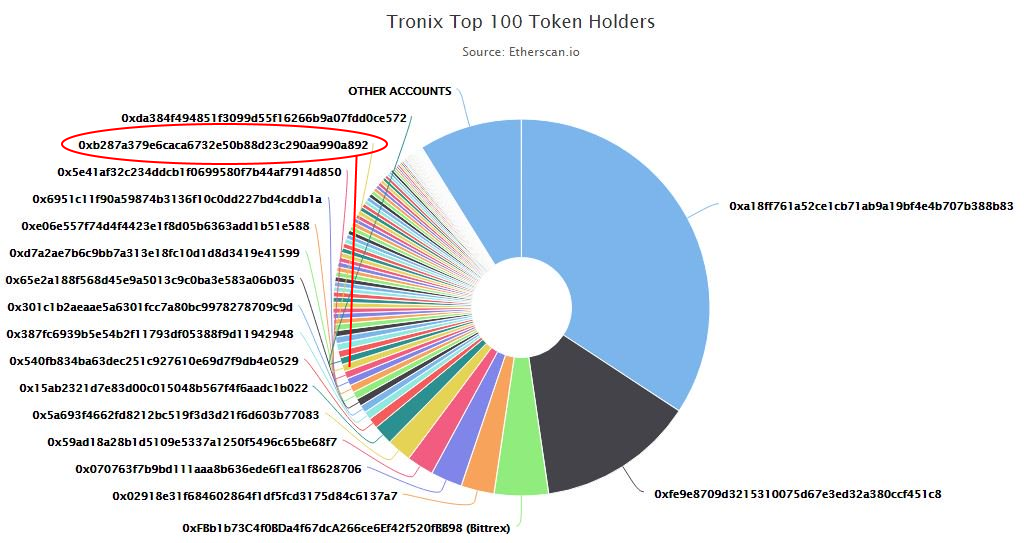
As you can see, the market maker’s holdings have diminished greatly, with less than 600 million TRON left.
The Moral of the Story
I encourage you to do your own research on this matter. TRON may be a great hold leading into the launch of the main net, and once the market maker can’t sell anymore, we may find that this token is severely undervalued.
Did this article help you out? Tip me a few TRON:
0x147b2918c66ddac9bacd0ada4723257518d32eb7


