August 10, 2026

Capitalizations Index – B ∞/21M

The Lightning Pump, Bitcoin Adoption Inevitable as BTC Prices Inch Higher

The lightning pump, bitcoin adoption inevitable as btc prices inch higher

The Lightning Pump, Bitcoin Adoption Inevitable as BTC Prices Inch Higher

  • bitcoin prices are technically bullish, must close above $3,800
  • Lightning Network picking up, Domino’s Pizza now accepts bitcoin via LN
  • Participation levels have been shrinking, volumes behind a bull confirming bar must exceed 35k

From the look of things, bitcoin adoption will be fast-tracked by the Lightning Network. Elizabeth Stark’s project recently got a boost. At this rate, it appears as if it’s a matter of when before BTC prices rally to $6,000.

bitcoin Price Analysis

Fundamentals

It’s the month of love, and it seems like merchants are in love with the Lightning Network. Many don’t agree with their off-chain option. Nonetheless, that is the modus operandi of Elizabeth Stark’s LN. Because of this implementation, the bitcoin legacy network is scalable. Besides, it allows instant transactions without confirmation time worries.

These properties are perhaps the reason why the number of supporting nodes and channels are increasing. As nodes pick up, the total network capacity is also expanding and at the time of press, statistics indicate that the LN capacity is at $2.4 million—or around $645 BTC.

Remember, LN is still in beta. Now, new businesses are interested in allowing their clients to pay for merchandise or services using their Bitcoins via the LN. The latest addition is Domino’s Pizza, a multi-billion-dollar business with more than 15,000 branches all almost all continents of the world including China.

Candlestick Arrangements
Bitcoin

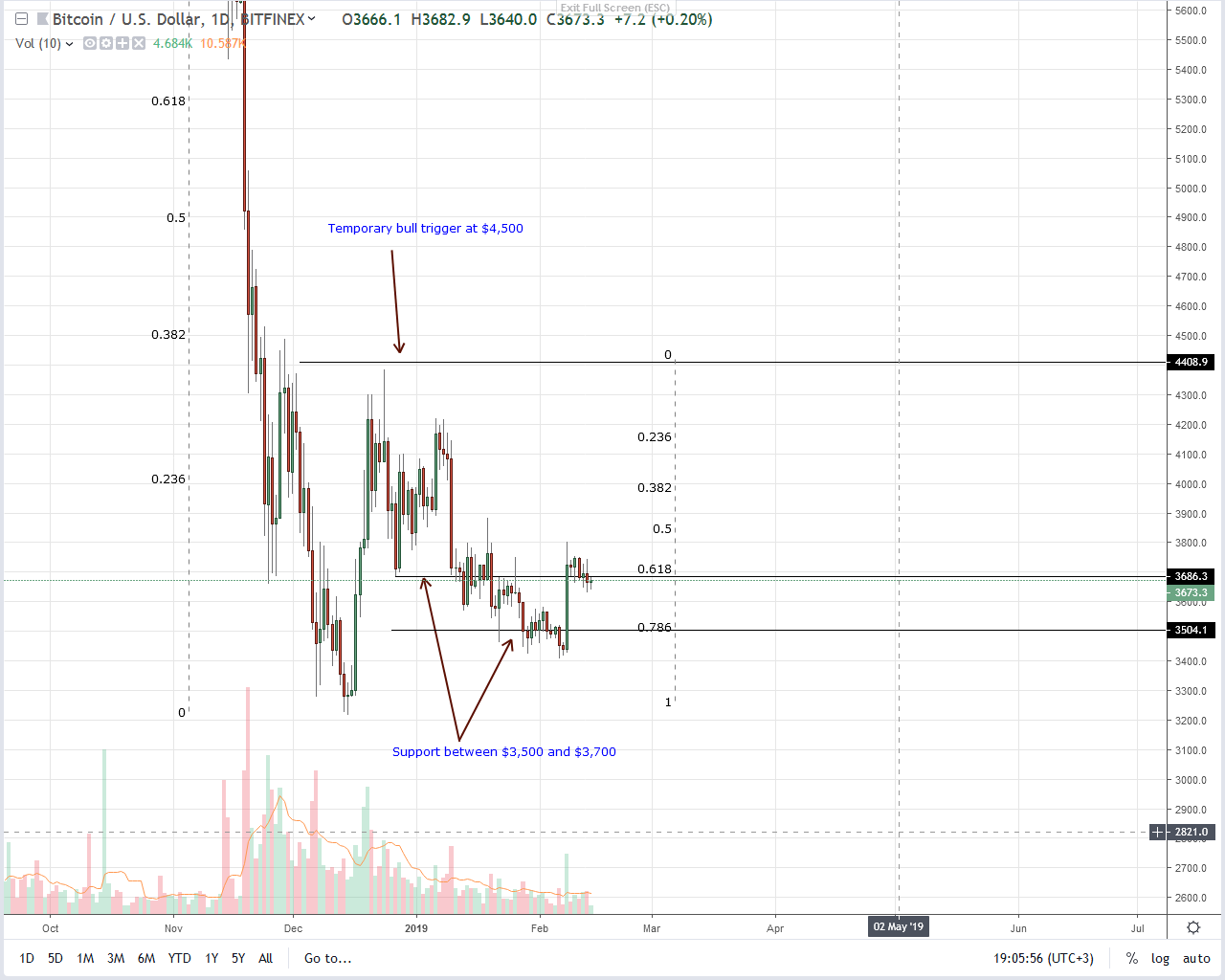
Market participants are expectant, and after 13 months of damaging lows, BTC buyers are trying to wrestle control from bears. Prices are stable but encouragingly up 5.7 percent from last week’s close. All the same, BTC is under immense sell pressure despite gains of Feb 8 when at one point, the coin registered double-digit gains.

The good thing, despite possible downturns, is sellers are yet to reverse losses and trending inside Feb 8, high-volume, wide-ranging bar meaning buyers are technically in charge. However, there must be evidence from candlesticks. Therefore, it is only after prices race above at $3,800—according to data from BitFinex, that aggressive traders can comfortably load up on dips. Our immediate buy targets will remain unchanged at $4,500 with the pace of this target being hit depending on market participation levels.

Technical Indicators

In a defined trend, buyers—as we have mentioned, have to prove their mantle. Market participation levels have been low, shrinking in the last two months from around 33k in mid-Dec to about 10k as registered yesterday.

For buyers to be in control, a bar that prints above $3,800 triggering short-term bulls should have high volumes—exceeding 10k (recent averages) and 32k of Feb 8.

Published at Thu, 14 Feb 2019 19:00:34 +0000

Previous Article

Bitcoin [BTC]: Craig Wright aka Faketoshi accused of lying

Next Article

Proof of Concept of Autonomous Self-Balancing Power Grid using IOTA

You might be interested in …

Who Created Ethereum?

Who Created Ethereum?

While working on a number of bitcoin projects, a 19-year-old programmer from Toronto, Vitalik Buterin, conceived the idea for Ethereum. Ethereum was intended to be a robust platform that allows developers to build blockchain applications. Buterin was inspired by some of the shortcomings he faced when trying to build applications on the bitcoin blockchain. He believed that the potential of blockchain technology was not limited to financial applications and quickly set out to create a blockchain that could support more common computations.

Vitalik Buterin was first introduced to bitcoin and cryptocurrencies in 2011. That same year he co-founded Bitcoin Magazine and wrote many articles explaining his views on the digital currency’s future. He later worked on Mastercoin and some alternate coins based on the bitcoin codebase. This work led him to believe the bitcoin blockchain was limited in scope.

The Ethereum white paper was released in 2013, and it documented a new open-source protocol for creating decentralized applications.   

Ethereum was officially announced on the Bitcointalk forum in 2014. In addition to Buterin, Ethereum was co-founded by Mihai Alisie, Anthony Di Iorio and Charles Hoskinson. Buterin also announced that he was working with developer Dr. Gavin Wood and Joseph Lubin. Wood soon released the Ethereum yellow paper, which covered the Ethereum Virtual Machine (EVM), the runtime environment that executes all of the smart contracts on the network. Lubin would go on to found ConsenSys, a venture studio focusing on decentralized applications.

The Ethereum Foundation held an ether crowdsale in July 2014 during which they sold 60 million tokens. 12 million ether (ETH) tokens were created so the Ethereum Foundation could expand its development and marketing efforts. The Frontier was the first release of the Ethereum network. It was released a year after the crowdsale and provided a bare-bones mechanism for developers to interact with and build apps on the network.  

Both the Ethereum network and community have grown substantially over the last year. The Ethereum Enterprise Alliance, an initiative working to connect the world’s largest companies to the Ethereum network, recently announced 86 new partners including Microsoft, Intel and BP. Similarly, a multitude of new blockchain projects leveraging the Ethereum blockchain have gained attention and capital.

Ethereum broke into the mainstream in early 2017 when the price of ETH increased by 1000 percent over the course of a couple months. This led to a similar rise in the price of alternative blockchain tokens, dubbed “altcoins.” A slew of new investors quickly entered the space as Ethereum was covered by large media outlets including CNBC, Reuters and Quartz. Investors and developers are awaiting the release of Metropolis, the next update to the Ethereum network promising to abstract a lot of functions and pave the way for user-friendly application designs.

The post Who Created Ethereum? appeared first on Bitcoin Magazine.